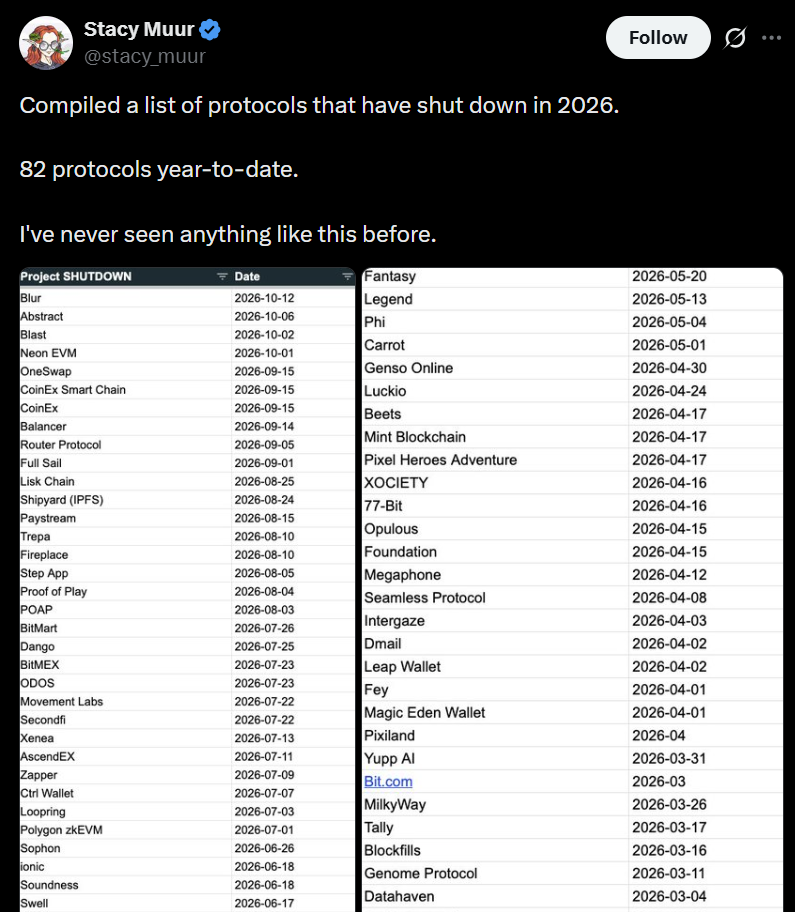
The decentralized finance, blockchain infrastructure, and Web3 gaming sectors are facing an unprecedented wave of shutdowns, casting a harsh light on the long-term financial sustainability of early-stage digital asset businesses. According to a comprehensive tracking list published on X by prominent crypto researcher Stacy Muur, at least 82 digital asset projects and protocols have officially closed their doors or announced their wind-down processes this year.
Muur’s findings, which she shared with her followers on Tuesday, highlight a landscape unlike anything she has witnessed throughout her career in the space. The roster of casualties features well-known industry names, including Balancer, Radiant Capital, Neon EVM, and Step Finance, alongside dozens of other lesser-known protocols and infrastructure plays. The sheer volume of closures underscores a systemic shift in the digital asset economy, where once-promising platforms are buckling under the weight of unrelenting economic pressures.
These closures do not exist in a vacuum. They follow a prolonged and punishing bear market that has severely tested the resolve of founders, investors, and community members alike. The broader macroeconomic and crypto-specific downturn has been particularly unforgiving following Bitcoin’s dramatic retreat from its all-time high above $126,000, recorded in October 2025. With the leading cryptocurrency tumbling below the $60,000 threshold earlier this year, the resulting market contraction has squeezed liquidity, depressed trading volumes, and starved Web3 companies of the capital they desperately need to survive. Projects that were already fighting an uphill battle to attract active users and generate sustainable protocol revenue suddenly found themselves entirely cut off from lifelines.
Among the most prominent casualties of this climate is the Ethereum Layer-2 network Blast. Earlier this month, the project announced that it would be winding down its operations after leadership concluded there was no credible path to economic viability. The decision sent shockwaves through the Ethereum ecosystem, marking a staggering reversal of fortune for a scaling network that had previously attracted more than $2 billion in total value locked (TVL) at its peak. Despite commanding massive user deposits during its initial hype cycle, Blast ultimately succumbed to a reality where operational costs vastly outpaced incoming revenue.
Other protocols on Muur’s list fell victim to catastrophic security events and operational mishaps that compounded the difficulties of a harsh market cycle. In February, Step Finance was forced to wind down its operations following a major treasury breach that crippled its financial reserves. Meanwhile, DeFi lending protocol Radiant Capital announced in June that it would officially close up shop after failing to recover from the lingering fallout of a severe 2024 exploit that eroded user trust and drained critical liquidity. In the infrastructure and venture-backed segment, Satori Finance, a derivatives protocol backed by prominent crypto exchange Coinbase, ceased operations after its leadership team concluded that incoming revenue could no longer support the ongoing costs of running the business.
Why Are So Many Crypto Projects Shutting Down?
The growing wave of liquidations and voluntary wind-downs is supported by wider industry research. Data published by DeFiLlama in August revealed that an alarming 100 crypto projects had announced total shutdowns over the course of the year, with a striking 40 of those closures occurring within a compressed 90-day window. These findings indicate that the difficulties facing the sector are not isolated incidents affecting a few poorly managed teams, but rather a widespread structural correction.
According to the DeFiLlama analysis, the most commonly cited reason for these failures is a fundamental lack of product-market fit. Many protocols launched during previous bull markets with innovative tokenomics and speculative incentives, but they ultimately failed to retain active users once the speculative frenzy subsided. Following a lack of product-market fit, teams frequently pointed to depleted treasury funding, insufficient organic revenue generation, and strategic decisions to pivot away from crypto entirely as primary drivers behind their closures.
Perhaps most revealing is the financial profile of the projects that have gone under. Collectively, the 100 projects tracked by DeFiLlama had raised approximately $1 billion in external capital and generated roughly $250 million in cumulative protocol fees throughout their lifespans. Notably, nine of these shuttered projects had each secured more than $50 million in venture backing. This data demonstrates that substantial financial backing, institutional endorsements, and multi-million-dollar war chests offered little to no assurance of long-term survival in an industry increasingly demanding tangible utility and self-sustaining business models.
The current wave of closures coincides with a dramatic consolidation of capital within the remaining pockets of the crypto economy. Venture capital deployment has shifted markedly in terms of accessibility. DeFiLlama data indicates that while aggregate venture funding increased during the first half of the year compared to the same period previously, the total number of individual funding deals plummeted by 80 percent. This indicates that investors are writing larger checks, but they are funneling that capital into a much smaller, highly vetted pool of mature projects rather than spreading risk across early-stage experiments.
At the same time, traditional corporate consolidation is accelerating. Mergers and acquisitions across the digital asset sector reached 87 reported transactions by the time of the report, representing a 65 percent increase over the previous year’s pace. As smaller, independent protocols struggle to maintain independent operations, larger enterprises and well-capitalized institutions are increasingly absorbing distressed assets, talent, and technology, reshaping the competitive landscape for the remainder of the decade.