
Cryptocurrencies could deliver a significantly better payoff from the ongoing artificial intelligence boom than traditional AI-focused equities themselves, according to Jordi Visser, founder of Visser Labs and a veteran of Wall Street.
Speaking on Cointelegraph’s Trade Secrets podcast, Visser pointed out that the explosive, straightforward gains seen in popular AI stocks are becoming increasingly difficult to repeat as valuations climb and markets mature. At the same time, the rapid proliferation of autonomous AI agents is creating an unprecedented, organic demand for decentralized crypto payments and tokenized assets, bridging the gap between two of the most dynamic sectors in modern finance.
"Without AI, I don’t think crypto would be going through this bull market," Visser noted, highlighting the fundamental shift in how macroeconomic liquidity and technological innovation are intersecting.
As a direct result of this thesis, Visser has expanded his personal investment holdings well beyond traditional large-cap digital assets like Bitcoin, Ether, and Solana, moving into a meticulously curated, broader basket of alternative tokens designed to capture the structural tailwinds of the AI revolution.
Visser brings three decades of elite financial experience to his current macro perspective. His extensive career includes serving as a managing director at Morgan Stanley and chief investment officer at Weiss Multi-Strategy Advisers. Today, he channels that decades-long expertise into heading 22V’s AI Macro Nexus Research, examining the deep structural links between global liquidity, equities, and digital assets.
AI is Crypto’s Smartphone Moment
The core of the Wall Street veteran’s macro investment thesis rests on the assumption that AI agents will fundamentally change how everyday people interact with financial markets. Rather than humans manually executing every trade, checking prices, or managing portfolios, individuals will increasingly instruct autonomous software agents to execute transactions, rebalance wealth, and manage financial contracts on their behalf.
"AI agents are effectively the same as the App Store or the smartphone for crypto," Visser explained during the interview.
In this transformative scenario, users will direct their AI agents while the software handles the complex background execution across decentralized networks. The exponential increase in the utilization of these autonomous agents will inevitably drive a massive surge in daily activity across tokenized assets and blockchain-based payments. This dynamic extends the investment opportunity far beyond the narrow group of hardware and semiconductor companies currently supplying the heavy computing power required to train large language models.

While major institutional players are beginning to take notice, the broader financial world is still waking up to the reality. BlackRock, the world’s largest asset manager, has similarly pointed out that the potential for artificial intelligence to drive structural crypto demand remains largely "underappreciated" by traditional equity markets.
However, Visser’s overarching crypto outlook is not completely divorced from traditional equity markets and still carries direct exposure to the very AI trade he has grown increasingly cautious about. He identifies a severe AI sector downturn that drags down broader equity indexes as a primary threat to his bullish digital asset thesis. While he believes a correction would not signal the death of the broader crypto bull market, he warns that it would likely result in a sharp retest of recent cyclical lows.
The AI “Fireworks Show” Is Over
Visser’s cautious stance on traditional technology stocks stems from a deliberate reassessment of market dynamics that began earlier in the year. He revealed that he started actively reducing his investment exposure to memory chipmaker Micron in mid-May, after concluding that hedge funds and everyday retail investors had become dangerously crowded into the AI trade.
"One of the reasons that Bitcoin and Ethereum were having such a hard time is because the focus was completely on AI," Visser observed, explaining how capital was aggressively sucked out of digital asset markets to chase soaring technology equities.
During this period, artificial intelligence offered investors seemingly greener pastures backed by rapidly rising enterprise revenues. Technology giants reported staggering growth figures to justify their massive capital expenditures. Microsoft announced in its quarterly report on April 29 that its specialized AI business was generating revenue at an annualized rate of $37 billion, more than doubling its figures from the previous year. Meanwhile, memory giant Micron reported in March that its fiscal second-quarter revenue had nearly tripled to reach $23.86 billion, fueling intense speculative buying across the entire supply chain.
Despite these impressive top-line figures, equity investors now find themselves navigating a much less forgiving market environment. Visser tracks a dedicated 100-stock AI portfolio that, while up approximately 40% for the year, has transformed into an asset class significantly more volatile than Bitcoin on a rolling 126-day measurement basis.
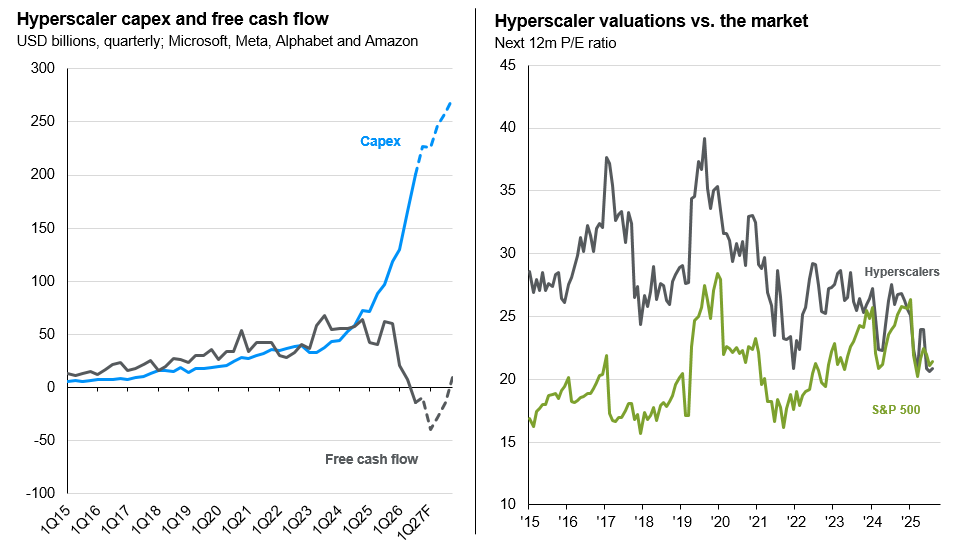
Compounding these volatility concerns, mounting financing pressures have begun to weigh heavily on the companies building the physical infrastructure for the AI boom. Constructing hyper-scale data centers and securing advanced chips currently costs technology corporations significantly more money than they are generating from their existing operational businesses.
As a stark example of this capital-intensive reality, Oracle disclosed that it spent a staggering $55.7 billion on capital expenditures during fiscal 2026, while generating only $32 billion in operating cash flow—forcing the tech titan to raise an additional $43 billion in debt financing to bridge the massive gap.
"I didn’t say AI was over. AI fireworks show is over," Visser clarified, emphasizing that while he still foresees several years of steady, secular growth ahead in computing demand driven by AI agents, investors must drastically temper their expectations for outsized stock market returns.
Visser Widens His Crypto Bets
Until recently, Visser’s digital asset strategy was conservative, consisting exclusively of foundational blue-chip assets like Bitcoin, Ether, and Solana. Although Bitcoin continues to command the largest allocation in his portfolio, he has shifted his strategy to gradually acquire a much broader range of tokens to capture the emerging utility narrative.
Among market indicators, Visser watches speculative assets like Dogecoin as a clear psychological signal for returning retail investor enthusiasm, which he views as an essential ingredient for sustaining a broad-based, healthy market rally.
"They’re the energy of the space and they’re the ones that are going to fuel this as other people get involved," he remarked.
To closely monitor the health of the wider digital asset economy, Visser maintains a custom, equally weighted index comprising 42 distinct tokens alongside four publicly traded stocks. According to his tracking data, this diversified basket has successfully outperformed Bitcoin since June, and he intends to hold all of its constituent assets as the market cycle progresses.
Privacy and data protection represent another major thematic pillar that has already attracted his capital allocation.
"I’m not betting on one company, but I believe in privacy," Visser stated.
As artificial intelligence systems become more deeply integrated into daily commercial and financial workflows, Visser argues that privacy and identity protection will take on critical importance to combat rising automated fraud, deepfakes, and other forms of digital abuse. Decentralized privacy-focused projects such as Zcash and Monero fit directly into this long-term investment thesis.