As the broader cryptocurrency market shifts from a prolonged period of red to green charts, the crypto lending sector is experiencing a significant resurgence of interest and capital inflows following a notoriously difficult second quarter.
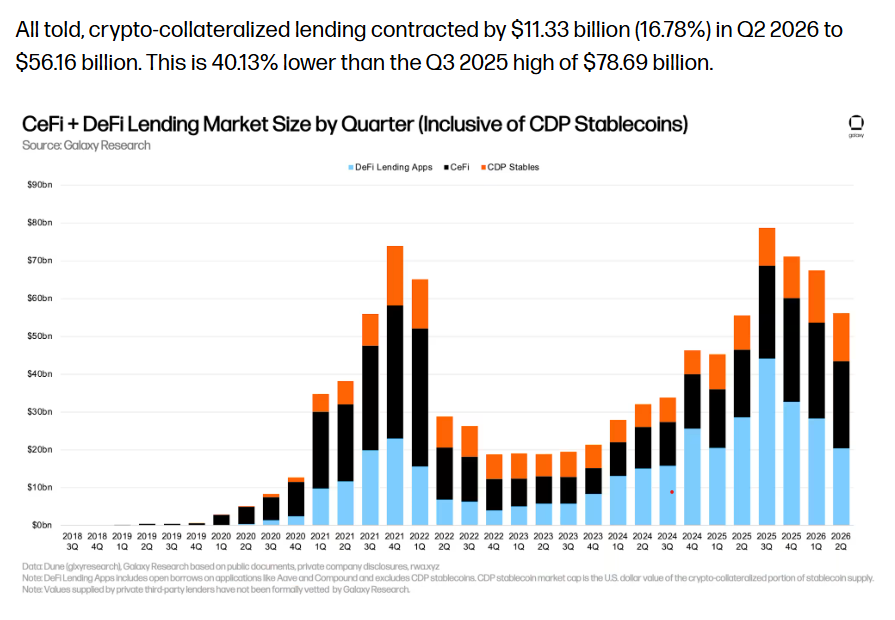
Market figures published by Galaxy reveal that an estimated $11.33 billion exited the decentralized finance (DeFi) lending sector over the course of Q2. This massive capital flight was driven in large part by a sharp crisis of confidence among users, which was catalyzed by the infamous Kelp DAO hack in April. That security breach left users of Aave—widely regarded as one of the most trusted protocols in the ecosystem—temporarily unable to access their Ethereum (ETH).
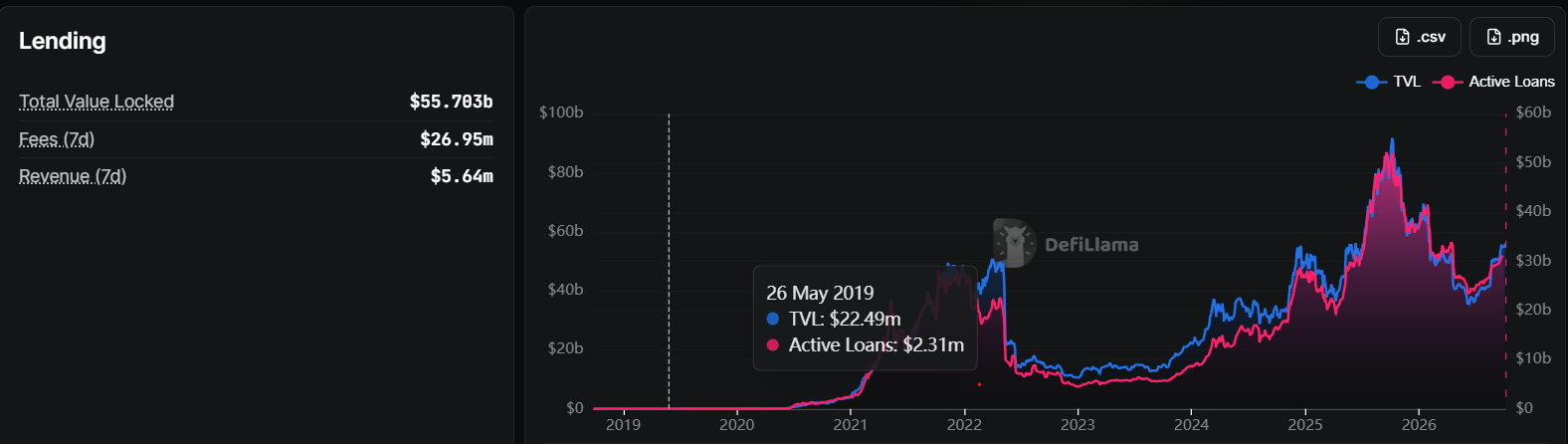
However, market dynamics have shifted drastically since the beginning of July. Total value locked (TVL) across decentralized lending protocols has surged by more than 55%, climbing back to sit at approximately $56 billion today, according to data from DeFiLlama.
While this dramatic recovery signals a renewed appetite for yield and credit markets, it also means that the collective honeypot has grown substantially larger. This raises a critical question for the industry: Can users genuinely trust interlinked DeFi lending protocols in an era defined by AI-assisted hacks, where a single exploit in one isolated protocol can trigger a cascading series of devastating effects across the entire interconnected web of applications?
Stani Kulechov, the founder and chief executive of Aave Labs, acknowledges that systemic risk management has quickly become a top-of-mind priority for developers and institutional participants alike. "When a protocol accepts a token as collateral, it is also accepting that token’s bridge, its verifier configuration, its oracle and its issuer’s operational security," Kulechov notes.
That precise systemic reality is what ultimately dragged Aave into the crossfire earlier this year.
An Expanding Attack Surface
The structural vulnerabilities of an interconnected financial ecosystem became painfully clear when hackers successfully exploited a Kelp DAO cross-chain routing mechanism in April. The malicious actors managed to mint 116,500 unbacked rsETH tokens—valued at roughly $290 million at the time of the exploit. A significant portion of these compromised tokens was subsequently deposited as collateral into various Aave markets to borrow other high-value digital assets.

Even though Aave’s core smart contract architecture was never directly breached, the protocol suffered immediate collateral damage. Deposits plummeted by roughly $15 billion in the days immediately following the exploit, forcing the platform to rapidly freeze its rsETH and wrsETH lending and borrowing markets to contain the contagion.
Reflecting on the incident, Kulechov explains that Aave has been forced to adopt a much more holistic approach to security than ever before. "We rebuilt our approach around that wider view," he says, emphasizing that modern protocol security simply cannot stop at the smart contract level. Traditional code audits and security reviews, he points out, consistently missed the hidden risks lurking within bridges, external verifier networks, and the myriad other foundational infrastructure components that a modern wrapped asset relies upon.
For everyday users and institutional participants navigating the lending landscape, judging the true risk profile of a protocol has become an increasingly complex endeavor. Evaluating a platform now requires looking past the user interface and examining the deep dependencies beneath the surface.
"Every wrapper, bridge and oracle between the lender and the underlying asset is another place a loan can go wrong," observes Thomas Wu, chief financial officer of Bitcoin-backed lending firm Ledn.
Similarly, Sid Powell, co-founder and chief executive of crypto credit platform Maple, stresses that serious lenders must operate under the assumption that a borrower can fail at any given moment, working backward from that worst-case scenario. For Powell, risk management boils down to fundamental asset visibility and liquidity: knowing precisely what assets are held, where they are physically located, whether they can be monitored in real time, and how rapidly management can seize or secure them if operational systems break down.
When Security Fails, Containment Matters
As developers look for ways to fortify their platforms against systemic shocks, industry leaders emphasize that proactive defense must be paired with robust containment strategies. Sam MacPherson, chief executive of rival DeFi lender Spark, explains that his team evaluates far more than just basic smart contract integrity. Their risk assessment framework includes rigorous reviews of governance design, operational security protocols, underlying collateral quality, liquidity management practices, and macro-level dependencies spanning the broader blockchain ecosystem.
In fact, Spark’s proactive risk assessment led the protocol to begin phasing out rsETH on SparkLend as early as January—months before the April Kelp exploit materialized. The decision was made after leadership determined that the token’s relatively low usage and minor revenue contribution did not justify the mounting structural risks associated with supporting it.
Aave has implemented comparable governance mechanisms, instituting a policy where every listed asset undergoes a comprehensive re-review on a quarterly basis, as well as immediate re-evaluations following any material market change. Kulechov notes that Aave has already initiated an orderly wind-down process across six distinct networks that failed to meet the platform’s stringent chain-level security standards.
"No protocol can control the entire ecosystem, but it can control how much of that risk it takes on and how quickly it responds," Kulechov asserts.
While preventing failures remains the ultimate objective, MacPherson stresses that protocols must also clearly demonstrate how potential losses would be successfully isolated and contained if disaster does strike. Preventing outright losses, he argues, is only a fraction of the overarching challenge.
The Margin for Human Error
Despite the heavy focus on code vulnerabilities and protocol mechanics, Shawn Owen, founder and chief executive of SALT Lending, warns that human error remains one of the single greatest vulnerabilities in the entire financial ecosystem—and paradoxically, the one most frequently overlooked by market participants.
"A lot of the biggest losses have come down to key management, access controls or someone getting socially engineered, and a smart contract audit won’t catch any of that," Owen cautions.
Additional layers of severe risk routinely materialize when deposited customer assets are redeployed across external platforms in search of higher yields. Crypto lenders learned this harsh reality during the brutal market unwind of 2022, when centralized platforms such as Celsius, Voyager, and BlockFi spectacularly imploded after taking on aggressive risks that their customer bases either did not understand or never agreed to take.
To minimize its overall attack surface and eliminate counterparty exposure, Ledn deliberately avoids lending out customer funds to generate speculative yields, choosing instead to store client Bitcoin directly with qualified institutional custodians.
Wu points out that every single transactional movement represents an additional point of potential failure, meaning that fewer movements inherently translate to a lower risk profile. The only foolproof way to take those specific risks entirely off the table, according to Wu, is to keep client assets in strictly segregated custody with tight operational controls.
Powell offers a similar warning regarding market dynamics, noting that when fresh deposits flow in faster than portfolio managers can identify high-quality lending opportunities, the intense commercial pressure to maintain competitive yields can easily lead to poor decision-making.
Under such pressure, managers may loosen collateral standards or extend credit to borrowers they would have summarily rejected a year prior. Historically, Powell observes, the lending managers who successfully weather severe market downturns are precisely those who possess the discipline to turn away capital when they lack a secure, productive place to deploy it.
Can AI Make Lending Safer?
Amid growing industry headlines concerning advanced AI-assisted hacks, automated exploits, and experimental AI agents occasionally escaping human oversight, artificial intelligence is paradoxically emerging as a valuable tool to help make crypto lending considerably safer.
Aave is already actively integrating AI-assisted testing alongside its conventional security pipelines. The protocol recently utilized mutation testing to deliberately inject hundreds of simulated bugs into its V4 smart contracts, finding that its automated test suites successfully caught 271 out of 304 artificially introduced vulnerabilities.
Furthermore, during a comprehensive security review of its V3 and V4 codebases, Aave deployed three distinct AI security tools that generated a total of 71 initial findings. Following rigorous manual reviews by human security engineers, 20 of those findings were validated as genuine security concerns. The remaining 51 false positives, however, highlighted precisely why human security experts will remain vital to the development process for the foreseeable future.
"AI is very good at breadth and speed," Kulechov notes, "but around 70% of the raw findings were false positives, so expert judgment stays essential."
At the same time, artificial intelligence remains a distinct double-edged sword for the sector. As AI agents gain broader permissions, deeper protocol knowledge, and autonomous decision-making capabilities within financial networks, their underlying logic and operational permissions inevitably transform into another complex attack surface that requires rigorous safeguarding.
"As AI agents start managing capital onchain," Kulechov concludes, "their permissions, inputs and decision logic become things that need to be secured just like a contract."
As the crypto lending industry embarks on its latest growth phase, the fundamental challenge facing developers and institutions alike is no longer simply writing secure code. Instead, it requires ensuring that every interconnected component of the decentralized financial puzzle is thoroughly understood, continuously monitored, and securely contained when unexpected disruptions occur.