

Prominent Bitcoin developer and educator Jimmy Song has sharply criticized the decision by Bitcoin Core developers to remove the OP_Return data limit for non-monetary data embedded on the Bitcoin blockchain. Slated for the upcoming Bitcoin Core 30 upgrade, the controversial change has reignited ideological divisions within the cryptocurrency ecosystem, drawing sharp reprimands from core advocates who view the policy shift as an existential threat to Bitcoin’s core principles of decentralization and monetary purity.
Song accused the Core development team of deflecting legitimate user concerns regarding the removal of the longstanding 80-byte limit on OP_Return payloads. Furthermore, he claimed developers have willfully ignored significant, vocal pushback from the broader Bitcoin community, individual node runners, and long-term ecosystem stakeholders.
The debate surrounding the OP_Return opcode has simmered across developer forums and social media channels for nearly six months, highlighting a growing schism over what kind of data should be allowed to live permanently on the premier decentralized ledger.
Taking to social media to voice his frustrations, Song did not mince words regarding the rhetoric used by proponents of the change. In a widely discussed post, he argued that dismissing the classification of non-monetary data as spam by claiming the term is too ambiguous is a disingenuous strategy reminiscent of conventional political maneuvering.
"The idea that spam is difficult to define, and because of this ambiguity, we shouldn’t be making any distinctions at all in the software, is a time-wasting argument from fiat politics where you pretend not to know the obvious, so the actual debate can never get off the ground — the non-monetary uses of Bitcoin are spam," Song wrote.
He continued by emphasizing that while individuals can debate whether non-monetary data storage is a desirable feature for a monetary network, hiding behind definitions is merely a stalling tactic. According to Song, this semantic evasion is intentionally designed to avoid a substantive debate concerning the real-world impact of the upgrade—particularly its long-term consequences for the health and economics of the network.

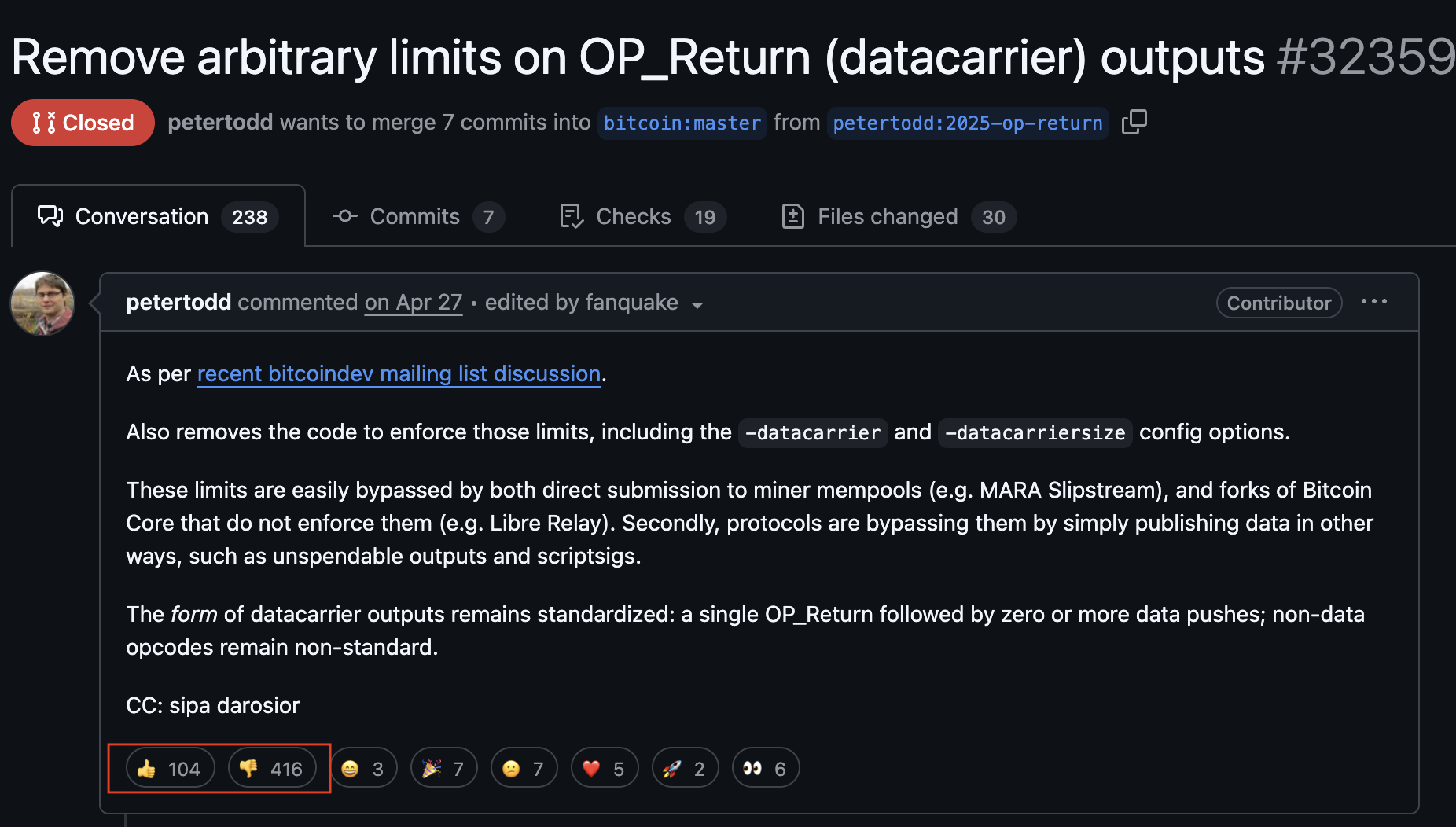
The pull request driving the removal of the OP_Return limit, logged on GitHub as pull request 32359, proved deeply unpopular across major segments of the community. Despite substantial opposition voiced during review stages, the change was ultimately pushed through by maintainers, setting the stage for wider network friction.
Echoes of the Block Size Wars
The current controversy has naturally drawn comparisons to one of the most tumultuous periods in Bitcoin’s history: the block size wars that spanned from 2015 to 2017. That intense ideological battle over scaling, throughput, and on-chain capacity eventually culminated in a contentious hard fork of the protocol. The split gave birth to alternative implementations like Bitcoin Cash, leaving scars within the community that have taken years to heal.
As tensions mount over the upcoming Bitcoin Core 30 release, industry observers and market participants are openly speculating whether the ongoing OP_Return dispute could eventually trigger a similar ideological or technical fracturing of the network. The debate touches on fundamental questions about Bitcoin’s identity: Is it exclusively a peer-to-peer monetary system, or should it serve as an open, permissionless data storage layer for arbitrary tokens, inscriptions, and non-financial applications?
While Bitcoin Core maintains its position as the reference implementation, the governance of a decentralized monetary network relies entirely on voluntary adoption. When core developers make decisions that alienate significant segments of the user base, network participants possess the ultimate enforcement mechanism: running alternative software.
Node Runners Vote With Their Feet in Historic Exodus to Bitcoin Knots
The decision by Bitcoin Core maintainers to lift the OP_Return limit has already triggered tangible consequences, accelerating a historic migration of node operators away from the default client. Frustrated by what they perceive as a top-down governance model, record numbers of Bitcoin node runners have transitioned to Bitcoin Knots, an alternative and independent implementation of the Bitcoin node software.
Data from network monitoring platforms like Coin Dance reveals a remarkable shift in ecosystem dynamics. Nodes running Bitcoin Knots now account for approximately 20% of the entire Bitcoin network. This represents a near-vertical leap from just 1% in early 2024, surging dramatically over a compressed period of roughly nine months.
The primary driver behind this mass migration is Bitcoin Knots’ strict enforcement of data size limits. Proponents of the alternative client argue that maintaining rigorous bounds on arbitrary data is essential to preserving the decentralized nature of the protocol. Without these guardrails, nodes risk bloating significantly faster, raising the barriers to entry for ordinary participants.
Since its inception by pseudonymous creator Satoshi Nakamoto in 2009, the Bitcoin ledger has accumulated roughly 680 gigabytes of blockchain data. This relatively modest size is a direct result of Bitcoin’s simple architecture, disciplined code maintenance, and conservative data limits.
Crucially, Bitcoin’s low data storage and processing requirements mean that everyday individuals can operate a fully validating node on modest retail computer hardware. A complete node setup can often be achieved using equipment costing as little as $300. This low financial and technical barrier to entry successfully democratizes access, ensuring that anyone anywhere can independently verify the rules of the network, thereby reinforcing maximum decentralization.
In stark contrast, alternative blockchain networks and smart contract platforms designed for high throughput generate massive volumes of data at a relentless pace. Operating a validating node on these resource-intensive networks can require tens of thousands of dollars in specialized commercial hardware and enterprise-grade data centers. Consequently, participation is largely restricted to wealthy investors, institutional validators, and large corporations.
Bitcoin advocates have long warned that bloated ledger requirements and demanding hardware thresholds inevitably lead to structural centralization. When running a node becomes prohibitively expensive for the average user, network consensus risks falling into the hands of a small, easily colluding oligopoly of powerful entities. Such centralization dramatically increases vulnerabilities, creating a heightened risk that a privileged few could alter consensus rules, censor transactions, or reverse the history of the ledger.
As the Bitcoin Core 30 upgrade approaches, the growing adoption of Bitcoin Knots demonstrates that the network’s decentralized checks and balances remain active, with node operators ready to assert their sovereignty when faced with contentious protocol modifications.