
Last weekend, the Federal Bureau of Investigation (FBI) disclosed that North Korean state-backed threat actors were behind the staggering $6.3 billion Binance hack—an incident that cybersecurity and blockchain analysts are now categorizing as the largest digital asset heist on record. Federal investigators traced the devastating breach back to a sophisticated social engineering campaign involving fake job interviews and a compromised artificial intelligence tool, which ultimately allowed the attackers to breach the platform’s defenses.
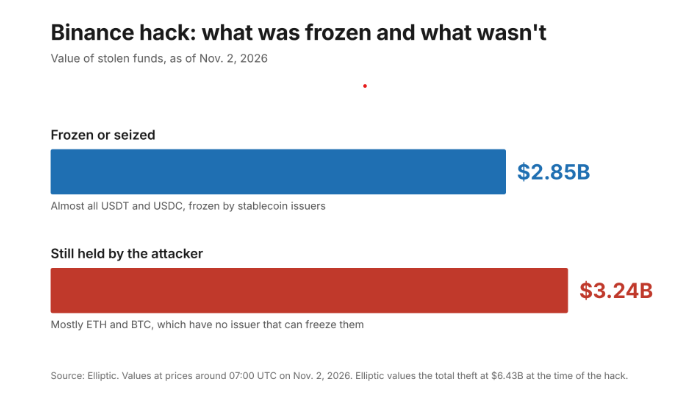
While mainstream headlines and industry commentary have focused heavily on the unprecedented scale of the theft, far less attention has been paid to an equally critical element of the narrative: what actually went right during the unfolding emergency. Despite the fact that the perpetrators successfully breached the exchange and extracted $6.3 billion in various cryptographic assets, they have ultimately been unable to retain control over a massive proportion of their loot. Through swift coordination and emergency intervention, a remarkable $2.85 billion of the stolen funds has been successfully frozen, preventing it from being permanently laundered into the broader financial system.
The primary driver behind this successful containment comes down to the fundamental composition of the stolen capital. Of that $2.85 billion in intercepted funds, an overwhelming 94 percent was held in fiat-backed stablecoins. This development has sparked intense debate across the digital asset ecosystem, highlighting a profound irony. While the centralized control mechanisms embedded within stablecoins are frequently criticized by decentralized finance purists and privacy advocates, this specific architecture may actually represent one of the most potent defense mechanisms currently available against large-scale cryptocurrency crime.
Unlike native decentralized cryptocurrencies such as Bitcoin or Ether, stablecoins like Tether (USDT) and USD Coin (USDC) are issued by centralized corporate entities. These issuers possess the technical capability to freeze tokens at the smart contract level, effectively blacklisting specific wallet addresses and halting the transfer of funds. This structural feature provides victims of digital heists with a narrow, yet viable, window of opportunity to intercept stolen wealth before it reaches the hands of illicit actors.
However, this undeniable defensive capability introduces a deeply uncomfortable governance question for the entire financial industry. If private corporations maintain the unilateral power to freeze billions of dollars in user assets on demand, who ultimately decides when, how, and under what legal conditions that extraordinary authority should be exercised? As regulatory frameworks struggle to catch up with the rapid pace of technological innovation, the United Kingdom now finds itself in a prime position to address this exact regulatory vacuum.
The Race to Get Rid of Stablecoins
To fully comprehend why the rapid freezing of funds mattered so much during the chaos of the Binance incident, one only needs to examine the tactical playbook deployed by the hackers during the immediate aftermath of the breach. Realizing that time was of the essence, the perpetrators understood that they faced a very narrow window to liquidate and move their stablecoin holdings before centralized issuers could mobilize defensive protocols.
Less than an hour after the initial breach began, the hackers executed a frantic series of transactions, dumping roughly $325 million worth of stolen USDT in exchange for Ether. The strategic rationale behind this maneuver was simple and calculated: they sought to rapidly swap a centralized asset that was vulnerable to freezing for a decentralized asset that could not be restricted by corporate intermediaries.

Fortunately, stablecoin issuers demonstrated unprecedented reaction speeds. Tether initiated its first major emergency freeze just 37 minutes after the stolen funds successfully reached the primary hacker wallet. Competitor Circle followed suit a mere three minutes later, successfully blocking the further movement of USDC across the network. Industry analysts agree that without the aggressive and decisive interventions of both Tether and Circle, a vastly higher proportion of the stolen billions would have slipped beyond the reach of law enforcement and victims alike.
We Are Yet to Agree on the Rules
While the emergency freezes largely achieved their intended objective, the success highlighted a deeper systemic vulnerability. The entire defensive operation succeeded primarily because a handful of private executives decided to take matters into their own hands in real time, improvising a response in the absence of standardized protocols.
The core problem facing the digital asset economy is the complete lack of a harmonized global standard outlining precisely when an asset freeze is legally justified, what evidentiary threshold is required, and how rapidly issuers are obligated to respond. The consequences of this regulatory gray area are already manifesting through mounting legal battles across multiple jurisdictions.
For example, Circle is currently facing a proposed class-action lawsuit filed by investors of Drift Protocol. The plaintiffs allege that Circle failed to freeze approximately $230 million in stolen USDC following a separate major hack in April, arguing that the issuer had the technical capacity to stop the funds from moving but failed to act in a timely manner. Conversely, Tether is facing a high-stakes lawsuit in New York brought by two businessmen who claim the company unjustly froze millions of dollars of their assets months before any official seizure warrant had even been issued. Tether has strongly defended its actions, dismissing the allegations as entirely baseless.
Drawing comparisons to traditional banking and payment sectors, financial professionals note that commercial banks freeze accounts and transactions on a regular basis. However, traditional financial institutions do not operate in a vacuum. Bank-initiated freezes are almost invariably bound to established legal triggers, statutory frameworks, and formal due process mechanisms that provide account holders with clear avenues to challenge restrictions.
Stablecoin issuers now wield equivalent, if not greater, financial power while operating on compressed timelines across complex international borders. Despite holding this immense authority, they continue to operate largely without formal structural guidelines, leaving both issuers and users exposed to legal uncertainty.
Britain Can Fix This
Addressing this regulatory challenge comes with a distinct geopolitical caveat. Major stablecoin issuers such as Tether and Circle are not domiciled within the United Kingdom, meaning British regulators cannot simply issue direct mandates to dictate their global operational policies.
What the United Kingdom can control, however, is the regulatory perimeter governing which digital assets and stablecoins are permitted to be listed, traded, or offered to UK retail and institutional customers. In fact, British financial authorities have already initiated steps in this direction.
Earlier this year, the Financial Conduct Authority (FCA) published its comprehensive cryptoassets regime. Under the new rules, UK-based trading platforms are required to conduct rigorous due diligence and publish detailed disclosure documents prior to listing any digital asset, a mandate that explicitly extends to overseas-issued stablecoins. This regulatory regime is scheduled to come into full legal force on October 25, 2027. Concurrently, the Bank of England has been finalizing its dedicated Code of Practice for systemic stablecoin issuers—targeting digital currencies utilized heavily enough for commercial payments to pose implications for wider UK financial stability.
Neither of these existing frameworks currently establishes the explicit operational obligations surrounding the freezing of stolen funds that many industry experts believe are urgently necessary. Nevertheless, because these regulatory architectures are still actively taking shape, the UK possesses a unique window of opportunity to address this critical gap proactively, rather than attempting to retrofit retroactive requirements after a crisis occurs.
Two Conditions for a UK Listing
To resolve this dilemma without stifling technological innovation, a practical regulatory solution could be integrated directly into the UK’s emerging framework. Before any stablecoin is authorized for distribution or trading on a regulated UK platform, its issuing entity could be required to meet two straightforward compliance conditions.
The first condition is operational responsiveness. While Tether and Circle acted decisively during the historic Binance breach, the victim in that instance happened to be the largest cryptocurrency exchange on the planet, commanding immediate attention. Smaller UK-based trading platforms and emerging fintech enterprises should be afforded the exact same level of responsiveness. Many smaller crypto businesses lack Binance’s corporate profile or a direct communication channel to major stablecoin issuers, leaving them vulnerable to prolonged delays during an active security incident.
The second condition involves establishing a clear, legally accountable timetable for asset freezes. Under this approach, if an issuer exercises its authority to freeze stolen funds, it should be legally mandated to notify the National Crime Agency or relevant law enforcement bodies within the same business day. Furthermore, the emergency freeze should automatically expire after a defined period unless law enforcement secures a formal court order to maintain the restriction.
These proposed measures are designed to strike a pragmatic balance. They would preserve the vital capability of law enforcement to intervene when digital assets are stolen through criminal acts, while simultaneously protecting ordinary market participants from indefinite asset freezes executed outside of established legal grounds.
The unprecedented Binance breach has demonstrated beyond a doubt that stablecoins can provide victims of digital crime with a fighting chance to recover stolen wealth before it vanishes permanently. Establishing clear rules of engagement will ensure that this protective mechanism functions reliably and fairly—not just as a privilege reserved for the world’s largest exchanges.