
Ripple USD (RLUSD), the stablecoin issued by prominent cryptocurrency firm Ripple, was initially brought to market with a firm pitch toward corporate utility. However, despite being heavily marketed as an enterprise-focused asset, the stablecoin has steadily gained significant traction among everyday retail users across multiple blockchain ecosystems.
Ripple officially introduced the RLUSD stablecoin in late 2024, aiming to carve out a specialized niche in the fast-growing digital asset economy. From the outset, Ripple executives championed its institutional focus, drawing a clear line between RLUSD and other stablecoins in the sector that are primarily designed for general retail trading and decentralized finance applications.
Despite this intentional positioning, market realities appear to be taking the stablecoin in a broader direction. Increasing adoption by self-custodial wallets such as Xaman—alongside strategic integrations with onboarding and gateway platforms like Transak—suggests that RLUSD is successfully breaking past strict enterprise boundaries and finding a home among individual crypto participants.
Weighing in on this organic market shift, the chief operating officer at XRPL Labs and Xaman noted that while RLUSD initially launched with an enterprise-focused narrative—likely driven by the inherent strengths of the XRP Ledger, including high speed, cost-efficiency, and deterministic finality—the ecosystem is witnessing genuine, measurable traction on the retail side.
Controversy and Strategic Evolution Regarding Enterprise Focus
The trajectory of RLUSD has been a subject of discussion within the broader digital asset community long before its official rollout. Initial reports and rumors regarding the stablecoin surfaced well ahead of its formal debut in December 2024. During the preliminary promotional phase, Ripple CEO Brad Garlinghouse publicly characterized the asset as the gold standard for enterprise-grade stablecoins, a sentiment he shared via social media channels as early as October of that year.
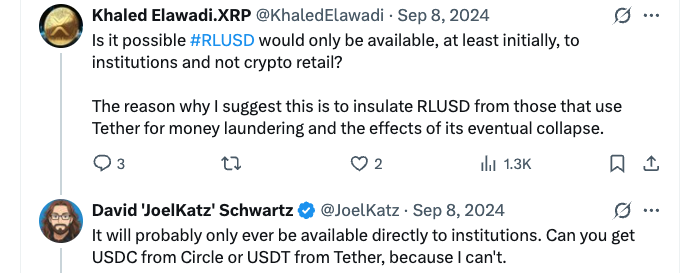
Further fueling the perception of institutional exclusivity, Ripple Chief Technology Officer David Schwartz remarked during the developmental stages that RLUSD would probably only ever be available directly to corporate institutions. These remarks sparked considerable debate across the cryptocurrency landscape, leading many industry observers to believe that the token would remain walled off from retail participants.

When Ripple finally issued its official announcement regarding RLUSD on December 16, 2024, the corporate press release omitted any explicit mention of retail use cases. Instead, the announcement focused heavily on the stablecoin’s initial day-one availability across major institutional-facing and regulated platforms, including Uphold, Bitso, and MoonPay, among others.
Despite the corporate-centric messaging, the infrastructure built to support the stablecoin has inevitably opened the door to a wider audience. According to Harshit Gangwar, head of marketing at Transak, RLUSD was indeed designed with enterprise-grade utility in mind. Nevertheless, Gangwar pointed out that the underlying issuance and redemption infrastructure inherently supports both institutional and retail accessibility, blurring the lines of its intended use case.
Erbil Karaman, co-founder of Huma Finance, offered a similar perspective on the matter, noting that RLUSD currently operates much like any general-purpose stablecoin in the open market. Karaman emphasized that the asset is now competing directly with established industry heavyweights, such as Circle’s USDC, across every market segment.
Reflecting on the unpredictable nature of product adoption in the blockchain sector, Karaman observed that the evolution of RLUSD underscores a fundamental truth about the industry: what ultimately matters is not who issues a stablecoin or what it is initially marketed for, but rather what it actually becomes useful for. He added that this utility only truly becomes clear after the asset has been launched and tested by the open market.
The Curious Case of Ethereum Issuance Versus XRPL Holder Preference
A fascinating dynamic has emerged regarding where RLUSD is minted versus where it is ultimately held and utilized. Addressing the distribution patterns of RLUSD usage, Kiuru of XRPL Labs pointed out a distinct gap between the heavy volume of RLUSD issued on Ethereum and the sheer number of users who actively prefer utilizing the XRP Ledger (XRPL).
According to recent data compiled by RWA.xyz, stablecoins issued on the Ethereum blockchain account for the vast majority of RLUSD’s current market capitalization, which sits at approximately $557 million. Ethereum-based RLUSD commands roughly 88% of this total figure, while less than 12% of the stablecoin supply is natively minted directly on the XRPL.
However, a reverse trend appears when examining the distribution of actual token holders. The overwhelming majority of RLUSD holders—representing more than 90% of the total 34,160 active users—reside on the XRP Ledger. This leaves only about 10% of individual holders interacting with the asset on Ethereum, according to insights shared by Kiuru, who cited data from a public analysis published on social media by prominent community figure Vet.
This statistical split highlights a fascinating juxtaposition between corporate deployment strategies and grassroots user behavior. When asked about this phenomenon, Kiuru suggested that Ripple and affiliated entities continue to market the asset primarily through an enterprise lens. He attributes this ongoing narrative to the historical positioning of the XRPL as an enterprise-grade blockchain since its inception, as well as its superior transactional speed and reliability.
At the same time, Kiuru views the widespread organic adoption by everyday users as a significant victory for the ecosystem. He noted that the growing footprint of retail participation does not mean the foundational positioning of the XRPL and RLUSD is pivoting away from corporate utility; rather, it demonstrates that the underlying technology is robust enough to serve both enterprise requirements and retail demand simultaneously.
As RLUSD continues to mature in a competitive stablecoin market dominated by established giants, its ability to bridge the gap between institutional compliance and retail accessibility will likely define its long-term success. Cointelegraph reached out to Ripple for formal comment regarding the accelerating trend of retail use surrounding RLUSD, but had not received a response prior to publication.