
A cohort of long-dormant Bitcoin addresses dating back to the network’s infancy has suddenly sprung to life after more than 16 years of absolute inactivity. The sudden movement of 600 BTC—valued at approximately $48 million at the time of the transfer—instantly captivated the cryptocurrency community over the weekend, triggering a fresh wave of speculation regarding a potential connection to Bitcoin’s pseudonymous creator, Satoshi Nakamoto. However, prominent blockchain tracking and analytics firms quickly stepped in to pour cold water on the rumors, confirming through meticulous onchain investigation that the awakened funds have no ties to the network’s legendary architect.
According to comprehensive onchain data reviewed by Cointelegraph, a dozen distinct addresses holding the combined 600 Bitcoin executed transfers on Saturday. The movement of coins that have remained untouched since the early days of cryptocurrency always commands intense market attention, primarily due to the historical rarity and the sheer financial magnitude held by early adopters, miners, and developers from the network’s foundational era.
Whale Alert, a leading blockchain transaction tracking platform that monitors large and notable cryptocurrency movements across various ledgers, was among the first to analyze the sudden activity. A spokesperson for Whale Alert clarified that the 600 BTC originated from block rewards generated across 12 separate Bitcoin blocks mined in March 2010. Following an exhaustive forensic review of the transaction histories, the platform’s researchers found zero evidence connecting the addresses to Satoshi Nakamoto.

"None of the blocks can be connected to Satoshi based on our research," a spokesperson for Whale Alert told Cointelegraph. This assessment successfully tempered widespread speculation across social media channels regarding the origins of coins that were mined during a period when Bitcoin’s elusive creator was still actively communicating with the developer community and overseeing the nascent software project.
Whale Alert Traces All 12 Mining Block Rewards
To arrive at its definitive conclusion, Whale Alert conducted a deep-dive investigation, successfully tracing all 12 rewards back to specific Bitcoin blocks mined during March 2010. During this early epoch of the cryptocurrency, the economic incentives embedded into the Bitcoin protocol were vastly different from today. At the time these blocks were secured and verified, each successfully mined block paid out a block subsidy of 50 BTC to the miner.
The foundational design of Bitcoin incorporates a strict disinflationary monetary policy, mandating that the block subsidy be cut in half roughly every four years, or every 210,000 blocks. This programmed reduction, universally known in the industry as the "halving," has occurred four times since the network’s inception. Most recently, the halving event in April 2024 reduced the block reward from 6.25 BTC down to its current level of 3.125 BTC per block. The stark contrast between the historical 50 BTC payouts of 2010 and today’s rewards underscores just how much the network has matured and how scarce new issuance has become.
The latest findings significantly expand upon Whale Alert’s earlier preliminary analysis, which initially focused on just seven of the rewards. In an update posted to X (formerly Twitter) on Sunday, the platform confirmed that those initial seven rewards originated from blocks that its comprehensive research had independently determined were definitively not mined by Nakamoto.
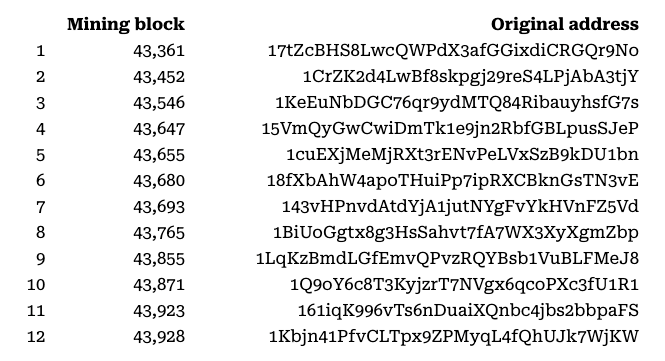
Other premier onchain analytics firms also jumped on the sudden movement as it unfolded. Lookonchain, a widely followed blockchain data intelligence platform, initially identified seven distinct miner wallets that collectively shifted 350 BTC after sitting completely dormant for 16.5 years. Lookonchain’s early tracking corroborated that these specific wallets had steadily accumulated their holdings through mining rewards earned during March 2010 before going entirely silent for over a decade and a half.
Satoshi-Era Doesn’t Mean Satoshi’s Bitcoin
The intense market reaction and immediate speculation surrounding Saturday’s transfers are largely driven by chronology. The year 2010 represents a very specific, highly scrutinized chapter in Bitcoin’s history—a time when Satoshi Nakamoto was still directly engaged in guiding the open-source software project, writing code, and collaborating with early contributors on public forums and mailing lists.
Nakamoto remained an active participant in Bitcoin’s development and public communications throughout 2010 before gradually withdrawing from the public eye. Nakamoto’s involvement tapered off significantly before their final known public communication, an email exchange that dates back to April 2011, after which the creator vanished completely, leaving the project in the hands of the broader developer community. Because the newly moved coins date precisely to this golden era of early participation, any awakening of 2010-era funds naturally invites immediate comparisons and theories about whether an early pioneer or Nakamoto himself is liquidating assets.
Delving deeper into the transactional mechanics of the weekend’s events, Whale Alert pointed out a specific behavioral pattern that accompanied the wallet awakenings. Researchers observed that one of the rewards was moved across the blockchain several blocks prior to the transfer of the majority of the other coins. According to the tracking platform, this staggered timing is highly consistent with a preliminary test transaction—a standard technical precaution often employed by users or entities preparing to move large sums of cryptocurrency after a prolonged absence, ensuring that destination addresses and private key access are fully functional before executing the bulk transfers.