

Prominent Bitcoin developer and educator Jimmy Song has sharply criticized the decision by Bitcoin Core developers to remove the OP_Return limit for non-monetary data embedded on the Bitcoin blockchain. Scheduled for deployment in the upcoming Bitcoin Core 30 upgrade, the removal has ignited intense debate across the cryptocurrency ecosystem. Song did not mince words, labeling the move a manifestation of a "fiat" mentality that bypasses genuine community consensus and evades accountability regarding the long-term health of the network.
The controversy centers on the OP_Return script, which is currently capped at 80 bytes in size. This limit has historically served as a restrictive barrier designed to discourage the embedding of arbitrary, non-monetary data directly into the Bitcoin ledger. By deciding to lift this restriction entirely in the forthcoming Bitcoin 30 release, the core development team has opened the door for increased non-monetary utilization of block space.
Song accused the Core developers of deflecting user concerns regarding the removal of the OP_Return limit and systematically ignoring the significant pushback voiced by the broader Bitcoin community, node runners, and ecosystem participants. The debate has exposed deep philosophical fault lines regarding the fundamental purpose of the world’s oldest and most secure cryptocurrency network.
Addressing the controversy publicly, Song argued that the developers’ defense of the policy change relies on semantic evasion. He pointed out that dismissing the problem by claiming spam is too difficult to define is a disingenuous strategy reminiscent of conventional political maneuvering.
"The idea that spam is difficult to define, and because of this ambiguity, we shouldn’t be making any distinctions at all in the software, is a time-wasting argument from fiat politics where you pretend not to know the obvious, so the actual debate can never get off the ground — the non-monetary uses of Bitcoin are spam," Song stated.

He further emphasized that while individuals can debate whether non-monetary use cases are desirable or not, pretending that the classification cannot be defined is merely a stalling tactic. According to Song, this rhetorical strategy is designed to avoid addressing the real argument about the actual impact—particularly the long-term, structural impact—that removing these guardrails will have on the network.
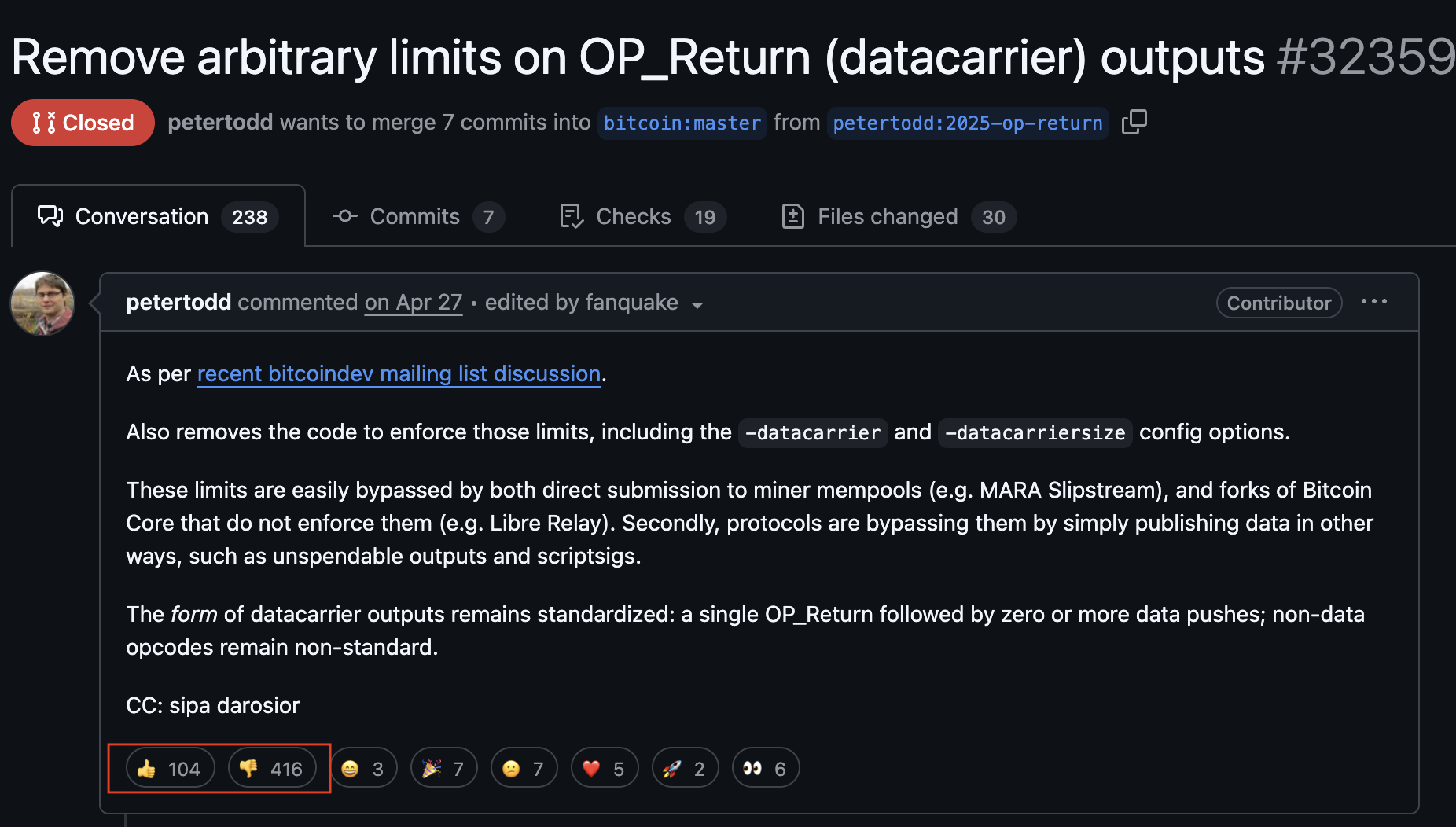
The pull request for removing the OP_Return limit was profoundly unpopular with a vocal segment of the Bitcoin community, yet it was pushed through regardless, highlighting a persistent governance friction point between independent contributors, downstream node operators, and foundational code maintainers.
The ongoing OP_Return debate has now raged for nearly six months, drawing frequent comparisons to the contentious Bitcoin block size wars of 2015 to 2017. Those historic disputes eventually resulted in a hard fork of the Bitcoin protocol that spawned Bitcoin Cash. The bitterness of the current ideological split has left some market observers and community members speculating whether the current OP_Return wars could eventually result in a similar structural or philosophical fork within the ecosystem.
Node Runners Vote With Their Feet in Historic Exodus to Bitcoin Knots
The decision by Bitcoin Core developers to unilaterally alter the OP_Return data limit has deeply fractured the community, driving a record-breaking exodus of Bitcoin node runners away from standard Core software and toward Bitcoin Knots, an alternative implementation of the Bitcoin node software.
This migration has manifested as a dramatic surge in nodes running Bitcoin Knots. Alternative implementations now account for approximately 20% of the entire network’s node distribution, marking a staggering leap from roughly 1% at the start of 2024. This near-vertical adoption curve has unfolded over the span of just nine months, representing one of the most significant shifts in node software preference in recent blockchain history.
Bitcoin Knots allows individual node runners to enforce strict data size limits and apply custom transaction relay policies. Proponents of this alternative implementation argue that such protective measures are absolutely vital to preserve the decentralization, security, and economic viability of the Bitcoin protocol over the long term.
Since the inception of the decentralized protocol in 2009, the Bitcoin ledger has accumulated roughly 680 gigabytes of data. This relatively modest blockchain size has been maintained precisely because of Bitcoin’s simple architecture and strict, uncompromising data limits.
Bitcoin’s exceptionally low data storage and processing requirements mean that virtually anyone can independently run a full node on standard, affordable retail computer hardware for as little as $300. This low barrier to entry democratizes access to the network, empowers everyday users, and ensures maximum decentralization by allowing individuals to independently verify all consensus rules without relying on trusted third parties.
In sharp contrast, higher-throughput blockchain networks and complex smart contract platforms generate vastly larger quantities of ledger data. Operating validator nodes on those networks can often cost tens of thousands of dollars in hardware and infrastructure expenses, requiring specialized commercial server setups. Consequently, only wealthy investors, institutional entities, and large corporations can afford to run full nodes and directly enforce the consensus rules of those high-throughput protocols.
Cryptocurrency analysts have long warned that robust, expensive hardware requirements inevitably translate into the increased centralization of a blockchain protocol. Centralized architectures carry a heightened risk that a small, colluding group of validator nodes could alter consensus rules, censor transactions, or reverse network history. For defenders of strict data limits like Jimmy Song and the operators migrating to Bitcoin Knots, keeping Bitcoin lightweight and accessible is not merely a technical preference, but an existential safeguard against the creeping centralization seen in the broader blockchain industry.