
Cryptocurrency markets faced a turbulent week as Bitcoin plunged by more than $10,000, sliding to trade at $65,116 and marking a sharp 12.4% weekly loss. Market analysts and observers have quickly pointed out a striking historical parallel: Bitcoin notably found its cyclical bottom following the United States midterm elections in both 2018 and 2022. With the latest market correction coinciding with the November 2026 midterms, many traders are left wondering if history is repeating itself.
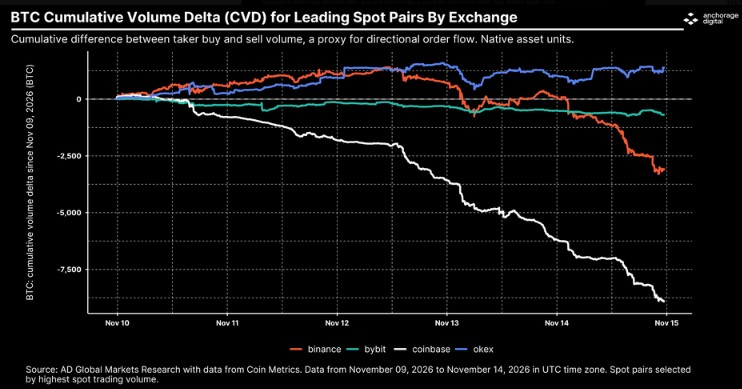
According to Anchorage Digital researcher David Lawant, the primary selling pressure is originating domestically within the United States. Lawant highlighted market data showing a continued heavy net taker sell flow, predominantly on Coinbase, compared to overseas exchanges. This localized selling pressure has been mirrored in the U.S. spot Bitcoin exchange-traded funds (ETFs), which experienced severe capital flight. Over the past two weeks, U.S. spot Bitcoin ETFs shed a staggering $2.35 billion in net outflows, with redemptions exceeding $1 billion in each of the two consecutive weeks. Farside Investors data revealed that spot Bitcoin ETFs shed $1.07 billion over a five-day stretch following $1.28 billion in outflows the prior week, marking the largest weekly redemptions seen since late June. Friday culminated in the seventh consecutive trading session of net withdrawals, bringing total redemptions to roughly $1.71 billion since November 5. Meanwhile, popular market influencers noted that Bitcoin dropped in the hour preceding the U.S. market open on all but two of the past fifteen trading days.
The broader macroeconomic and market environment has also weighed heavily on investor sentiment. Binance founder Changpeng Zhao publicly rebuffed circulating rumors that his exchange was responsible for the sell-off, stating that he had actually purchased crypto over the previous few days. Zhao attributed the broader market crash to a confluence of factors: capital shifting toward the Anthropic initial public offering, the massive Bitcoin ETF outflows, general security concerns following a recent hack involving Binance, and hot inflation data that has revived expectations of further interest rate hikes. Financial markets are now actively pricing in a quarter-point rate hike by the Federal Reserve in December.

After dipping to a four-month low near $62,000 on Sunday, Bitcoin managed a modest rebound above the $65,000 threshold. However, the broader sentiment remains deeply pessimistic, with the Crypto Fear and Greed Index plunging to 10, signaling "Extreme Fear." Despite the bleak short-term outlook, historical trends offer a glimmer of hope; following the 2018 and 2022 midterm elections, Bitcoin managed to more than double in price within the subsequent twelve months.
Jensen Discusses Nvidia Comeback Days After Resigning
The turbulence in digital assets has been compounded by severe shocks in traditional technology and artificial intelligence markets. The Financial Times reported that former Nvidia CEO Jensen Huang is actively plotting a comeback to the top job at the company alongside key allies, following a determined push within Silicon Valley to pressure the corporate board to reinstate him.
Nvidia shares plunged dramatically after Huang resigned as CEO and stepped down from the board on November 12, prompting the appointment of Chief Financial Officer Colette Kress as interim CEO. The abrupt resignation came shortly after reports emerged regarding alleged personal conduct, including a third affair with a subordinate. Despite an ongoing independent board probe into allegations that he had a romantic relationship with a Chinese spy who allegedly helped ferry semiconductor chips to China, sources close to Huang confirm he has been discussing a return with confidants. An ally told the Financial Times that supporters have established a "war room" dedicated to his reinstatement, noting that figures across the technology sector outside of frontier labs deeply support him.
A petition advocating for Huang’s return has rapidly accumulated over 100,000 signatures. The list of supporters notably includes 5,600 current Nvidia employees, alongside high-profile industry leaders such as SpaceX and Tesla CEO Elon Musk and Epic Games CEO Tim Sweeney. The leadership crisis at Nvidia has reverberated across AI stocks and broader risk assets, including cryptocurrencies. Regulatory and political fallout is also mounting, with U.S. congressional leaders advancing three separate bills aimed at tightening export restrictions on AI chips to China in the wake of the spy scandal. According to reports from the New York Times, U.S. intelligence officials reportedly briefed President Trump a year ago regarding Huang’s close relationship with the individual accused of espionage, though no immediate action was taken at the time.
Ethereum Should Become Post-Quantum in 2027: Ethlabs
In the blockchain development sector, Ethereum research group Ethlabs announced it is withdrawing its Quick Slots proposal from the forthcoming Hegotá upgrade, urging core developers to accelerate preparations to defend the network against potential quantum computing attacks by 2027.
The research collective outlined a proposed roadmap designated "pqai27," which aims to fortify Ethereum against emerging threats from both artificial intelligence and quantum computing. While the official published protocol priorities currently target a post-quantum transition by December 2029, prominent researcher Justin Drake expressed hope at Devcon that the timeline could be advanced to completion by 2028.

Strategy Gets Booted From MSCI Indexes
Index provider MSCI confirmed that Bitcoin treasury company Strategy will be removed from its global equity indexes following months of deliberation over whether corporate entities holding large crypto treasuries genuinely qualify as operating businesses. Japan-based Metaplanet and digital asset treasury firm Upexi have similarly been marked for deletion, while Ether treasury firm Sharplink has been placed on an index watchlist. These adjustments are scheduled to take effect following the market close on November 30.
Market analysts noted that inclusion in these global indexes meant ordinary passive investors—such as everyday workers holding global index funds in their retirement accounts—were unwittingly gaining leveraged exposure to Bitcoin without explicitly choosing to do so. The index provider’s decision effectively separates traditional equity portfolios from direct crypto-treasury volatility. Following the announcement, Strategy shares fell 6.49%, extending their monthly losses to over 25%.
Winners and Losers
As the trading week concluded, major cryptocurrencies recorded steep double-digit declines. Alongside Bitcoin’s 12.4% drop to $65,116, Ethereum fell 14.4% to $1,822, and XRP declined 13.3% to trade at $0.96. Overall cryptocurrency market capitalization contracted to $2.2 trillion, according to data from CoinMarketCap.

Among the top 100 digital assets by market capitalization, the strongest performing altcoins of the week included Kite, which posted a 35.5% gain, Pieverse with a 33.8% increase, and Midnight, which rose 28.7%. Conversely, the steepest weekly losses were sustained by Zcash, down 25.4%, Uniswap, falling 23.2%, and Aero, which dropped 23.1%.
Prediction of the Week: Bitcoin’s Buying Opportunity
Despite the acute market downturn, prominent voices in the digital asset space remain exceptionally bullish on the long-term outlook. Bitcoin Opportunity Fund co-founder Mark Moss asserted that with traditional financial institutions and exchange-traded funds significantly widening market access, Bitcoin is positioned to reach a new record high in 2027. Moss described Wall Street’s broadening embrace of the asset class as creating what he considers to be the "best buying opportunity ever" for investors.
Top FUD of the Week: Microsoft Outage and Corporate Restructuring
In broader technology news, Microsoft successfully restored Microsoft 365 services after a massive global technical outage disrupted Outlook, Teams, and other critical enterprise applications for more than 24 hours. The technology giant explicitly ruled out a cyberattack, explaining that the disruption originated from a technical issue introduced during an earlier network capacity upgrade. Company representatives emphasized that the incident was unrelated to cybersecurity threats or artificial intelligence agents.

Meanwhile, MEGA, the organization supporting the Ethereum layer-2 network MegaETH, implemented a 20% workforce reduction following months of structural reorganization. The company is shifting its strategic focus toward the development of new artificial intelligence products natively integrated with the MegaETH ecosystem, having committed $30 million toward the initiative.
In corporate financial news, Japanese firm Metaplanet reported a net loss of 27.16 billion yen—approximately $170 million—for the first nine months of 2026. As the world’s second-largest publicly traded corporate holder of Bitcoin, the company’s earnings were severely impacted by a decline in the market value of its holdings, alongside losses realized from the sale of 10,000 Bitcoin aimed at demonstrating liquidity and capital-raising capabilities. This contrasted sharply with a net profit of 13.53 billion yen recorded during the same period in the previous year.