

The Bitcoin network requires a dedicated, "conservative" client node software implementation to safeguard its core monetary properties and fortify its overarching network decentralization. This perspective was recently emphasized by Jimmy Song, co-founder of ProductionReady, a non-profit organization dedicated to funding open-source Bitcoin node software development and community education.
Speaking on the operational philosophy guiding his organization, Song revealed that ProductionReady maintains a strict "bias" against significant code modifications unless there is an overwhelming consensus and community support backing the proposed change. The guiding principle for maintaining sound money is straightforward and uncompromising. According to Song, if developers are not entirely certain that a proposed alteration genuinely improves the asset as a reliable form of money, the modification should simply not be made.
This conservative outlook arrives at a critical juncture for the world’s leading cryptocurrency network. As debates surrounding block space usage, data storage costs, and network bloat intensify among developers and node operators, the question of who controls the reference implementation of Bitcoin software has taken center stage. ProductionReady aims to address these anxieties by championing software that respects the traditional economic and technical boundaries that have historically kept Bitcoin resilient against centralization pressures.

Preserving Self-Sovereignty Through Low Node Costs
A central pillar of the conservative philosophy championed by ProductionReady is the absolute necessity of keeping storage and bandwidth requirements low. Song highlighted that the foundational strength of the Bitcoin network relies heavily on the self-sovereignty of its users. When ordinary individuals can easily afford to run a full node from their homes, the network becomes structurally more decentralized and resilient against external interference or malicious attacks.
Conversely, when storage demands and bandwidth thresholds creep upward, the hardware and resource requirements to participate fully in the network also rise. Consequently, fewer everyday people are able to independently verify transactions for themselves, leading to a default slide toward network centralization. A conservative client software implementation takes this fundamental tradeoff very seriously, prioritizing accessibility over feature bloat.
By maximizing the total count of operational nodes and ensuring that the software remains accessible to the average user, the Bitcoin network hardens its defenses. A dense, highly distributed web of independent nodes drastically reduces the probability of systemic cheating, such as bad actors submitting invalid transactions or a small cartel of powerful entities colluding to centralize network governance and validation.
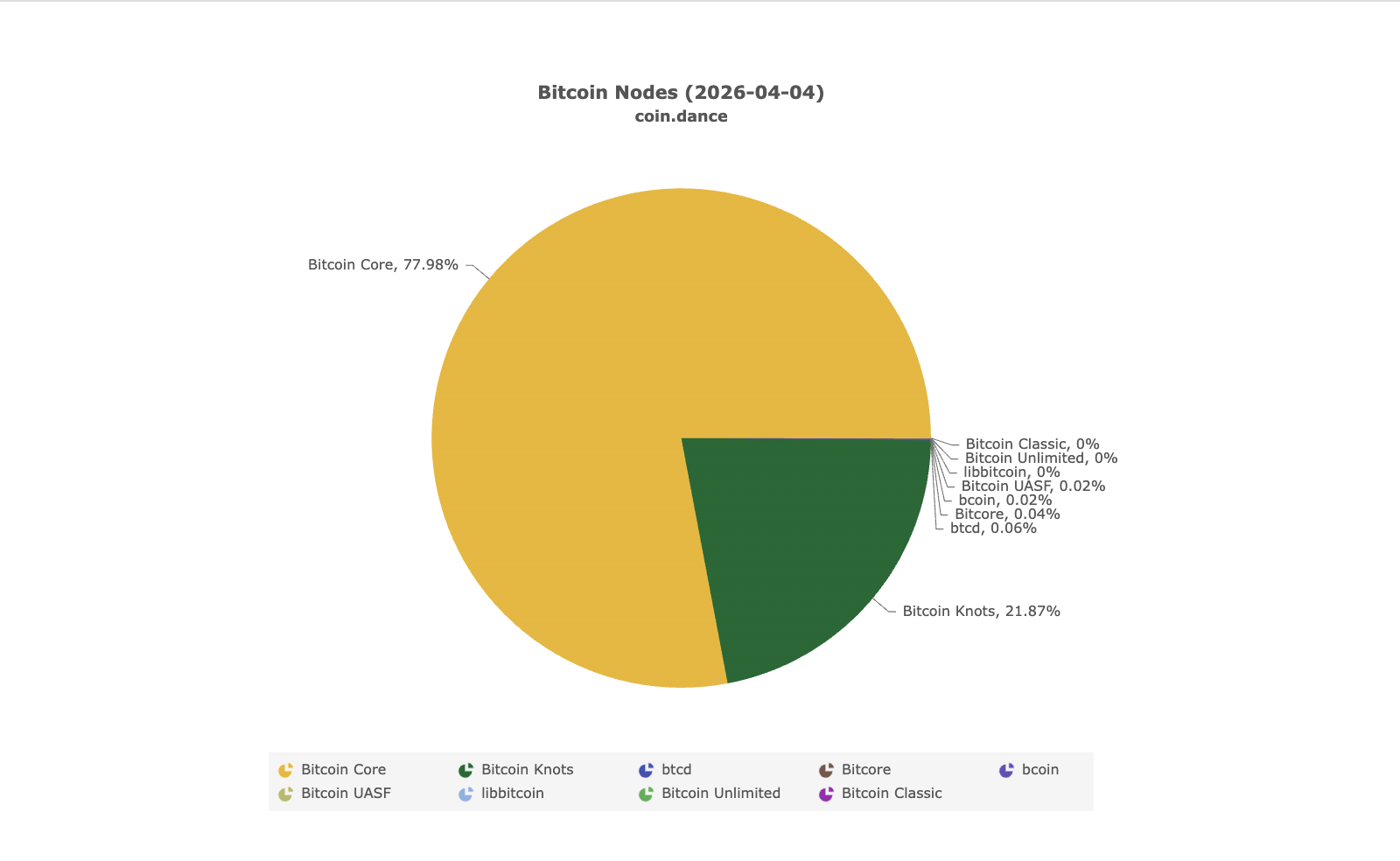
Data tracking the distribution of Bitcoin node software implementations reveals that Bitcoin Core has historically commanded the vast majority of the market share. Current figures from Coin Dance show that Bitcoin Core continues to be the dominant software choice for node operators, with approximately 77.8% of the network running some iteration of the Core software. Meanwhile, alternative implementations such as Bitcoin Knots have captured a notable and rapidly growing share of the ecosystem, currently accounting for 21.8% of active nodes.
Bitcoin Core 30 Removes the OP_Return Data Limit, Sparking Major Pushback
The ongoing friction regarding node storage limits and onchain spam intensified dramatically in 2025. The controversy erupted when Bitcoin Core developers unilaterally altered the longstanding 83-byte data limit on the OP_Return function within Bitcoin Core version 30, which serves as the latest major upgrade to the reference implementation for Bitcoin node software.
Despite immediate and significant pushback from the broader Bitcoin community, developers proceeded to raise the arbitrary data limit to an expansive 100,000 bytes. The decision proved deeply contentious from its inception. Historical records from the proposal’s GitHub pull request page indicate that the initiative to alter the limit faced severe resistance, receiving roughly four times as many downvotes as it did upvotes from community participants and developers alike.
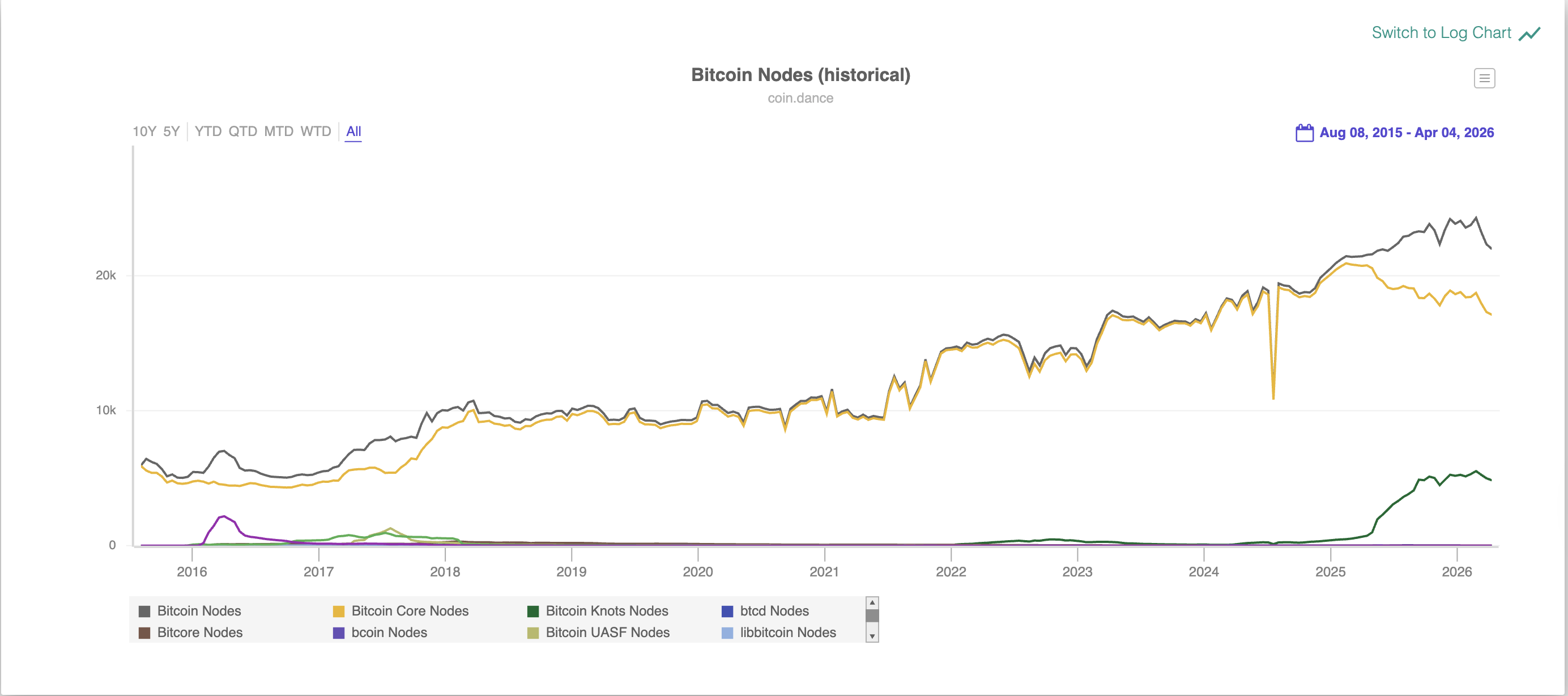
Despite the widespread opposition, Bitcoin Core version 30 officially went live in October 2025. The contentious deployment acted as a catalyst, triggering a historic and unprecedented surge in the number of Bitcoin nodes migrating away from the reference client and toward Bitcoin Knots, an alternative implementation of the node client software that maintains stricter rules regarding non-monetary data storage.
ProductionReady expects to directly address this shift by working to restore the original 83-byte OP_Return data limit for arbitrary, non-monetary information within Bitcoin transactions. Song reiterated that keeping node storage costs under strict control by limiting arbitrary data usage is an indispensable requirement for preserving long-term network decentralization.
The market response to the release of Bitcoin Core 30 demonstrated a profound appetite for a more conservative approach. The number of nodes running Bitcoin Knots surged to all-time record highs following the October release. According to metrics provided by Coin Dance, there are currently 4,746 active Bitcoin Knots nodes operating globally, representing over 21.7% of the entire network’s node count. To put this explosive growth into perspective, only about 1% of the entire Bitcoin network was running the Knots software throughout 2024, prior to the announcement and subsequent implementation of the controversial OP_Return function changes.