Federal Bureau of Investigation agents have arrested a prominent Canadian cybersecurity executive in Pennsylvania as part of an escalating, high-stakes investigation into the notorious "ShinyHunters" cybercrime syndicate. The arrest comes on the heels of a massive breach that saw the hacking group infiltrate federal systems and relieve the FBI of sensitive personnel data concerning thousands of its agents.
According to multiple sources familiar with the ongoing probe, the suspect was taken into custody earlier this week while visiting the United States to attend a cyber insurance conference. Federal court records indicate that an individual named Edward Dobrovsky—with a slight misspelling of the surname matching the prominent security figure—was arrested on October 8 in Pennsylvania on serious charges including cyber extortion and conspiracy.
The New York Times was first to report that federal authorities had apprehended a Canadian man in Pennsylvania on suspicion of providing assistance to the ShinyHunters organization. However, neither the initial reporting nor a public statement shared on social media platform X by FBI Director Kash Patel explicitly identified the detained individual by name.
Sources close to the federal investigation revealed that the Canadian executive was in the Philadelphia area to attend the Cyber Risk Summit, an annual gathering hosted at the Loews Philadelphia Hotel between October 5 and October 7. The summit draws numerous professionals from the cyber insurance, legal, and risk mitigation sectors. Online records for the event indicate that while several firms sponsored the summit, its premier and largest sponsor was a prominent Canadian security company known as Cypfer.
Public professional networking profiles on LinkedIn indicate that Edward Dubrovsky was formerly associated with Cypfer, where his profile claimed he was an "ex-founder." More recently, Dubrovsky became affiliated with another Canadian security firm and conference sponsor called CyberSteward. Approximately one month prior to his arrest, Dubrovsky published a post on LinkedIn announcing his plans to travel to Philadelphia to attend the Cyber Risk Summit alongside members of the CyberSteward team.

Following the initial reports, a spokesperson for Cypfer clarified that Dubrovsky was never a founder or co-founder of the firm, contrary to the claims on his LinkedIn profile. Instead, the company stated that he had served as a managing director prior to his resignation in November 2025.
In the weeks leading up to the summit and his subsequent arrest, Dubrovsky had publicly expressed enthusiasm for continuing industry dialogues regarding ransomware and extortion advisory services. In a professional post, he wrote that he was looking forward to discussions centered around strategy and compliant-driven coercive response, negotiations, and global settlement services.
Federal court documents show that the formal charges filed against Dubrovsky include "conspiracy to threaten to impair the confidentiality of information with the intent to extort money" and "interference with commerce by threats." While several key documents, including the core criminal complaint, have been placed under seal by the court, a handful of filings have been indexed on public legal databases such as CourtListener.
The inmate locator maintained by the U.S. Bureau of Prisons lists a 54-year-old Edward Dubrovsky as currently being held at a federal detention facility in Philadelphia. However, court dockets reveal that a transfer notice was filed on October 9 moving the legal proceedings to the U.S. District Court for the Eastern District of Texas. Sources indicate that the Texas field office has become the centralized epicenter for the broad, multi-jurisdictional investigation into the ShinyHunters network. The FBI has repeatedly declined to comment on the specifics of the ongoing case.
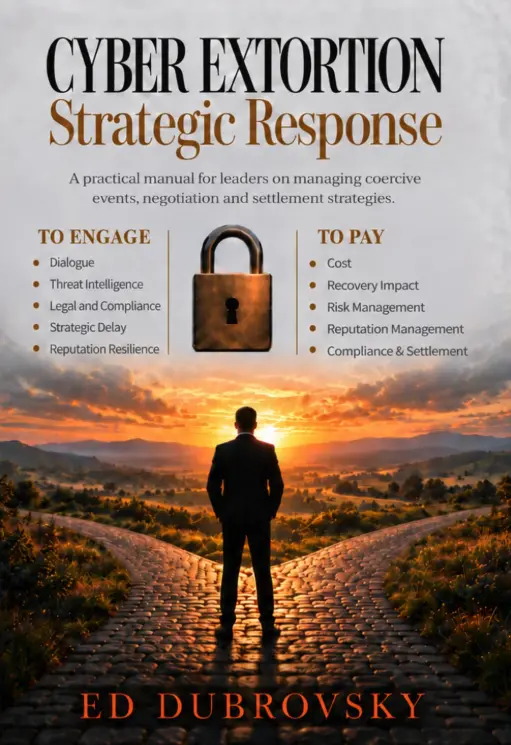
Beyond his executive roles within the Canadian cybersecurity sector, Dubrovsky is also known within the industry as an author. His LinkedIn profile highlights that he wrote a 252-page book titled Cyber Extortion Strategic Response, which is marketed as a guide to help organizations navigate the complex decisions required during and after a ransomware incident. Promotional material for the book emphasizes a strategic distinction often discussed among incident responders: that communicating with cybercriminals is not synonymous with negotiating a payment, and that entering into dialogue does not mean an organization has committed to paying a ransom. The text suggests that engagement can serve alternative tactical objectives, such as validating attacker claims, gathering intelligence, buying valuable time, and preserving options while corporate leadership evaluates its next steps.
At the time of his detention, Dubrovsky could not be reached immediately for comment, and representatives from CyberSteward did not immediately respond to inquiries. Available court records indicate that he has not yet retained private legal counsel, and the court has yet to formally appoint a public defender to represent him.

The ShinyHunters hacking collective has established a formidable reputation in the cybercrime underground by employing sophisticated phishing campaigns and stolen credentials to siphon massive volumes of corporate data from software-as-a-service providers. Once the data is secured, the group typically threatens to leak or publish the stolen files publicly unless lucrative ransom demands are met. According to estimates provided by federal law enforcement, the group has successfully extorted upwards of $70 million from corporate and institutional victims over the course of the year.
The arrest of the cybersecurity executive is part of a broader, rapidly accelerating law enforcement offensive against the hacking group. Investigators have spent recent weeks poring over digital devices and hardware seized last month when Dutch law enforcement authorities arrested Pepijn van der Stap, a reformed hacker linked to the ShinyHunters operation. Sources indicate that these seizures have yielded a wealth of operational data, and federal authorities anticipate filing additional criminal charges against principals at other firms that specialize in ransomware negotiation and incident response.
The pressure on the hacking group has been intensifying amid an escalation of bold cyberattacks. Immediately following the apprehension of Van der Stap, another prominent member of ShinyHunters who operates under the alias "Rey" assumed de facto control of the group. In a brazen display of defiance, Rey began taunting federal investigators online regarding a significant data breach that compromised the FBI’s online recruitment portal. That stolen cache of information reportedly contained sensitive details regarding prospective applicants, including their specific operational units, professional specializations, and confidential medical and psychiatric records.
International law enforcement agencies quickly mobilized to identify and locate the individual behind the moniker. Reuters reported that the suspect using the handle Rey—subsequently identified as a teenager named Saif Al-din Khader—had been detained by authorities and was actively cooperating with federal investigators. The apprehension of Khader occurred as the cybercrime syndicate attempted to carry out an extortion scheme against a digital aviation and navigation unit that had been spun off from Boeing in late 2025.
As federal authorities continue to examine seized evidence, coordinate international arrests, and unravel the network of facilitators supporting modern cyber extortion rings, the case remains fluid. Federal prosecutors in Texas are expected to release further details as the legal proceedings against Dubrovsky and other associated figures unfold in the coming weeks.