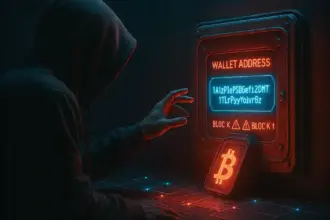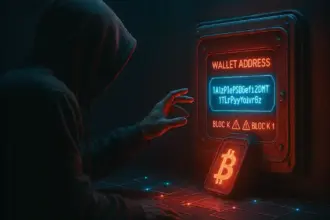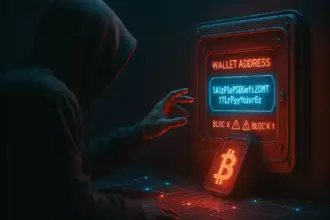
Cryptocurrency security analysts at BitMEX Research have issued an urgent warning to the digital asset community regarding an emerging and sophisticated scam scheme targeting early Bitcoin holders. The malicious campaign specifically focuses on dormant digital asset addresses dating back to the foundational years of the network, particularly those originating around 2011.
According to the intelligence gathered by BitMEX Research, the perpetrators behind this operation are attempting to exploit long-abandoned or inactive blockchain addresses. They achieve this by injecting false, fraudulent transactions and highly misleading messages directly onto the blockchain ledger via OP_Return outputs. This mechanism serves as an optional, specialized field within Bitcoin transactions capable of carrying arbitrary strings of data, which the bad actors are weaponizing to deliver their deceptive directives to anyone monitoring the public ledger.
In one of the most prominent and concerning cases documented by researchers, the scammers set their sights on the legendary and heavily monitored "1Feex" wallet. This particular address holds approximately 80,000 Bitcoin, a staggering sum that is widely believed to have been originally stolen during the catastrophic security breach of the Mt. Gox exchange years ago. Leveraging this famous dormant address, the attackers crafted a malicious on-chain message designed to lure unsuspecting individuals or historical stakeholders to an elaborate, fraudulent web portal.
This fake website is meticulously designed to impersonate Salomon Brothers, a prominent historical Wall Street firm that has long since ceased operations in its original capacity. By wrapping their scheme in the legacy branding of a well-known financial institution, the fraudsters attempt to establish a veneer of corporate and legal legitimacy that might catch an unsuspecting or aging early adopter off guard.
Fake Legal Claims and Coercive Deadlines
Upon visiting the fraudulent web domain, visitors are immediately confronted with a fabricated legal notice. The site falsely claims that the targeted wallet has been officially classified as "lost or abandoned" under financial regulations. To fabricate an air of urgency and pressure potential victims into action, the portal invites supposed rightful owners or associated parties to step forward and prove their claim.
The fraudulent instructions demand that victims either sign a cryptographic on-chain message using the underlying private key of the wallet or submit sensitive personal documentation through an online contact form hosted on the site. To maximize psychological pressure, the fake legal notice introduces a strict deadline, warning that if no valid claim or response is received by October 5, the wallet will be permanently deemed legally abandoned and forfeited.

BitMEX Research has strongly cautioned that the website and its associated entities bear no credible or legitimate connection whatsoever to the real Salomon Brothers organization or its former corporate leadership. While a cursory glance at the fraudulent platform reveals a list of real individuals who genuinely worked at the historic Wall Street firm during the 1980s, investigators confirmed that none of these former professionals have any association with this new and spurious entity.
Instead, security analysts noted that the operational structure and tactics of the campaign bear striking similarities to previous contentious episodes. Observers pointed out that the approach is reminiscent of earlier, controversial campaigns associated with figures such as Calvin Ayre, who previously funded legal actions centered around the exact same Bitcoin address. However, this current iteration strips away even the pretense of standard legal proceedings, replacing them with a blatant phishing and social engineering trap.
Community Warning and the Rising Tide of Crypto Fraud
As news of the advisory spread across social media and developer forums, cryptocurrency community members quickly weighed in with their own technical assessments. Observers pointed out that under normal circumstances, a legitimate wallet owner wishing to prove activity or retain control over a dormant address would simply need to move a negligible amount of Bitcoin to establish recent activity, rather than attempting to transfer a full balance or surrender private keys and personal data to an unknown entity.
This glaring discrepancy has led widespread segments of the digital asset community to suspect that the campaign is merely one piece of a much larger, increasingly aggressive social engineering scheme. The broader objective appears to be the systematic harvesting of sensitive personal information, cryptographic credentials, and private keys under the guise of fake legal compliance. BitMEX reiterated its firm warning that users, historical holders, and asset custodians should under no circumstances interact with the contact form, follow the verification prompts, or provide any personal details to the malicious platform.
The emergence of these specialized social engineering and blockchain-injected scams highlights the growing sophistication and complexity of modern cryptocurrency-related fraud. As malicious actors continue to innovate new ways to exploit the intersection of legacy finance terminology and blockchain transparency, security risks across the ecosystem remain exceptionally high.
Data from the broader cybersecurity sector underscores this escalating threat landscape. During the first half of the year, hackers and fraudulent actors successfully stole over $2.1 billion across 75 separate security incidents. This staggering figure represents a concerning 10% increase in total stolen funds compared to the exact same period in the previous year, demonstrating that digital asset security, user vigilance, and on-chain awareness remain more critical than ever for participants across the cryptocurrency economy.