Cryptocurrency security analysts have raised urgent alarms across the digital asset community regarding a sophisticated and deceptive new scam campaign targeting early Bitcoin holders, with a particular focus on dormant wallets dating back to the pioneering days of 2011. The scheme represents a calculated evolution in social engineering tactics, weaponizing blockchain mechanics and fabricated legal pressures to extract sensitive information and private keys from unsuspecting long-term investors.
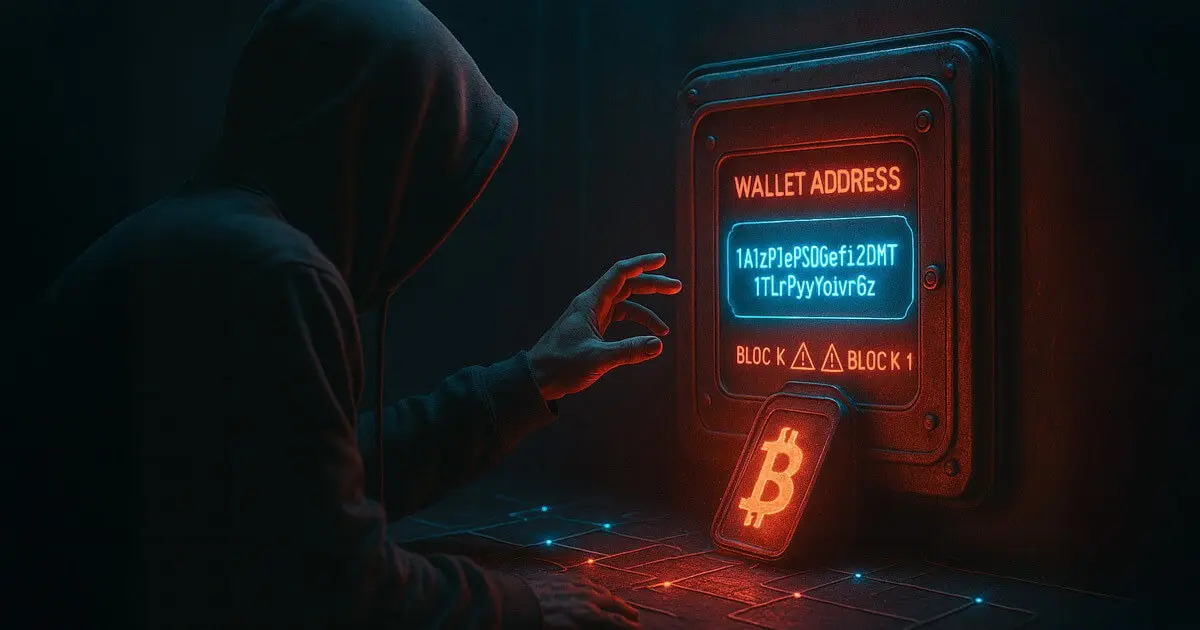
According to researchers at BitMEX Research, the fraudulent operation exploits ancient, long-dormant addresses by injecting fabricated transactions and misleading, deceptive messages directly onto the blockchain. Attackers accomplish this by utilizing OP_Return outputs, an optional field within Bitcoin transactions specifically designed to carry arbitrary data. By embedding malicious text and transaction identifiers into these fields, the perpetrators attempt to establish direct contact with historical wallet owners who may have ignored their holdings for over a decade.
In one prominent and well-documented case highlighted by the research firm, the scammers targeted the infamous “1Feex” wallet. This heavily monitored address holds approximately 80,000 Bitcoin, which industry analysts widely believe was stolen during the catastrophic 2011 hack of the defunct Mt. Gox exchange. The attackers meticulously crafted an on-chain message linked to this specific address, directing any observers or potential claimants to a professional-looking, yet entirely fraudulent, website that brazenly impersonates the long-defunct Wall Street investment banking firm Salomon Brothers.
Upon visiting the fraudulent portal, targeted individuals are confronted with an alarming fake legal notice. The site asserts that the dormant wallet in question is legally classified as "lost or abandoned." To manufacture a sense of urgency and false legitimacy, the platform invites purported owners to step forward and prove their rightful claim. Victims are instructed to either sign an on-chain cryptographic message utilizing their private key or submit detailed personal identification documentation through a web-based contact form hosted on the domain. The notice explicitly warns that if no valid ownership claim is formally acknowledged or submitted by October 5, the wallet will face permanent legal forfeiture under fabricated statutory provisions.
Fake Legal Claims and Fabricated Advisory Boards
Security analysts at BitMEX have thoroughly debunked the claims made on the fraudulent portal, confirming that the website exhibits zero credible connection to the real Salomon Brothers or its historical leadership structure. While the fraudulent operators attempted to construct a facade of authenticity by displaying a comprehensive list of genuine individuals who historically worked at the investment bank during the 1980s, investigators confirmed that none of these former professionals maintain any association with the spurious, newly established entity behind the scam.

The investigative platform noted that the overarching strategy bears a striking methodological resemblance to previous, highly controversial campaigns associated with public figures such as Calvin Ayre, who previously financed various legal maneuvers and disputes involving the exact same Bitcoin address. However, this iteration shifts away from conventional litigation theater toward direct, phishing-style social engineering aimed at extracting critical cryptographic credentials from the public eye.
Community members, developers, and blockchain forensics experts have actively weighed in on the unfolding situation. Many observers have pointed out glaring operational inconsistencies in the scammers’ narrative, noting that a legitimate, real-world wallet owner attempting to prove active control or existence would simply execute a minor, low-risk transaction by moving a tiny fraction of Bitcoin to demonstrate ongoing activity. The cumbersome requirement to interact with an unverified web contact form or sign arbitrary cryptographic challenges for unknown third parties immediately signals a malicious intent to harvest private keys.
This glaring discrepancy has led widespread segments of the cryptocurrency community to conclude that the campaign functions primarily as a targeted social engineering operation designed to fleece elderly, apathetic, or distracted early adopters under the guise of pseudo-legal authority. BitMEX Research has issued a stern advisory warning all digital asset holders to completely ignore these blockchain-injected messages, strictly avoid interacting with the contact forms, and under no circumstances disclose personal data or private keys.
The Escalating Threat Landscape of Crypto Fraud
The emergence of these inventive, blockchain-injected legal notices underscores the rapidly growing complexity and sophistication of crypto-related fraud and cybercrime. As blockchain analysis tools become more advanced, perpetrators are increasingly forced to move beyond simple wallet-draining malware and pivot toward psychological manipulation, exploiting the legal ambiguities and historical baggage surrounding ancient, high-value cryptocurrency addresses.
This incident arrives amid a broader surge in illicit activities across the broader digital asset economy. During the first half of 2025 alone, malicious actors, criminal syndicates, and state-backed hacking collectives successfully stole over $2.1 billion across 75 distinct security incidents and exploitation vectors. This alarming figure represents a roughly 10% increase in total stolen capital compared to the corresponding period in 2024, demonstrating that the financial stakes for security awareness have never been higher for both institutional entities and individual holders alike.