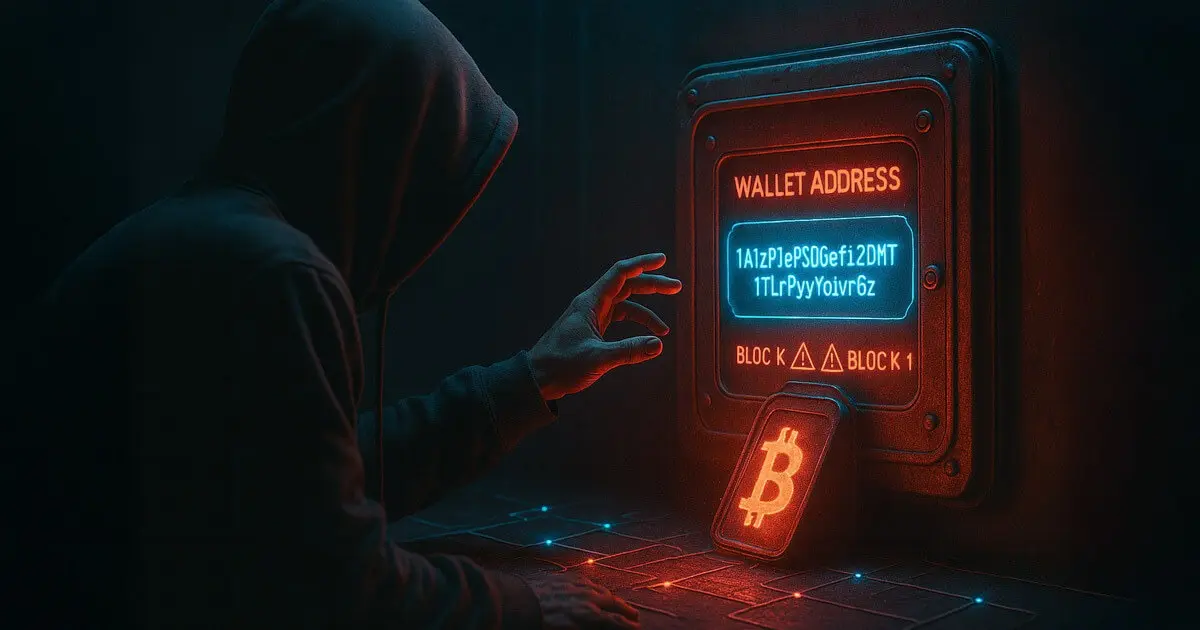
Analysts at BitMEX Research have raised the alarm about an evolving and increasingly sophisticated scam targeting early Bitcoin holders, particularly those possessing dormant wallets dating back to the cryptocurrency’s formative years in 2011.
According to the research firm, the malicious campaign exploits long-inactive blockchain addresses by injecting deceptive transactions and misleading messages directly into the ledger. Attackers are utilizing OP_RETURN outputs—an optional field within Bitcoin transactions capable of carrying arbitrary data—to broadcast their fraudulent narratives directly to anyone monitoring the blockchain.
In one prominent and well-documented case uncovered by security analysts, the perpetrators trained their sights on the infamous "1Feex" wallet. This heavily monitored address currently holds approximately 80,000 Bitcoin that are widely believed to have been stolen during the catastrophic 2011 hack of the Mt. Gox exchange.
The attackers crafted a specialized transaction containing a hardcoded message that directs curious blockchain observers or potential victims to a fraudulent, newly minted website designed to impersonate the defunct, historical Wall Street firm Salomon Brothers.
Fake Legal Claims and Coercive Deadlines
Upon visiting the fraudulent portal, users are greeted with a fabricated legal notice proclaiming that the targeted wallet is legally considered "lost or abandoned." The site employs high-pressure tactics, inviting supposed rightful owners to step forward and prove their claim to the immense fortune. To substantiate ownership, the portal instructs visitors to either sign an on-chain message using the private key associated with the address or submit sensitive personal documentation through an unverified web contact form.
Adding an air of manufactured urgency, the fake legal notice dictates that if no response or claim is registered by October 5, the wallet will officially be deemed legally abandoned under bogus statutory guidelines, opening the door for the scammers to siphon or manipulate the assets.
BitMEX Research thoroughly investigated the claims made on the website and confirmed that the platform bears zero credible connection to the real Salomon Brothers or its historic legacy leadership. While the fraudulent site attempts to build a facade of legitimacy by displaying a public list of real individuals who genuinely worked at the esteemed investment firm during the 1980s, none of those former professionals have any association with this new and spurious entity.

Security researchers noted that the strategic approach deployed in this campaign bears a striking resemblance to previous controversies. Observers pointed out parallels to earlier schemes associated with polarizing figures such as Calvin Ayre, who previously funded legal actions and public campaigns concerning this exact same historical Bitcoin address.
In a public advisory statement regarding the operation, BitMEX Research stated that the connections claimed by the website are entirely fabricated. The firm highlighted the illusion of authority constructed by the perpetrators, noting that the advisory board page listing genuine former Salomon Brothers employees is merely a deceptive tool designed to lower the guard of unsuspecting targets.
Social Engineering and the Broader Threat Landscape
As news of the campaign spread across cryptographic circles, community members and security experts weighed in on the technical mechanics of the attack. Industry analysts pointed out a glaring logical flaw in the scammers’ premise: a legitimate wallet owner wishing to prove activity or reclaim an address would simply need to move a negligible amount of Bitcoin to establish control, rather than risking the transfer of a full balance or exposing private keys through a suspicious web interface.
This glaring discrepancy has led many cybersecurity professionals and on-chain investigators to suspect that the entire campaign is not actually about recovering lost funds, but rather serves as a wider social engineering venture. The primary objective appears to be harvesting sensitive personal information, credentials, or private keys under the false pretext of a formal legal proceeding.
In light of these findings, BitMEX has issued a stern warning to the digital asset community, emphasizing that users and wallet administrators should under no circumstances interact with the contact forms, submit personal details, or attempt to sign messages on unverified external websites.
The emergence of these specialized, highly targeted social engineering schemes highlights the growing complexity and persistent ingenuity of crypto-related fraud. Malicious actors continue to shift away from simple phishing links toward contextual, historically aware attacks that leverage deep knowledge of cryptocurrency history and blockchain architecture.
Data from the broader blockchain security sector underscores the escalating financial stakes involved in these digital threats. During the first half of the year, malicious actors and hackers successfully stole over $2.1 billion across 75 separate security incidents, representing a notable 10% increase in stolen funds compared to the same tracking period from the previous year. As digital asset values remain high and historical wallets sit dormant, security analysts expect malicious actors to continue developing sophisticated, context-aware traps to ensnare unsuspecting long-term holders.