Decentralized liquidity protocol THORChain is navigating the aftermath of a major security breach that resulted in the theft of approximately $10.7 million from one of its core vaults. The incident, which first came to light after being flagged by blockchain investigator ZachXBT, has prompted a series of rapid network responses, ongoing community governance votes, and a broader industry debate regarding the cryptographic standards that secure cross-chain protocols.
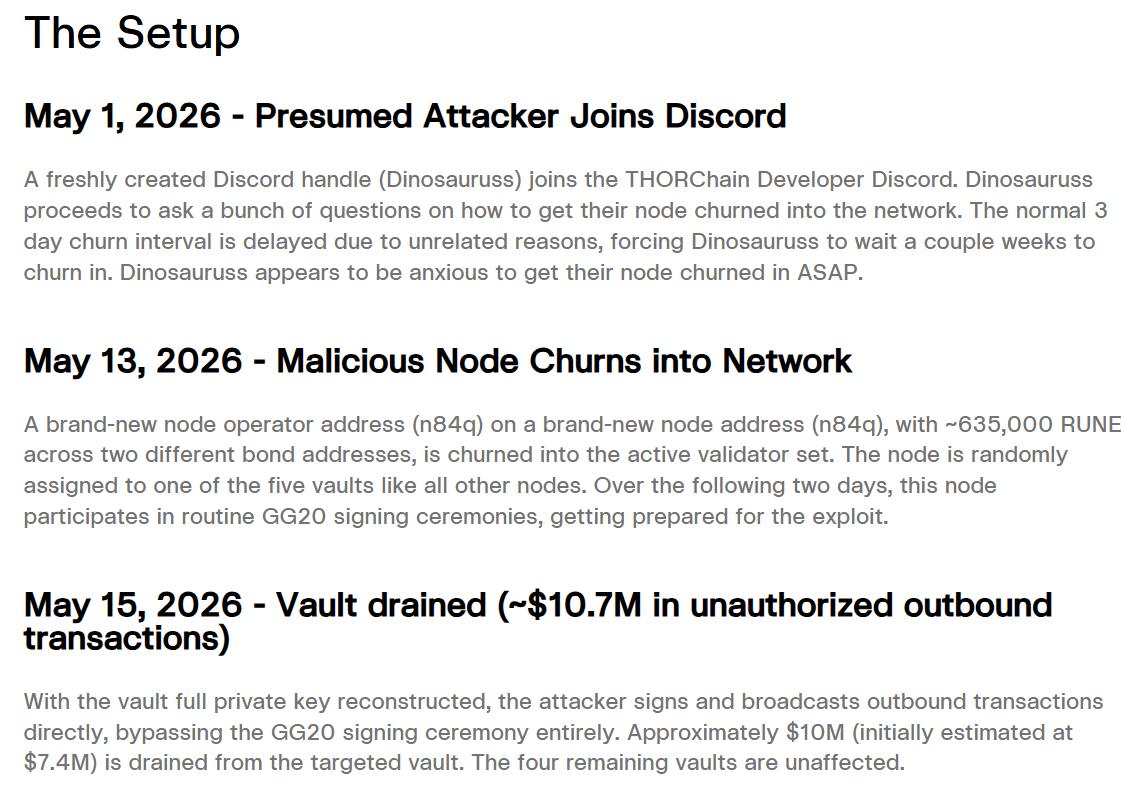
According to an official post-mortem report released by THORChain on Wednesday, the exploit was carried out by a malicious node operator who successfully weaponized a vulnerability within the protocol’s GG20 threshold signature scheme (TSS). The GG20 framework is a critical security architecture designed to safeguard THORChain vaults by distributing key control across multiple independent node operators. Under normal operating conditions, this decentralized mechanism ensures that no single entity or node holds the complete private key, thereby mitigating the risk of unilateral compromise.
However, the protocol disclosed that the vulnerability enabled the malicious operator to progressively extract fragments of key material across multiple signing sessions. This phenomenon, referred to in the post-mortem as "progressive key material leakage," ultimately allowed the attacker to reconstruct a full, functional private key for a targeted vault.
Despite the sophistication of the attack, THORChain’s automated defense mechanisms demonstrated resilience. The protocol reported that its automatic solvency checks were triggered within minutes of the unauthorized activity. These safeguards immediately halted signing and trading operations across multiple supported blockchain networks without requiring manual intervention from developers.
Building upon the automated shutdown, node operators rapidly coordinated via Discord to execute a full network halt within two hours of the initial detection. Following the freeze, the core development team deployed a targeted patch designed to address the specific vector exploited in the GG20 framework. The post-mortem analysis underscored that these swift safety measures successfully prevented the exploiter from draining additional vaults or expanding the scope of the theft.
The breach arrives amid a troubling resurgence in illicit activity within the decentralized finance (DeFi) sector. Market tracking data from DefiLlama indicates that crypto exploits collectively stole more than $634 million in April alone, underscoring persistent systemic vulnerabilities across various blockchain architectures and bridging protocols.
THORChain Weighs Recovery Path Without RUNE Sales
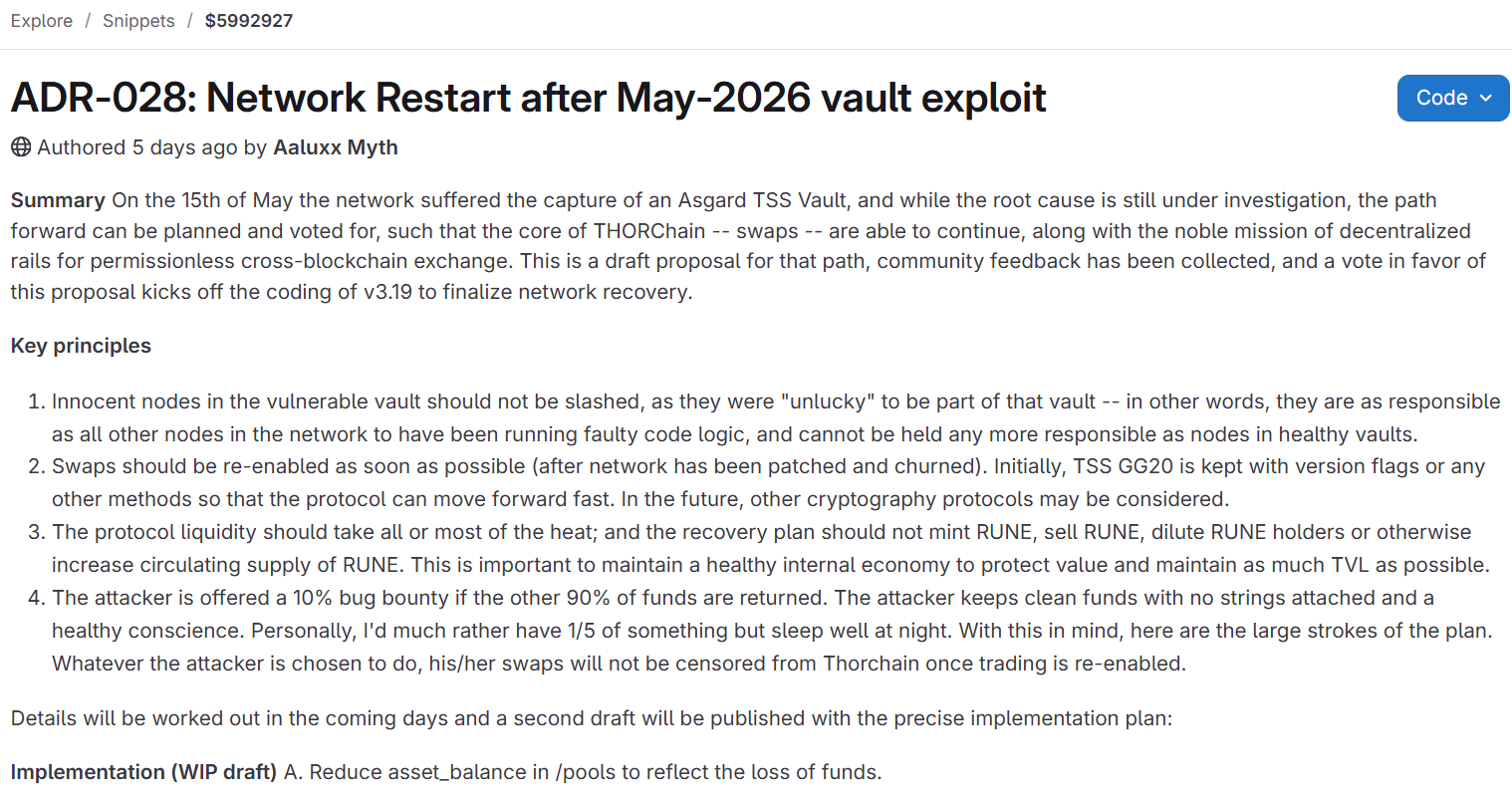
As the network works to stabilize, THORChain announced that its post-exploit recovery path will be determined entirely by community consensus. To formalize this process, the protocol published governance proposal ADR-028, with active voting currently underway among qualified node operators.
The proposed recovery framework outlines a strategy designed to absorb the financial losses without resorting to the direct minting or open-market selling of THORChain’s native RUNE token. Under ADR-028, the protocol intends to cover the deficit initially by utilizing existing protocol-owned liquidity, while distributing any remaining uncovered balance across synthetic asset holders. To restore the depleted protocol-owned liquidity over time, a designated portion of ongoing protocol income will be automatically redirected to treasury replenishment.
In tandem with the governance proposal, THORChain introduced a recovery bounty aimed at incentivizing the return of the stolen funds. The protocol also confirmed that it would immediately slash the stake of the malicious node operator responsible for the breach. Meanwhile, innocent nodes that happened to be assigned to the same compromised vault alongside the exploiter will be shielded from financial penalties.
ADR-028 proposes maintaining the GG20 threshold signature framework, albeit in a thoroughly patched and upgraded iteration, with cross-chain trading slated to resume only after the vulnerability has been definitively neutralized.
Addressing the decision to stick with the existing standard, THORChain co-founder Chad Barraford explained that migrating to an entirely new cryptographic architecture carries its own set of unverified risks. "We are staying with GG20 for now, because if we move to another standard, it could have vulnerabilities too," Barraford told Cointelegraph. He added that while transitioning to an alternative framework like DKLS was already on the project’s development roadmap for the year, it had previously been deprioritized. "It was pushed out due to other priorities. But obviously now we are taking a closer look at it (and others)," he noted.
The decision to retain a patched version of GG20 has elicited mixed reactions from independent security researchers and crypto market observers. Pseudonymous industry analyst Bird commented that the initial vulnerability points toward an underlying flaw in randomness generation or local signing isolation within the GG20 stack. However, Bird commended THORChain’s automated safeguard systems for effectively containing the blast radius of the attack.
Other industry participants adopted a more skeptical stance regarding the long-term viability of the GG20 framework. Writing on the social media platform X, crypto investor JP expressed reservations about the architecture’s foundational security assumptions. "My mental model is that GG20 has many brittle assumptions. You can keep patching it, but it will forever be a bit of a black box," JP wrote.
In the wake of the exploit and subsequent network suspension, market sentiment surrounding THORChain’s native asset experienced notable downward pressure. CoinMarketCap data shows that the price of the RUNE token dropped by roughly 15.5% over the course of the week following the security breach. However, market activity exhibited signs of stabilization as RUNE staged a 4% recovery in the 24 hours leading up to Friday morning.