-Line Inflation Data
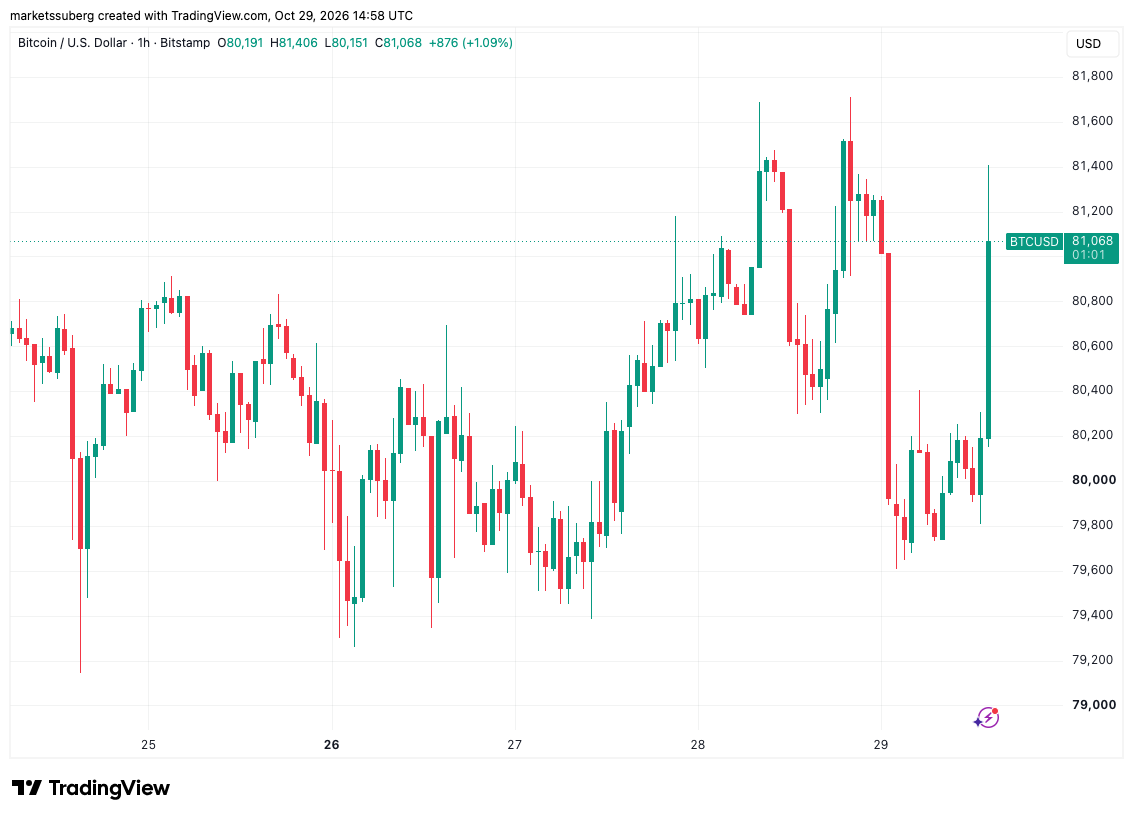
Bitcoin (BTC) staged a notable recovery above the $81,000 threshold following Thursday’s opening bell on Wall Street. The upward price action came as fresh macroeconomic data underscored the resilience of the United States economy, highlighted by stronger-than-expected Gross Domestic Product (GDP) growth and inflation metrics that aligned closely with Wall Street estimates. Despite broader macroeconomic turbulence, including a sharp downturn in big tech stocks triggered by an Alphabet earnings miss, the leading cryptocurrency managed to shake off immediate downside pressure and resume its upward trajectory on lower time frames.
Bitcoin Brushes Off Alphabet Earnings Miss
Data pulled from TradingView on Bitstamp captured the swift rebound in the BTC/USD trading pair, which climbed as high as $81,547. This recovery followed a brief mid-week dip that saw prices slide to a low of $79,607 in the wake of Wednesday’s daily market close. The resilience displayed by digital assets was particularly striking given the gloomy sentiment washing over traditional equities during the same trading session.

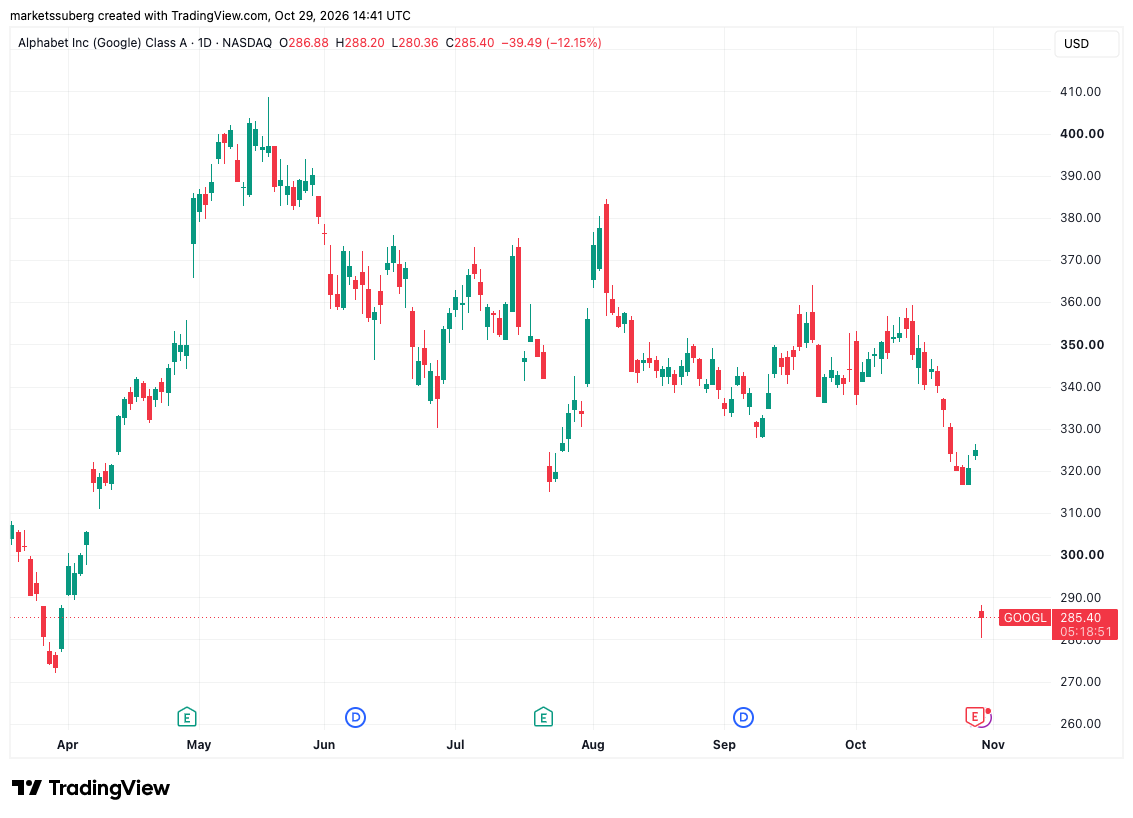
US stock markets opened lower on Thursday, weighed down heavily by a steep 12% drop in shares of tech giant Alphabet. The company suffered a sharp correction following disappointing third-quarter revenue figures and an earnings miss that caught many traditional investors off guard. Yet, rather than moving in lockstep with the sudden sell-off in risk-on tech equities, Bitcoin decoupled momentarily to carve out a recovery path of its own.
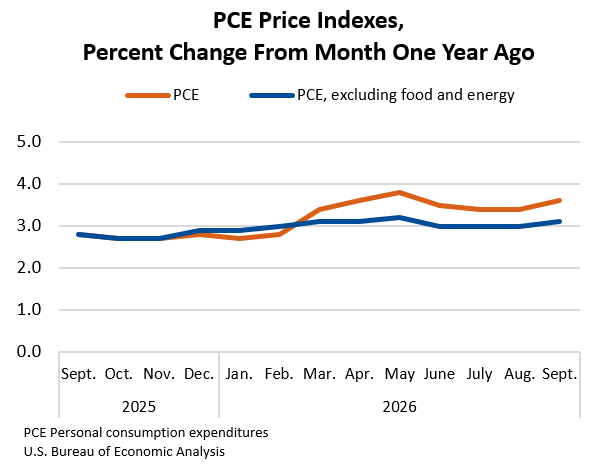
Underpinning the broader financial narrative was the release of the September Personal Consumption Expenditures (PCE) index. Widely regarded as the Federal Reserve’s preferred gauge of consumer inflation, the index recorded an increase of 0.5% compared to the previous month, translating to a 3.6% rise on a year-on-year basis.
An official release from the Bureau of Economic Analysis (BEA) provided further granularity into the consumer price environment, noting that the core metric—which strips out volatile food and energy costs—advanced by 3.1% over the preceding twelve months. These figures matched market consensus expectations, preventing any major panic among institutional traders who had been bracing for a potential upside inflation surprise.
Simultaneously, the final estimate for third-quarter GDP expansion printed at 3.4%, comfortably beating the median market expectations of 3.2%. Weighing in on the robust economic data during an interview with CNBC, Fwdbonds chief economist Chris Rupkey pointed out that the domestic economy continues to power ahead against significant headwinds. Rupkey emphasized that economic momentum has remained remarkably strong despite persistent geopolitical uncertainties and the severe financial damage inflicted on multiple industrial sectors by elevated energy costs.
Reflecting on the broader trajectory of the domestic economy, Rupkey noted that while economic growth had frequently been written off during earlier periods of the current political administration, real GDP has managed to bounce back above a 3% annualized run rate in the third quarter of 2026 for the first time in an entire year.
This economic strength was also acknowledged by the Federal Reserve. At the conclusion of the Federal Open Market Committee (FOMC) meeting, central bank officials opted to leave the benchmark interest rate unchanged in the 3.75% to 4% range, a decision that was fully anticipated by market participants. In an accompanying official statement, Fed Chair Kevin Warsh described overall economic activity as expanding at a robust pace, even while characterizing the broader inflation environment as remaining elevated.
Elaborating on the health of the broader economy, Warsh highlighted several underlying pillars of strength. He noted that while domestic uncertainty remains elevated due in part to ongoing geopolitical developments, domestic consumer and corporate spending has continued to demonstrate remarkable resilience. Furthermore, productivity growth remains strong, capital investment initiatives are robust, job gains have successfully kept pace with expansion in the labor workforce, and the national unemployment rate has remained relatively unchanged.
Analyst Sees $81,400 Reclaim as Key for Weekly Close
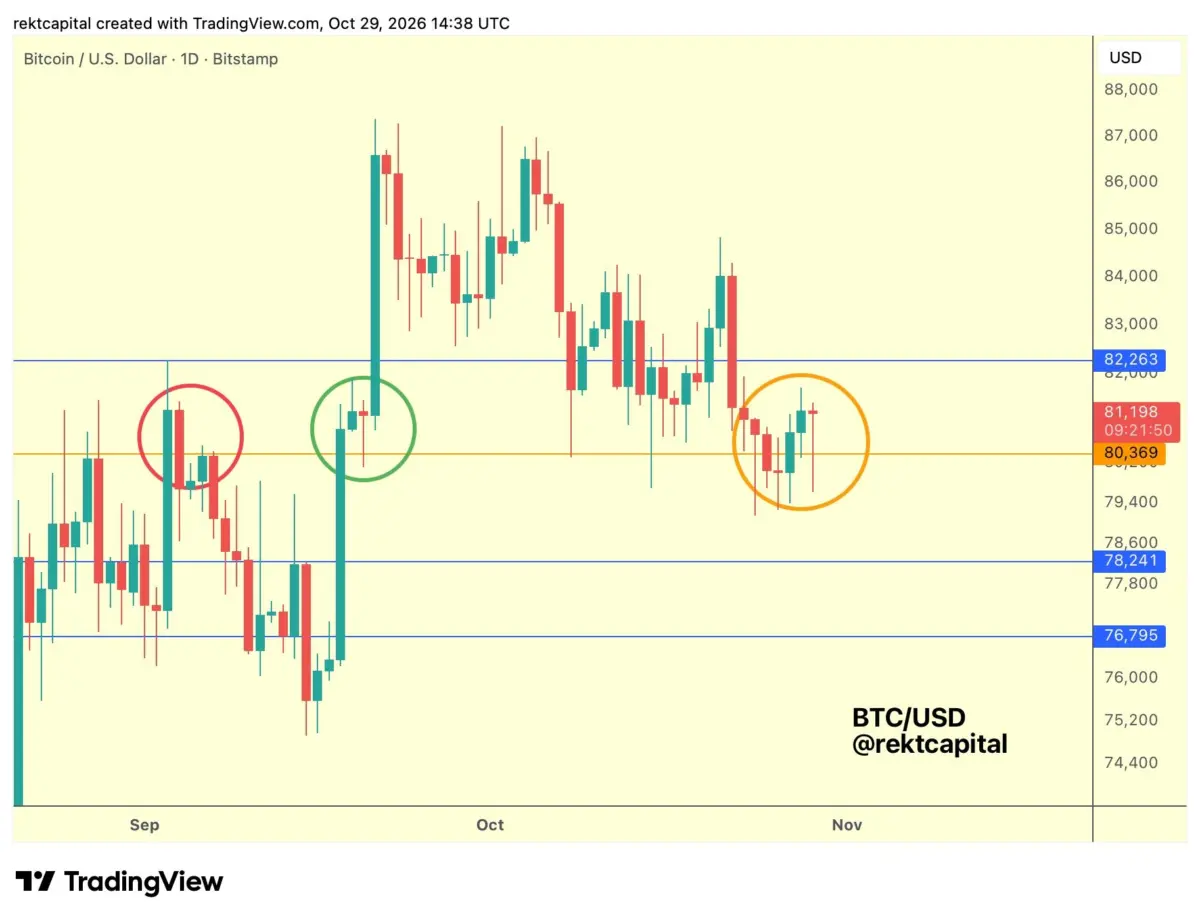
Despite the favorable macroeconomic backdrop, Bitcoin price action continued to grapple with near-term overhead resistance as traders evaluated low-time-frame market structures. Crypto trader and analyst Rekt Capital identified $81,400 as the immediate technical hurdle that market bulls must clear to secure sustainable upside momentum heading into the weekly candle close.
In his latest market assessment shared on social media platform X, Rekt Capital noted that Bitcoin has been experiencing a series of sharp zig-zags relative to crucial weekly price levels situated around $80,400 and $81,400. He cautioned that this erratic sideways chop is likely to persist as the market transitions toward the new weekly close.
For market participants, successfully reclaiming and holding the $81,400 level by the weekly close is viewed as a vital technical prerequisite for mitigating short-term selling pressure. Meanwhile, looking at the broader calendar perspective, the monthly close was tracking toward a modest 3.3% decline for the month of October. This performance stands in sharp contrast to historical seasonal trends; previous market data compiled by Cointelegraph indicates that the month of October has historically been one of the strongest historical performers for Bitcoin, yielding average returns of roughly 26% since 2010.