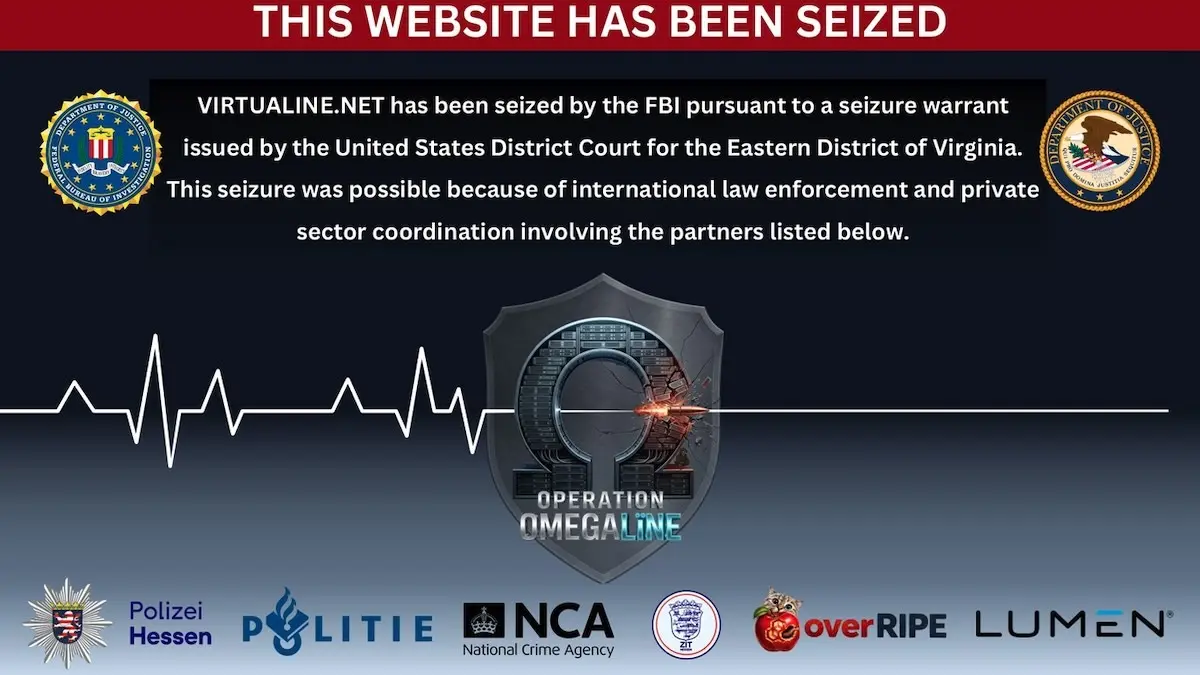
In a significant blow to the digital infrastructure supporting global cybercrime, the Federal Bureau of Investigation (FBI) has seized the domain virtualine.net. The site served as the primary gateway for a Russian-speaking "bulletproof" hosting provider known by various aliases, including Virtualine, Secury, Massgod, Spamhouse, Lanedo, and Omegatech. This operation marks a major escalation in the ongoing battle against specialized hosting services that explicitly market their immunity to legal intervention and law enforcement takedowns.
According to court documents released following the seizure, Virtualine had established itself as a critical sanctuary for a vast array of illicit digital activities. By providing a technical environment where abuse complaints were ignored as a matter of policy, the service became a preferred partner for cybercriminals looking to evade detection. The provider operated under a business model specifically designed to facilitate illegal enterprises, offering not just storage, but active assistance in navigating the scrutiny of international law enforcement agencies.
A Sanctuary for Cybercriminal Activity
The operational ethos of Virtualine was centered on providing a "bulletproof" environment—a term used in the cybersecurity industry to describe infrastructure providers that disregard abuse reports and actively protect their clients from takedown attempts. On various underground cybercrime forums, the operators of Virtualine were remarkably transparent about their services. They advertised support for a wide spectrum of criminal activities, ranging from large-scale phishing campaigns and spam operations to sophisticated credit card fraud, known as "carding."
Perhaps most significantly, the provider marketed its agility, boasting of its ability to seamlessly migrate customer services to unaffiliated infrastructure the moment a particular server or network segment came under pressure from authorities. This "fail-safe" architecture was a cornerstone of their value proposition, ensuring that even when a portion of their network was targeted, the underlying criminal operations could remain active and largely uninterrupted.
The nature of the content hosted on Virtualine’s infrastructure was particularly egregious. Beyond standard cybercrime, the provider allowed users to host and monetize explicit imagery and videos of both adults and minors. Furthermore, the platform supported high-level abuse, including "hack-for-hire" services. These services were specifically designed to facilitate the theft of sexually explicit content from private online accounts, which were then leveraged for extortion or illicit distribution. Despite repeated notifications and formal takedown requests from law enforcement agencies across multiple jurisdictions, Virtualine consistently refused to cooperate. In several documented instances, rather than removing the illicit content, the provider actively assisted the customer in migrating the material to a new website, effectively shielding the illegal activity from justice.
Tracing the Financial Flow of Illicit Hosting
The financial footprint of Virtualine has provided investigators with a clear view of its role within the criminal ecosystem. According to insights provided by the blockchain intelligence firm TRM Labs, the hosting provider was a major node for illicit cryptocurrency inflows. The data suggests that while Virtualine may not have handled the highest volume of total cryptocurrency compared to some of its industry peers, it occupied a unique position as a destination for highly illicit-attributed funds.
TRM Labs reported that Virtualine received more cryptocurrency linked to illicit activities than any other bulletproof hosting provider they have tracked. An analysis of the Bitcoin addresses associated with the service reveals a disturbing breakdown of its client base. A plurality of these payments—roughly 44%—originated from a prominent Russian drug marketplace. Another 17% of the funds were linked to a large-scale sextortion scheme, highlighting the provider’s role in facilitating predatory digital crimes. Cryptocurrency mixers, often used to obfuscate the source of stolen funds, accounted for 13% of the inflows, while ransomware operations contributed 5%.
The sophistication of their client base continued to evolve; by 2026, the provider was actively receiving payments from operators of the StealC infostealer, a notorious malware strain used to harvest credentials and sensitive data from compromised machines.
Operational History and Industry Influence
Although the domain virtualine.net was officially seized this year, the entity’s roots in the underground economy run deeper. The service first gained public visibility on the prominent Russian-language cybercrime forum Exploit in 2024. However, in their marketing materials, the operators claimed to have been active since 2019, suggesting a long-standing, albeit quiet, presence in the hosting sector. By 2025, Virtualine claimed to possess the largest collection of autonomous system numbers (ASNs) specifically dedicated to the hosting of malware and botnet command-and-control infrastructure, signaling their intent to dominate the technical backend of global cybercrime.
Despite the high-profile nature of the domain seizure, experts caution that this is not a final victory. TRM Labs noted that while a domain seizure effectively disrupts how customers discover and interact with a service, it does not necessarily mean the operator has ceased all activity. Furthermore, it does not guarantee that the underlying physical or virtual infrastructure has been completely dismantled. Sophisticated criminal hosting providers often maintain decentralized networks, and a domain loss is frequently treated by such entities as a temporary obstacle rather than a permanent closure.
The seizure of Virtualine represents a tactical victory for international law enforcement, aimed at degrading the reliability of the tools upon which cybercriminals depend. By dismantling the "front end" of the business, authorities complicate the ability of these criminal actors to find new targets and maintain their existing operations.
As the digital landscape becomes increasingly hostile to such services, the role of intelligence firms like TRM Labs in mapping these illicit financial networks has become indispensable. The investigation into Virtualine serves as a reminder that the cybercrime industry is not merely a collection of isolated hackers, but a structured ecosystem that relies on service providers to keep their operations online. The FBI’s action underscores a broader, global effort to target the infrastructure layer of cybercrime, moving beyond the arrest of individual actors to address the service providers that enable their continued survival.
The ongoing legal proceedings and technical analysis of the seized assets will likely provide further insights into the extent of Virtualine’s operations and potentially lead to further disruptions of the criminal networks that relied on its services to operate with impunity. For now, the loss of its primary domain creates a significant barrier to entry for new criminal clients and forces existing ones to navigate the volatile and risky waters of shifting their illicit operations to new, unproven hosting environments.