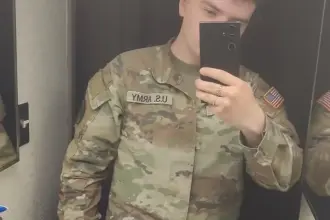
A teenager from Amman, Jordan, suspected of acting as a key leader for the prolific data theft and extortion syndicate known as ShinyHunters, has been detained by local authorities and is reportedly cooperating with the FBI to identify other members of the hacking collective.
According to reports, the suspect—who operates online under the hacker handle “Rey”—was apprehended while ShinyHunters was actively engaged in an extortion campaign targeting a business unit recently divested by the global aerospace giant Boeing. In a striking twist of digital geography, Boeing is the manufacturer of the aircraft fleet operated by Royal Jordanian Airlines, the employer of Rey’s father.
On October 3, Reuters cited three unnamed sources confirming that a suspected ShinyHunters member in Amman named Saif Al-din Khader had been detained by Jordanian law enforcement and was actively cooperating with federal investigators. KrebsOnSecurity had previously identified Rey as Khader in a November 2025 profile, during which the young man admitted to collaborating with multiple ransomware operations.
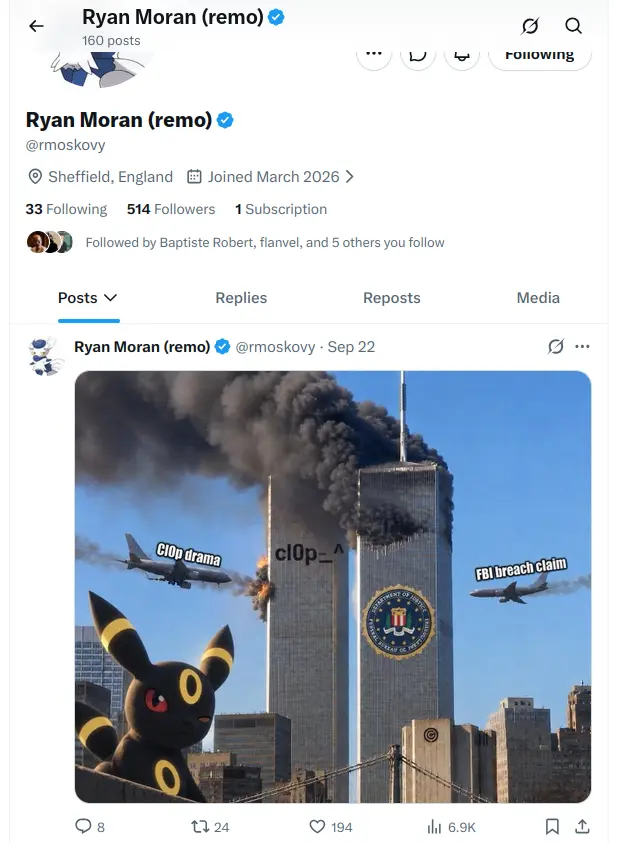
Rey’s name surfaced once more in a September 28 exclusive detailing the arrest of 24-year-old Dutch cybercriminal Pepijn van der Stap by Netherlands police on suspicion of aiding ShinyHunters’ data thefts and extortion schemes. Investigations revealed that immediately following Van der Stap’s arrest on the evening of September 15, Rey seized control of the ShinyHunters brand. He proceeded to publicly boast about infiltrating the FBI and extorting the Cl0p ransomware operation.
To taunt law enforcement and rival cybercriminals, Rey posted a series of memes to his long-standing Twitter/X account. These posts prominently featured images of the avatar once used by Van der Stap under his former hacker alias, “Umbreon,” in an apparent maneuver to frame the Dutch national for the high-profile hacks.

The underlying infrastructure breaches tied to this campaign leveraged a critical vulnerability, tracked as CVE-2026-35273, within PeopleSoft—a software-as-a-service platform developed by Oracle and widely utilized across enterprises for hiring, human resources, benefits, and payroll management. Oracle rapidly deployed a security patch after ShinyHunters began exploiting the vulnerability as a zero-day in June. Concurrently, cybersecurity firm Mandiant issued web application firewall (WAF) rules for organizations unable to apply the update immediately.
While initial attempts by ShinyHunters in June targeted the FBI’s own PeopleSoft database—an effort the group claimed was unsuccessful—the hackers later pivoted to a well-known URL-encoding technique to bypass Mandiant’s WAF defenses.
A threat intelligence report released on September 25 by Mandiant and the Google Threat Intelligence Group (GTIG) confirmed that ShinyHunters had mass-exploited the PeopleSoft vulnerability, compromising dozens of systems across higher education, technology, healthcare, agriculture, transportation, and government sectors. Further compounding the fallout, Reuters reported on October 5 that the FBI dismissed an Accenture contractor due to failures in patching the recruitment website compromised by the hackers, an incident that exposed sensitive personal and medical records of over 5,000 bureau personnel.
"Rey" Means King, As in Royal
Sources close to the ShinyHunters investigation revealed that among the victims targeted in the extortion scheme at the time of Rey’s arrest was a digital aviation and navigation unit recently divested by Boeing. The involvement of this former Boeing subsidiary added substantial urgency to the FBI’s investigation, given that the stolen data carried potential operational safety and security implications.
In statements provided to security researchers, Boeing acknowledged the extortion attempts involving data stolen from Jeppesen ForeFlight, a subsidiary that Boeing sold in November 2025 to private equity firm Thoma Bravo for $10.55 billion.

"We are aware of claims by a threat actor regarding data allegedly associated with Boeing and our former subsidiary Jeppesen ForeFlight," a Boeing spokesperson stated. "Estamos actively reviewing the matter with the Jeppesen ForeFlight team."
Representatives for Jeppesen ForeFlight maintained that their internal operations remained secure. "Based on our investigation to date into this claim and proactive security posture, there was no impact to our operations or products," the company said in a written statement.
Rey’s suspected role in targeting the former Boeing division drew heightened scrutiny because of evidence linking his father to Royal Jordanian Airlines, a carrier majority-controlled by the Jordanian government that relies heavily on Boeing widebody aircraft for its long-haul operations. Although Rey claimed on Telegram in early 2025 that his father worked as an airline pilot—a claim that could not be independently verified—password-stealing malware recovered from a shared family computer revealed login credentials belonging to his father used across various employee portals for the airline.
Royal Jordanian Airlines has not responded to requests for comment. Following outreach from researchers updating the suspect’s family on his activities, Rey rapidly deleted multiple social media accounts, including the Twitter/X profile used to taunt federal agents and rival criminal groups. Despite the purge, a GitHub-hosted cybersecurity blog authored by Rey remained online, featuring a lengthy post from March 2026 that doxxed two Russian men alleged to be the core developers and operators behind the Cl0p ransomware enterprise.
Murder for Hire Allegations in the Netherlands
Meanwhile, Dutch media outlets published explosive allegations concerning Pepijn van der Stap, whose narrative of personal rehabilitation following a prior conviction had previously gained traction in technology circles. According to a report by Dutch daily RTL on September 29, investigators suspect Van der Stap attempted to orchestrate at least two murders to be carried out abroad.

Van der Stap had recently completed the majority of a four-year prison sentence for data theft and extortion offenses that prosecutors estimated netted between 1.5 million and 2.7 million euros. Prior to his September 15 arrest, Van der Stap presented himself as a reformed figure, taking on a role as an "offensive security lead" at Dutch cybersecurity firm Neo Security.
Neo Security owner Benjamin Korper told reporters that an independent firm was retained to audit the company’s networks and determine whether Van der Stap had compromised internal or client systems. Investigators confirmed no evidence of malicious activity directed against the firm, though Dutch forensic teams conducted a high-profile raid on Van der Stap’s residence involving flash-bang grenades.
Before his initial 2023 arrest, Van der Stap worked as a software engineer at Amsterdam-based cybersecurity startup Hadrian and volunteered with the Dutch Institute for Vulnerability Disclosure (DIVD), even while engaged in systemic enterprise hacking operations. When questioned about the credibility of his rehabilitation, Van der Stap maintained that his remediation efforts should speak for themselves.
Franchising and Burning a Brand
Cybercriminals associated with the ShinyHunters moniker have been linked to dozens of major data breaches spanning billions of records since at least 2019. However, security analysts emphasize that the individuals currently operating under the banner do not comprise the original core members, most of whom are French citizens previously apprehended by law enforcement.
Instead, ShinyHunters has evolved into a criminal franchise model. Much like the literary concept of the Dread Pirate Roberts, succession within the group has been driven by arrests rather than death, allowing multiple individuals to adopt the mantle simultaneously. Investigators note that federal efforts are heavily focused on freelance affiliates who supply stolen credentials for corporate SaaS platforms in exchange for a percentage of subsequent ransom payments.

In the aftermath of Van der Stap’s arrest, chat channels on Telegram previously administered by Rey became sites of intense infighting and ridicule. Commentators mocked Rey for backing down from his public threats against the FBI and Cl0p, particularly after the primary ShinyHunters darknet portal went offline following an ultimatum from federal authorities.
Contributors to underground forums accused Rey of purchasing historical PGP keys associated with defunct groups to launch imitation BreachForums sites and Telegram channels, leveraging the legacy brand to extort companies and monetize stolen data repositories. A dedicated monitoring channel on Telegram, "The Battle," repeatedly targeted Rey and other affiliates, accusing the teenager of exploiting a notorious name to negotiate ransoms and secure a 25 to 30 percent cut of illicit proceeds.
In previous statements to industry media, representatives for the active iteration of ShinyHunters claimed their intrusion into the FBI’s systems was executed to counter public advisories issued by the agency warning victims against yielding to extortion demands. While the group argued the maneuver demonstrated technical prowess and served as a marketing initiative to counter law enforcement warnings, the public nature of the conflicts ultimately eroded their leverage and drew coordinated pressure from international investigators.