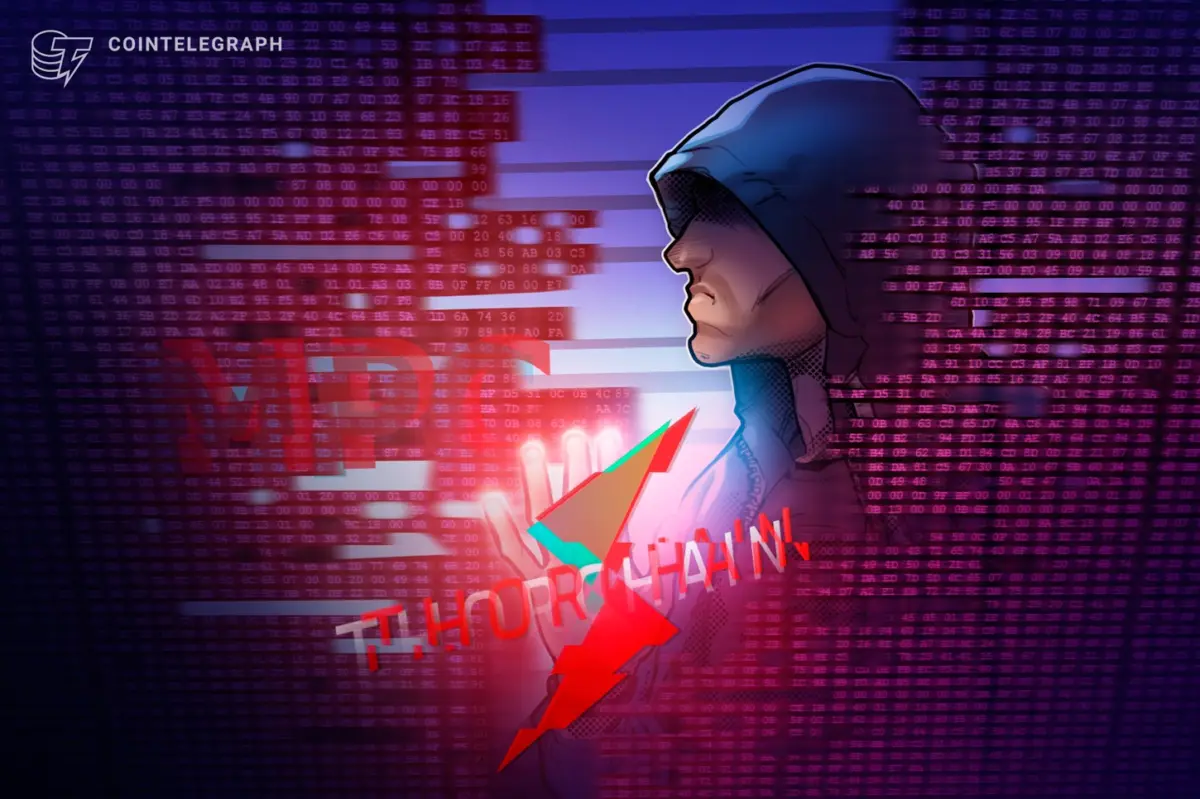
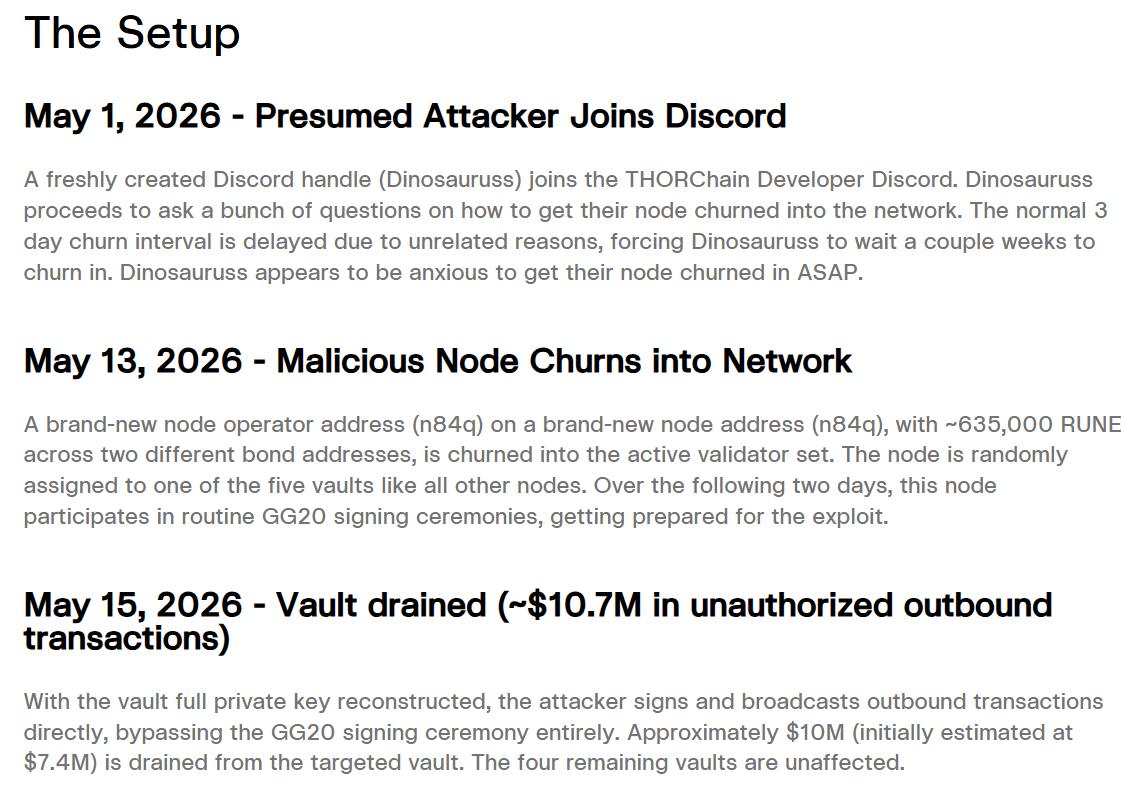
Decentralized liquidity protocol THORChain is navigating the aftermath of a security breach that saw approximately $10.7 million drained from one of its vaults. The incident, which unfolded last week, was executed by a malicious node operator who managed to exploit a vulnerability embedded within the protocol’s GG20 threshold signature scheme.
According to a detailed post-mortem report released by THORChain on Wednesday, the breach occurred because the underlying architecture allowed for "progressive key material leakage." This specific flaw enabled the malicious node operator to gradually piece together a full private key for a single vault. In a standard threshold signature scheme, key control is deliberately split across multiple independent node operators precisely to prevent any single entity from holding the entire private key, making compromises exceedingly difficult under normal operating conditions.
Despite the successful extraction of funds, the protocol’s automated defense mechanisms demonstrated a high level of resilience. THORChain reported that its automatic solvency checks triggered within minutes of the anomalous activity. Without requiring immediate human intervention, these automated safety measures successfully halted signing and trading activities across multiple integrated blockchains, effectively containing the breach and preventing the exploiter from draining additional capital from other vaults.
Node operators quickly mobilized and coordinated through Discord following the automated halts. Within two hours of the initial detection, the network was brought to a complete full halt as developers and operators deployed a targeted patch designed to address the vulnerability. The swift response validated the effectiveness of the protocol’s automated safeguards, a factor that prominent blockchain investigators and security analysts acknowledged in the wake of the event. The exploit first came to light publicly when noted on-chain investigator ZachXBT flagged suspicious movements totaling around $10 million, moments before THORChain officially announced the comprehensive trading and signing suspension.
The timing of the THORChain incident coincides with a broader uptick in security breaches across the decentralized finance sector. DefiLlama data indicates that crypto exploits stole more than $634 million in April alone, underscoring persistent vulnerabilities in cross-chain protocols, smart contracts, and cryptographic signature schemes.
THORChain Weighs Recovery Path Without RUNE Sales
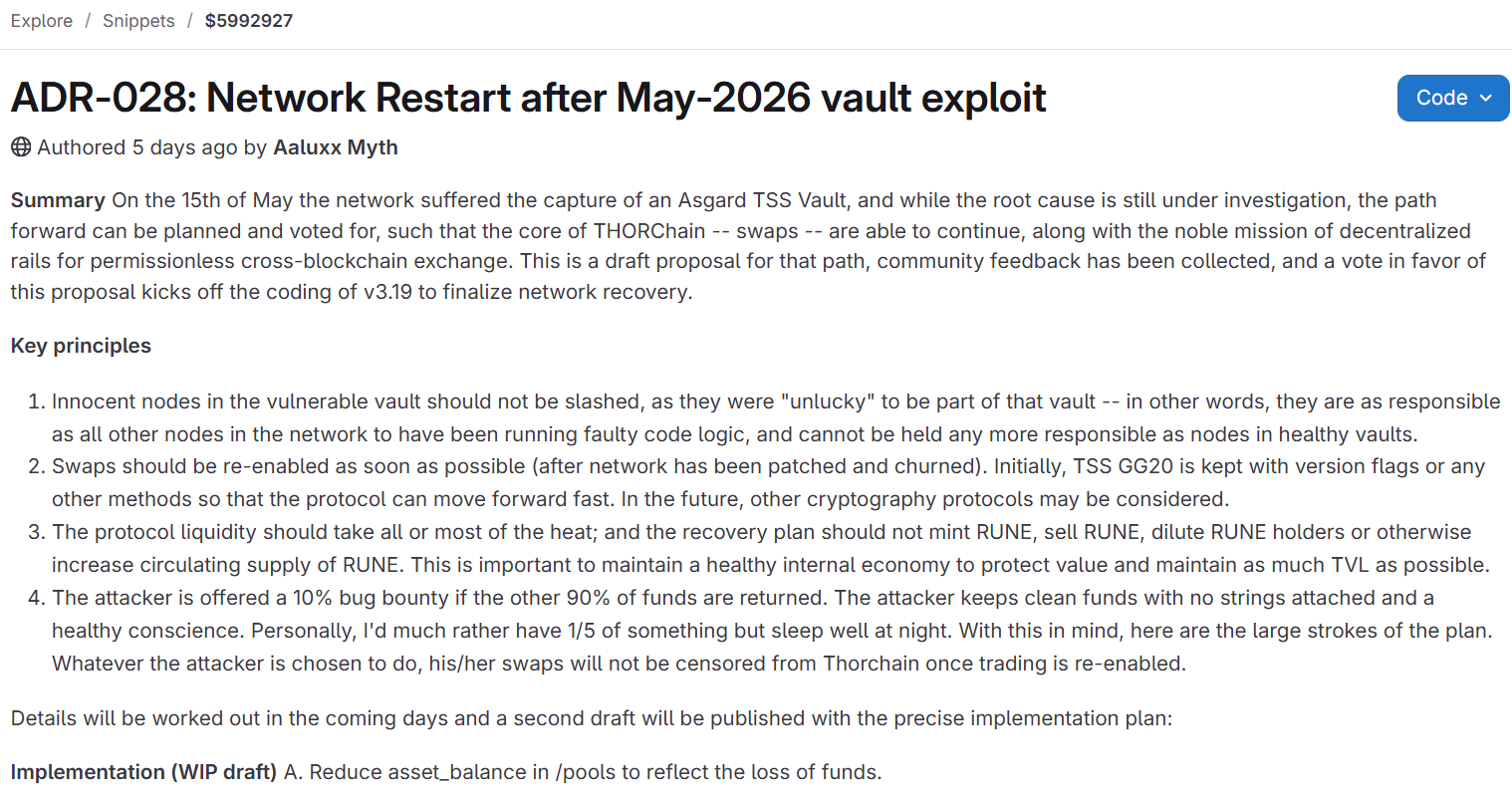
As the network looks toward restoration, THORChain announced that its post-exploit recovery path will be determined by community consensus through a formal governance proposal designated as ADR-028. Voting procedures for the proposal are currently open, allowing node operators to cast their votes on how the protocol should absorb and rectify the financial deficit.
Under the framework outlined in ADR-028, THORChain intends to absorb the financial losses primarily through its existing protocol-owned liquidity, distributing any remaining shortfall across synth holders. While this approach will temporarily deplete the protocol-owned liquidity reserves, the plan involves redirecting a specific portion of ongoing protocol income to replenish those reserves gradually over time. Crucially, the proposed recovery mechanism aims to achieve this without resorting to the minting or open-market selling of THORChain’s native RUNE tokens, thereby shielding token holders from artificial dilution and downward price pressure.
Alongside the governance proposal, THORChain introduced a recovery bounty aimed at incentivizing the return of the stolen funds. The protocol also confirmed that it will definitively slash the malicious node operator responsible for the breach, while taking technical measures to protect innocent nodes that happened to be assigned to the same vault as the exploiter during the incident.
Addressing the long-term architectural security of the network, the ADR-028 proposal outlines plans to maintain the existing GG20 threshold signature scheme, albeit in a thoroughly patched and upgraded iteration. THORChain has maintained that trading across the network will only resume once the vulnerability has been completely resolved and thoroughly tested.
The decision to retain the GG20 framework rather than immediately migrating to an entirely different cryptographic standard has sparked varied reactions throughout the cryptocurrency industry. Chad Barraford, co-founder of THORChain, explained the reasoning behind the decision in comments to Cointelegraph, stating that sticking with the familiar framework is a calculated measure to avoid introducing unknown risks.
"We are staying with GG20 for now, because if we move to another standard, it could have vulnerabilities too," Barraford noted, adding that alternative standards had previously been evaluated. "Moving to DKLS was on our roadmap for this year. It was pushed out due to other priorities. But obviously now we are taking a closer look at it (and others)."
Industry watchers and security analysts offered mixed perspectives on the decision and the nature of the exploit. A pseudonymous crypto project analyst known as Bird suggested that the initial vulnerability pointed toward underlying flaws in randomness generation or local signing isolation within the GG20 stacking architecture, while simultaneously commending THORChain’s automated safeguards for limiting the overall scale of the damage.
Other observers adopted a more skeptical view regarding the long-term viability of the signature scheme. Crypto investor JP expressed reservations in a social media post, writing that the framework relies on brittle assumptions that make it difficult to secure permanently. "My mental model is that GG20 has many brittle assumptions. You can keep patching it, but it will forever be a bit of a black box," the investor wrote.
In the financial markets, the impact of the exploit was reflected in the valuation of the protocol’s native asset. CoinMarketCap data indicates that the price of the RUNE token declined by 15.5% over the course of the week following the security breach. However, as governance discussions progressed and network patches were prepared, RUNE staged a modest 4% recovery in the 24-hour period leading up to Friday morning.