

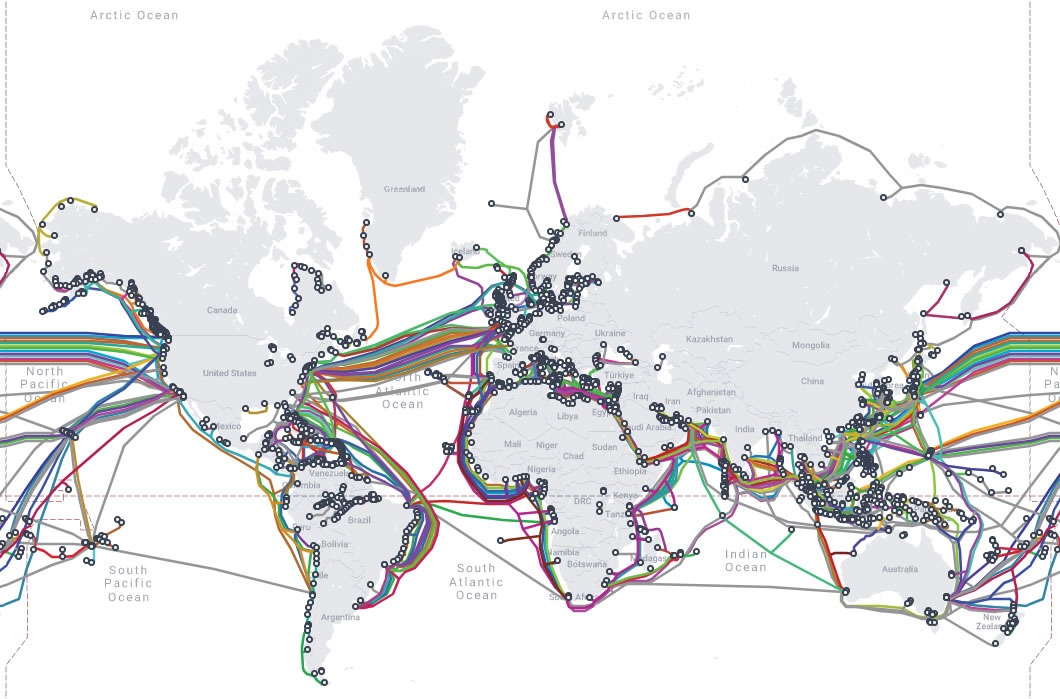
Nearly three-quarters of all undersea fiber-optic internet cables—the critical marine infrastructure that carries roughly 99% of all international data traffic—would need to fail simultaneously before the Bitcoin network suffers any significant operational impact. That is the key finding of a comprehensive new research paper that sheds light on the physical resilience of the world’s leading cryptocurrency.
In research first published in February and updated in mid-March, researchers Wenbin Wu and Alexander Neumueller from the Cambridge Centre for Alternative Finance examined peer-to-peer network data spanning an eleven-year period from 2014 to 2025. By pairing this decade-spanning dataset with 68 verified historical submarine cable fault events, the researchers applied a sophisticated country-level cascade model to evaluate the exact physical infrastructure resilience of Bitcoin.
The study represents what the authors claim is the first longitudinal analysis of Bitcoin’s vulnerability to submarine cable disruptions. For years, industry analysts, technologists, and financial commentators have debated a long-standing hypothetical question: What would happen to the decentralized Bitcoin network if a catastrophic global internet disruption severed vital transoceanic communications? Until now, much of the discourse remained speculative. This new academic research provides empirical data to address those concerns.
Quantifying the Threshold of Disruption
To measure how the global network handles physical communications blackouts, the Cambridge researchers analyzed what happens when international connections are systematically severed. Their findings indicate that the critical failure threshold for random cable removal sits between 0.72 and 0.92. In practical terms, this means that an astounding 72% to 92% of all inter-country submarine cables would need to fail before more than 10% of the network’s active nodes become disconnected from one another.

However, the study also uncovered a distinct vulnerability when examining malicious or coordinated actions rather than random accidents. The Bitcoin network proved significantly more vulnerable to targeted attacks directed at specific, highly concentrated subsea cable chokepoints. The researchers noted that targeted disruptions at these critical maritime bottlenecks are an order of magnitude more effective at causing network fragmentation, bringing the critical failure threshold down to a range of 0.05 to 0.20.
Despite this heightened sensitivity to targeted chokepoints, the overarching takeaway from the random removal model emphasizes the immense structural redundancy built into the global decentralized architecture. Because Bitcoin nodes are distributed across numerous jurisdictions and rely on a vast mesh of interconnected pathways, taking down the network through physical infrastructure damage alone requires an almost unimaginable scale of destruction.
Tor Routing Provides Greater Resilience
The study also explored the role of privacy-enhancing technologies within the peer-to-peer architecture, finding that Tor—short for The Onion Router—creates a compound barrier to disruption, given the current geographic concentration of network relay infrastructure in well-connected European regions.
Tor functions in a manner similar to virtual private networks, commonly known as VPNs. It routes internet traffic through a decentralized chain of volunteer-run servers distributed across the globe, wrapping each relay hop in a layer of strong encryption to protect user and node privacy, much like the concentric layers of an onion.
Within the Bitcoin ecosystem, the network utilizes Tor to obfuscate the true operating locations of various nodes, rendering their physical locations hidden from casual observers and potential adversaries alike. The Cambridge paper revealed that approximately 64% of all Bitcoin nodes operate in this obscured fashion, effectively making them invisible to external researchers attempting to map the physical topology of the network.
Rather than introducing hidden structural fragility or points of failure, Tor adoption actively increases overall network resilience under the current geography of its relay infrastructure. This resilience exists because Tor relay infrastructure is heavily concentrated in countries like Germany, France, and the Netherlands. These specific European nations feature exceptionally extensive, highly redundant submarine cable connectivity, meaning that isolated marine cable failures rarely succeed in taking down local relay capacity.
Near-Zero Correlation Between Cable Events and BTC Price
Beyond analyzing network topology, packet routing, and physical node distribution, the researchers investigated whether historical submarine cable accidents have ever translated into financial distress for investors. By cross-referencing their database of physical network incidents with historical market data, the authors evaluated the real-world economic fallout of marine infrastructure damage.
The researchers concluded that 87% of the 68 verified historical cable fault events caused less than a 5% disruption impact on active network nodes. More importantly, they found that historical cable events demonstrated essentially zero correlation with Bitcoin prices. Statistical analysis of the data yielded a correlation coefficient of minus 0.02, indicating that fluctuations or sudden outages in physical marine communication lines have historically had no meaningful statistical relationship with the market valuation of the digital asset.