
Crypto investors across the United States who failed to accurately report their digital asset trades in previous years may soon find a clear pathway to compliance, thanks to a legislative measure currently advancing through Congress.
Section 502 of the Digital Asset Tax Certainty Act, designated as H.R. 10357, would mandate the United States Treasury secretary to establish a specialized Digital Asset Voluntary Disclosure Program within 12 months of the bill officially becoming law. This prospective program would grant eligible taxpayers the legal mechanism needed to correct any past digital asset tax violations. By filing amended returns and settling the outstanding tax owed—along with appropriate interest and a structured program penalty—taxpayers could resolve long-standing liabilities that currently lack a predictable resolution framework.
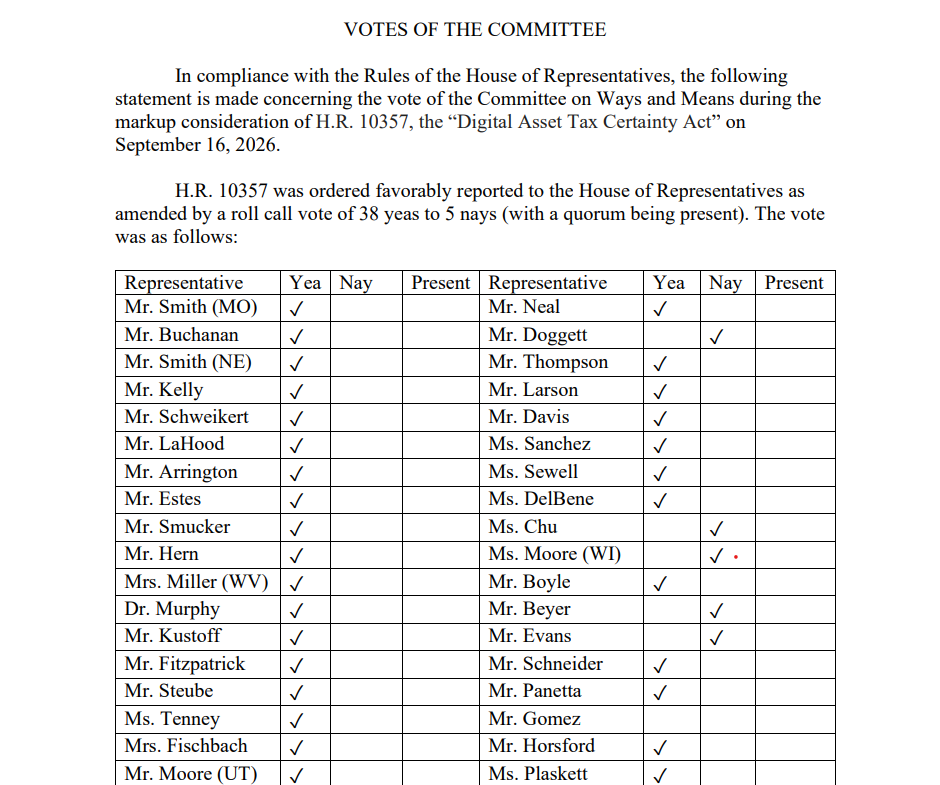
The legislative momentum behind the bill cleared a significant hurdle when the House Ways and Means Committee approved the measure by a bipartisan 38-5 vote on Sept. 16. However, the bill has not yet been enacted into law. It still requires full passage in both the House of Representatives and the Senate before it can be presented to the president for a signature.
Andrew Gordon, executive director of Digital Asset Tax Action, emphasized the potential impact of the legislation, noting that it represents a substantial shift in how past compliance issues could be handled. Gordon pointed out that while the policy change could assist a large number of ordinary taxpayers, it has managed to fly largely under the radar, attracting very little public attention relative to its potential scope.
A Gap in the System
The push for legislative relief arrives as US crypto investors navigate their first filing season under the newly implemented 1099-DA broker reporting rules. These regulations grant the Internal Revenue Service unprecedented visibility into digital asset transactions, fundamentally changing how exchanges and financial platforms report user activity to federal tax authorities.

While industry experts generally agree that these new reporting standards will streamline tax compliance moving forward, they do little to resolve the regulatory uncertainty surrounding prior tax years. Gordon explained that a large share of investors failed to report transactions correctly throughout the rapid evolution of the crypto market, and existing federal procedures fail to offer taxpayers who made honest mistakes a predictable way to clear their financial obligations.
For years, investors who discovered that they had improperly reported their digital asset holdings—or failed to report them entirely—found themselves without a viable, standardized mechanism to correct the oversight. Many discovered years after the fact that they had fundamentally misunderstood the complex tax treatment governing crypto-to-crypto trades, or that they had struggled to reconcile activity spread across multiple centralized and decentralized trading platforms.
What Taxpayers Could Get
The IRS currently maintains its standard Voluntary Disclosure Practice, but that existing mechanism is specifically tailored for individuals who willfully violated tax rules and consequently face potential criminal exposure. For everyday taxpayers with errant reporting skills who made non-willful errors, the primary option has been filing amended tax returns. However, the penalty treatment under that traditional route remains far less predictable than the clear-cut framework proposed by Section 502’s crypto-specific program.
Sharon Yip, a certified public accountant and the founder of Crypto Tax Advisors, observed that reporting errors among ordinary retail crypto investors remain remarkably common. Based on her firm’s professional experience, many clients previously failed to report their digital asset activity because they operated under the mistaken belief that no taxable event occurred until they formally cashed out into fiat currency. Other clients relied on incomplete exchange records or incorrectly classified complex transactional activity.
Yip noted that the absence of a standardized process leaves non-willful crypto investors without predictable penalty treatment or a clear path toward resolution. She emphasized that a dedicated crypto-specific disclosure program could effectively fill this institutional gap. Such a program would establish a defined correction period, reduced and predictable penalties, and much-needed regulatory certainty for individual taxpayers who decide to step forward voluntarily.
What the Bill Would Offer
Under the specific provisions outlined in Section 502, participating taxpayers would generally be required to file their amended returns within 24 months of the official establishment of the program. The bill establishes two distinct penalty tracks depending on the nature of the taxpayer’s previous omissions.
Significantly lower rates are designated for taxpayers who formally certify under penalty of perjury that their past violations were neither fraudulent nor willful. Under the proposed terms, these individuals would face a 0% penalty on the first $25,000 of tax deficiency per year, and a modest 5% penalty on amounts exceeding that threshold, provided they submit their filings within the first 12 months of the program’s operation.
Conversely, for individuals who choose not to make this certification, much steeper rates apply. These taxpayers would face a 25% penalty on the first $25,000 of deficiency and a 40% penalty on amounts above that level, with these punitive rates escalating further if taxpayers fail to meet the initial application window.
The legislation also provides relief from specified civil penalties. Furthermore, taxpayers who opt not to certify are nevertheless protected from criminal referrals that might otherwise arise from information they properly disclose regarding the specific tax offenses covered under the provision.
Yip advises that taxpayers should thoroughly examine their historical transaction records across all exchanges, platforms, and personal wallets to identify which specific tax years require correction before attempting to assess whether their past mistakes qualify as genuinely non-willful. Because making a false certification carries severe legal consequences under penalty of perjury, she strongly recommends seeking professional guidance whenever taxpayers feel uncertain about their historical status.
The urgency for such a program is underscored by broader industry data regarding taxpayer awareness. A collaborative 2026 report published by CoinTracker and Coinbase revealed that only 49% of surveyed crypto users correctly understood that disposing of or selling cryptocurrency can constitute a taxable event. As Congress continues to weigh the Digital Asset Tax Certainty Act, Section 502 stands as a potentially vital bridge for millions of Americans attempting to bring their historical digital asset activities into full regulatory compliance.