
Crypto investors across the United States who failed to properly report digital asset trades in previous years may soon receive a much-needed opportunity to rectify their tax history. Legislation currently advancing through the US Congress aims to establish a structured path to compliance for individuals grappling with historical omissions, offering a potential shield against severe administrative uncertainty and penalties.
At the center of this legislative effort is Section 502 of the Digital Asset Tax Certainty Act, designated as H.R. 10357. Under the provisions of this bill, the Treasury secretary would be legally mandated to establish a specialized Digital Asset Voluntary Disclosure Program within 12 months of the legislation officially becoming law. This upcoming framework would permit eligible taxpayers to correct past digital asset tax violations by submitting amended returns and paying the exact tax owed, alongside standard interest and a specified program penalty.
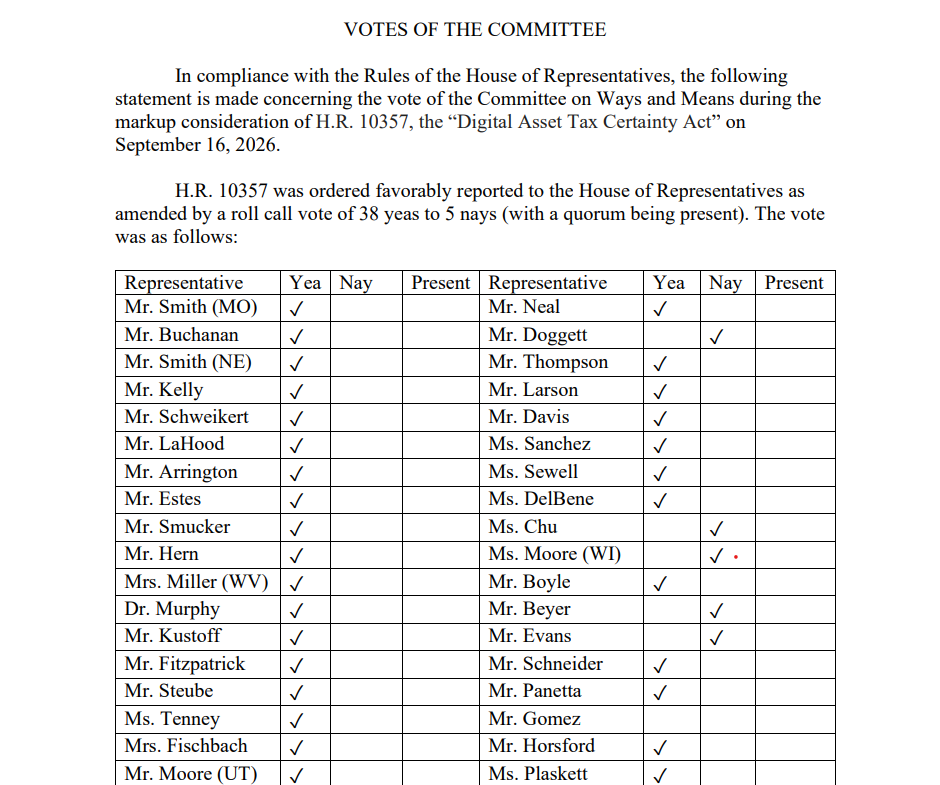
The measure has already cleared a significant hurdle in the legislative process. On Sept. 16, the House Ways and Means Committee approved the bill by a decisive 38-5 vote. Despite this strong bipartisan committee backing, the legislation has not yet become law; it must still navigate the broader floor votes in the House of Representatives and the Senate before it can reach the president’s desk for a final signature.
Andrew Gordon, executive director of Digital Asset Tax Action, emphasizes the transformative scale of the proposed change, noting that it addresses a widespread issue that has managed to fly largely under the radar. "It’s a big change that would help a lot of ordinary taxpayers, and it has gotten very little attention," Gordon explains.
A Gap in the System
The push for a dedicated disclosure mechanism comes as US crypto investors navigate an increasingly complex regulatory and reporting landscape. Taxpayers are currently experiencing their first filing season under the newly implemented 1099-DA broker reporting rules. These regulations grant the Internal Revenue Service unprecedented visibility into digital asset transactions, fundamentally altering how tax agencies monitor market activity.
While industry experts generally agree that these new broker reporting mandates will streamline compliance for ongoing and future transactions, they leave a glaring operational vacuum concerning prior tax years. Gordon points out that the new framework fails to address the historical period preceding its implementation, leaving millions of market participants vulnerable.

"A large share of investors didn’t report correctly over the years," Gordon observes, noting that existing administrative procedures simply do not offer taxpayers who made honest mistakes a predictable, reliable way to resolve their historical liabilities.
For years, market participants have frequently discovered long after the fact that they fundamentally misunderstood the complex tax treatment governing crypto-to-crypto trades, decentralized finance interactions, or the process of tracking transactions across multiple distinct trading platforms and wallets. According to Gordon, a crypto investor who realizes they failed to report their activity properly currently faces an uphill battle with no clear, standardized mechanism to set things right.
What Taxpayers Could Get
To understand the significance of the proposed Section 502, tax professionals point to the limitations of existing avenues provided by federal tax authorities. The IRS’s current Voluntary Disclosure Practice is primarily designed for individuals who willfully and intentionally violated tax laws, often leaving them facing potential criminal exposure and intense scrutiny.
For taxpayers whose errors stemmed from confusion rather than malice, the alternative has been to file amended returns through standard channels. However, the penalty treatment under normal amending procedures lacks predictability, leaving everyday investors exposed to arbitrary or heavy fines without a guaranteed path to a clean slate.
Sharon Yip, a certified public accountant and founder of Crypto Tax Advisors, notes that reporting errors among ordinary, non-professional crypto users are remarkably common. Drawing from her firm’s extensive practical experience, Yip explains that many clients historically failed to report digital assets because they genuinely believed no taxable event occurred until they converted their holdings into fiat currency like US dollars. Others relied heavily on incomplete or fragmented exchange records, or simply misclassified complex digital asset transactions.
"There is no standardized process that gives non-willful crypto investors predictable penalty treatment or a clear resolution," Yip notes. She adds that a dedicated crypto-specific disclosure program could effectively fill this structural gap by providing a defined correction period, reduced and predictable penalties, and a much-needed sense of certainty for participants who step forward of their own accord.
What the Bill Would Offer
Under the exact terms outlined in Section 502, participating taxpayers would generally be required to file their amended returns within a 24-month window following the official establishment of the program. The legislative framework outlines two distinct penalty tracks designed to differentiate between negligent oversights and intentional evasion.
The legislation provides significantly lower penalty rates for taxpayers who formally certify under penalty of perjury that their historical violations were neither fraudulent nor willful. Those who qualify and file within the initial 12 months of the program would face a 0% penalty on the first $25,000 of tax deficiency per year, and a modest 5% penalty on any amounts exceeding that threshold.
Conversely, for individuals who choose not to make this formal certification or fail to meet the criteria, much harsher financial terms apply. These taxpayers would face a 25% penalty on the first $25,000 of deficiency and a 40% penalty on amounts above it, with these rates scaling upward if taxpayers miss the initial implementation window.
The program also incorporates vital administrative protections. It offers relief from specified civil penalties and ensures that taxpayers who decline to certify are still shielded from criminal referrals based on information they properly disclosed for the specific tax offenses covered under the provision.
Yip advises that taxpayers considering utilizing the program should proactively examine their comprehensive transaction histories across all historical exchanges and digital wallets. This preparatory step allows them to identify precisely which tax years require correction before attempting to assess whether their past missteps qualify as genuinely non-willful. Because executing a false certification carries severe legal consequences under the penalty of perjury, she strongly recommends seeking qualified professional guidance for anyone uncertain of their standing.
The introduction of Section 502 arrives as a potentially welcome lifeline for a substantial portion of the American crypto community. Highlighting the ongoing educational deficit surrounding digital assets, a comprehensive 2026 report published by CoinTracker and Coinbase revealed that only 49% of surveyed crypto users correctly understood that selling digital assets can constitute a taxable event.