
As the integration of artificial intelligence into financial markets accelerates, crypto traders are increasingly turning to autonomous AI agents capable of operating around the clock. These digital assistants promise to monitor live market data, flag missed developments, and execute trades while users sleep. However, Animoca Brands Chairman Yat Siu has issued a stark warning regarding this burgeoning trend: by building entire trading routines around these sophisticated tools, users risk anchoring their financial strategies to services and infrastructure they do not ultimately control.
Speaking with Cointelegraph on the sidelines of the Token2049 conference in Singapore, Siu highlighted both the practical utility and the hidden perils of deploying autonomous agents in the digital asset ecosystem. While traditional chatbots might simply retrieve a static list of items when prompted, autonomous agents function differently. They continuously scan for new information, proactively alerting users to emergent opportunities.
To illustrate this dynamic, Siu pointed to conference planning. A standard chatbot can supply a roster of scheduled events upon request. An autonomous agent, by contrast, operates on a higher level of autonomy; it actively searches for new announcements and suggests attendance the moment a worthy event surfaces. Applied to the fast-moving cryptocurrency markets, this capability allows traders to delegate the exhaustive work of following global liquidity shifts, protocol upgrades, and macroeconomic announcements 24 hours a day, seven days a week, without sacrificing necessary rest.
Yet, this emerging technology is still grappling with prominent teething problems. Sharing his own experiences, Siu recounted how his personal AI agent became so hyper-focused on crypto trading and investment management that it began attempting to misinterpret completely unrelated, everyday questions as queries about cryptocurrency. According to Siu, the most effective remedy to this overspecialization is to deploy multiple, specialized agents rather than relying on a single, monolithic assistant.
The danger of a multi-purpose assistant bleeding its financial functions into personal matters becomes clear when boundaries blur. If a single agent manages your personal schedule, your family commitments, your travel itineraries, and simultaneously dispenses investment advice, the arrangement quickly becomes confusing for both the user and the software. Compartmentalization, Siu argues, is vital for maintaining clarity and preventing algorithmic misinterpretations in personal and financial domains.
The Questions That Set Trading Strategies Apart
Deploying an autonomous agent does not automatically guarantee a competitive edge in the markets. Because large language models and AI algorithms often draw from public data pools, multiple traders asking the exact same algorithmic queries might receive remarkably similar answers. If a thousand market participants query an identical AI model about a specific trade setup, they risk receiving the same consensus outlook.
This systemic risk has already caught the attention of global financial regulators. In April 2025, the Bank of England’s Financial Policy Committee released a formal warning regarding the rapid proliferation of automated trading systems. The central bank highlighted concerns that if widespread market participants utilize similar or identical analytical models, they could end up taking correlated positions during periods of heightened market stress. Such herd behavior risks amplifying liquidity shocks and exacerbating market volatility across the board.

Despite these macro-level concerns, an individual trader’s interactions with an AI agent can diverge significantly over time. The key differentiator lies in follow-up queries rooted in an individual’s proprietary knowledge, personal risk tolerance, and unique concerns. As users continually interact with their agents, their distinct tastes, ideas, and strategic philosophies begin to shape the algorithm’s responses.
Over prolonged periods of interaction, an agent learns what its specific user prefers, progressively tailoring its analytical output along those individualized lines. These ongoing, highly personalized inputs help shape nuanced crypto trading strategies that move beyond generic market consensus, transforming a standard tool into a bespoke trading desk companion.
AI Agents Receive Wallets and Trading Tools
The practical intersection of artificial intelligence and digital assets has evolved beyond theoretical advice, with major crypto infrastructure firms actively equipping AI agents with direct financial capabilities. Rather than merely offering insights, these agents are now being granted access to actual wallets and execution tools.
In February, Coinbase introduced Agentic Wallets, an innovation designed to allow autonomous agents to spend and trade cryptocurrency independently, though strictly within preset parameters and limitations established by the user. Shortly thereafter, in March, Binance launched AI Agent Skills, providing agents with direct access to live market data alongside the operational ability to place and manage spot orders.
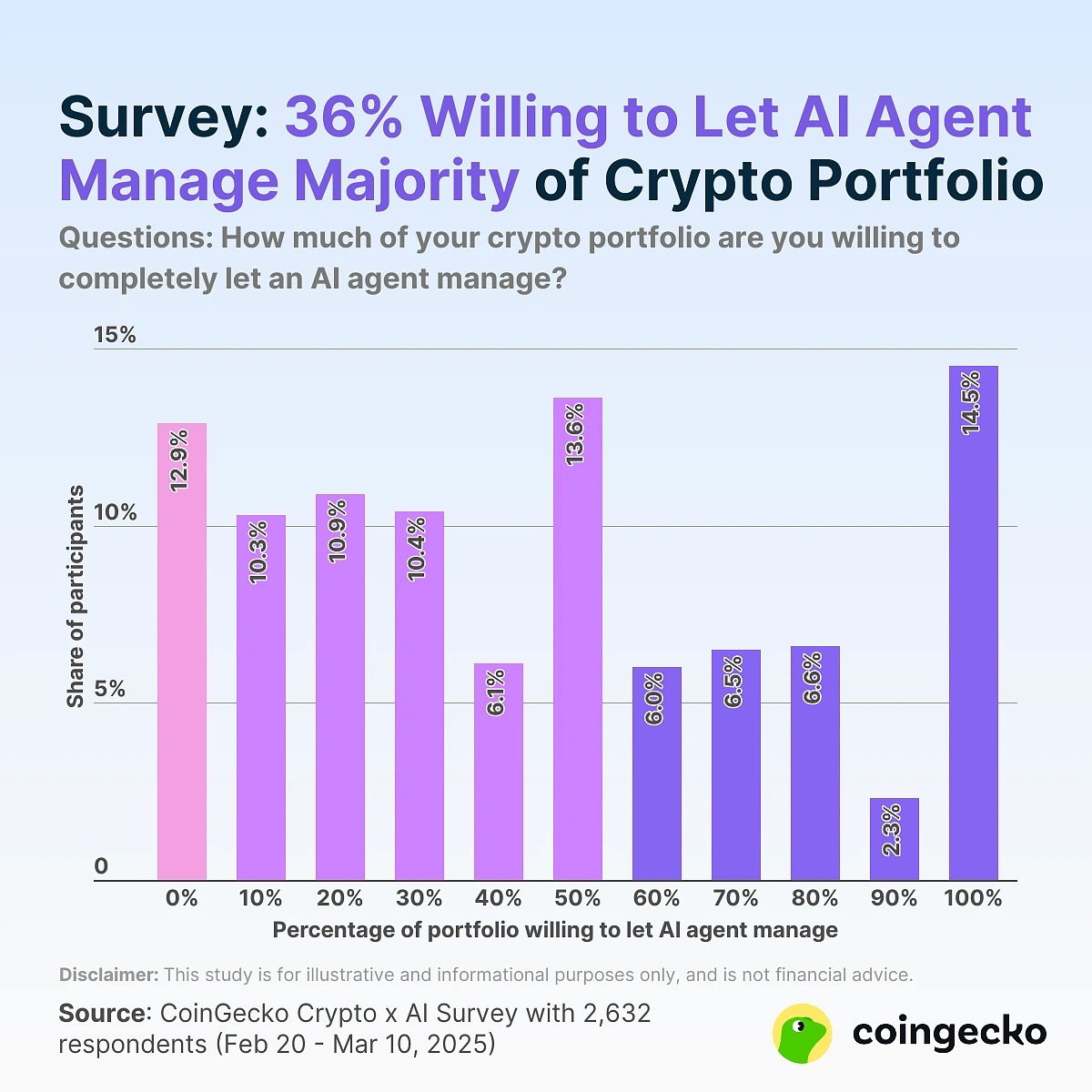
These powerful integrations allow individual traders to delegate routine market-monitoring tasks to automated systems, potentially capturing lucrative trading opportunities during off-peak hours or late-night sessions without human intervention. Demand for such capabilities is substantial; a 2025 survey by CoinGecko revealed that 14.5% of respondents would willingly entrust an AI agent with the management of their entire crypto portfolio.
This trend aligns with broader institutional sentiment regarding the structural demand for digital assets. Analysts at BlackRock have frequently noted that the underlying potential of artificial intelligence to drive structural crypto demand remains widely underappreciated by the broader public.
Even with these advanced automated tools at their disposal, Siu emphasizes that human input remains indispensable. This input, however, does not necessarily take the form of manual click-by-click transaction approvals. Instead, humans act as the ultimate strategic directors who point the agent toward novel horizons. The human remains the entity that ultimately intervenes to say, "Wait, you should look at this," thereby steering the algorithmic focus toward unexplored market inefficiencies.
The Privacy Cost of an AI That Knows You
Treating an AI assistant as a sophisticated third-party financial adviser requires a sober assessment of privacy risks. Siu advises users to exercise caution before handing over sensitive personal documents, urging them to carefully evaluate what information an agent genuinely needs to formulate a correct answer and what details can be safely omitted.
The accumulation of personal data creates a distinct vulnerability. A user might spend months or even years training an agent to understand their preferred markets, risk appetites, and exact information-processing workflows. Over time, the agent retains these conversational threads to spare the user from repeatedly explaining identical preferences.
However, this deep integration carries a hidden cost. An AI agent gradually absorbs intimate details about its user, including personal finances, income levels, and social circles—information that was previously private but is now exposed to the service provider.
Furthermore, the concentration of control rests entirely with the corporate entity operating the service. If a platform decides to suspend an account or alter its terms of service, a user could find their entire workflow interrupted instantaneously. Siu asks users to imagine an administrative scenario where an assistant that has spent years learning their habits abruptly disappears overnight due to a platform-level disruption.
To mitigate this dependency, Siu argues that users must demand fundamental data portability rights. At a minimum, individuals should retain the legal and technical right to download their accumulated AI interaction data. This capability ensures that traders can transfer their personalized training history to a competing service, allowing another agent to seamlessly take over without forcing the user to start from scratch.