
Solana’s first major consensus upgrade, Alpenglow, officially went live on the mainnet on Wednesday, marking what developers and researchers are calling the most significant overhaul to the network’s core architecture since its inception.
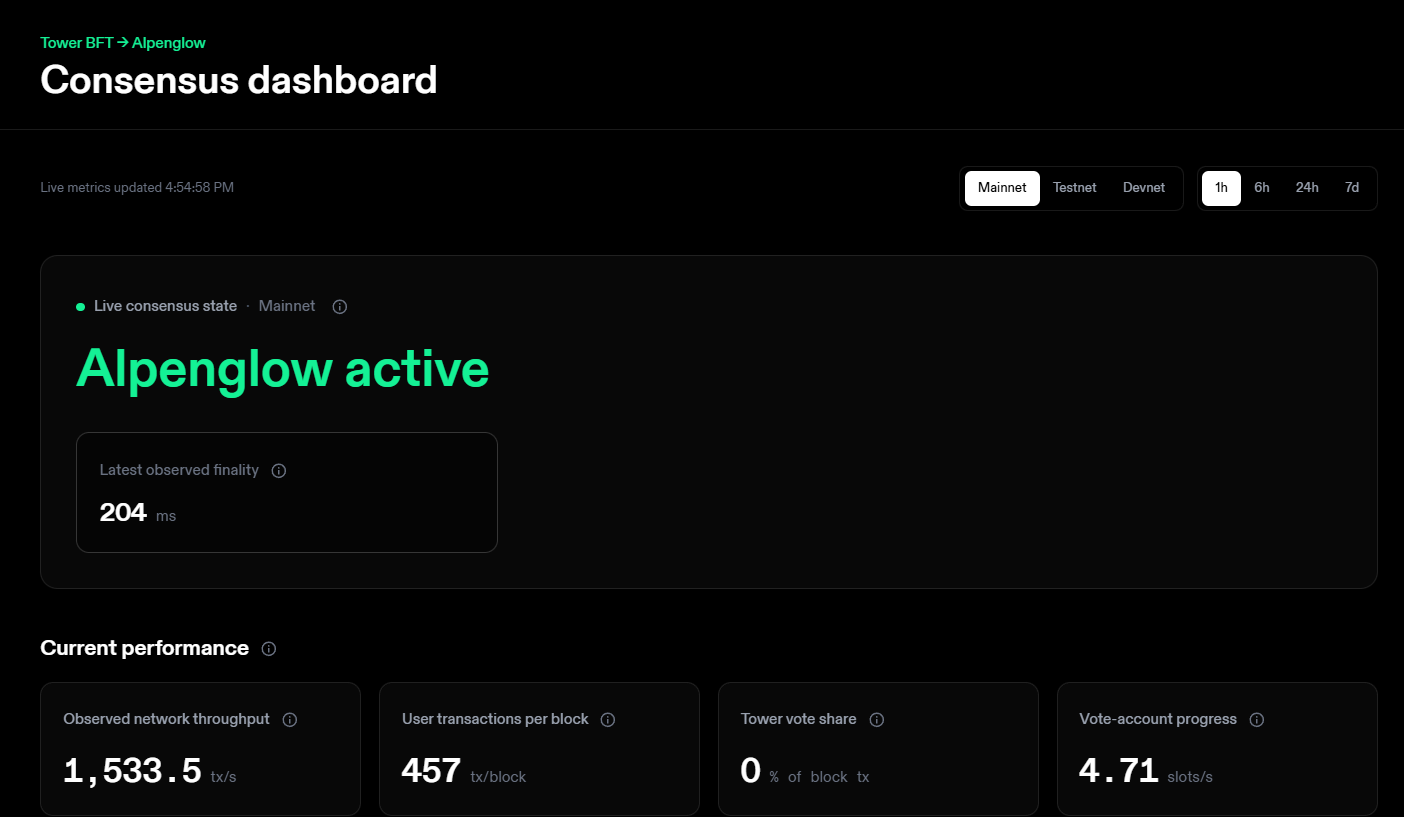
According to the official Solana Foundation Alpenglow dashboard, the long-awaited activation occurred at approximately 1:54 pm UTC. The landmark upgrade is engineered to slash transaction finality by an extraordinary 99%, theoretically bringing transaction confirmation times down from about 12.8 seconds to a blistering 150 milliseconds. This near-instantaneous settlement tier is designed to bridge the gap between blockchain technology and traditional Web2 infrastructure, unlocking entirely new categories of high-frequency applications, instant payments, and complex trade settlements.
The rollout of Alpenglow represents a monumental shift for the high-performance blockchain. For years, the network has relied on its native TowerBFT consensus model to secure transactions and maintain ledger state. Alpenglow replaces this legacy mechanism through a multi-phase rollout strategy, beginning with its foundational component known as Votor.
Votor fundamentally reimagines how validators reach consensus by substituting the traditional voting and finalization pipeline with a direct validator voting structure and a robust certificate-based system. By streamlining this cryptographic overhead, the network can achieve confirmation metrics previously thought impossible for decentralized base layers.

Looking ahead, a subsequent phase of the upgrade will introduce Rotor, a cutting-edge block data-distribution protocol engineered to ultimately replace Turbine. Rotor is expected to further optimize network efficiency by ensuring that block data propagates across the globally distributed validator set with minimal latency.
Alpenglow Marks ‘Biggest Change’ for Solana’s Core Protocol: Anza
The activation of Alpenglow follows years of rigorous research and development, spearheaded heavily by engineering teams including Solana Labs offshoot Anza. In a comprehensive blog post published in May, Anza researchers described Alpenglow as the single "biggest change to Solana’s core protocol" since genesis.
Authored by researchers Quentin Kniep, Kobi Sliwinski, and Roger Wattenhofer, the publication emphasized the profound implications of achieving 150-millisecond finality. The team noted that operating at such speeds allows Solana to directly compete with traditional Web2 infrastructure in terms of pure responsiveness. This capability positions blockchain technology not merely as an alternative settlement layer for financial assets, but as a viable foundation for latency-sensitive consumer applications, real-time gaming, and instantaneous global commerce.
The mainnet activation of Alpenglow is the latest milestone in an aggressive scaling and optimization roadmap executed by the Solana community throughout the year. In August, Solana successfully reduced its blockchain slot time for the first time since genesis, a move that formed part of the Solana Foundation’s strategic initiative to halve slot times down to 200 milliseconds. That multi-stage optimization effort successfully completed its fourth and final phase in October, steadily improving network responsiveness and reducing average confirmation times across the board.
Even as Alpenglow goes live, core developers and validators are already looking toward the horizon. Attention is rapidly shifting to Agave 4.5, an upcoming upgrade that proposes expanding the number of accounts supported within a single versioned transaction from 64 to 96. According to documentation from the Solana Foundation, this enhancement aims to facilitate better routing paths for decentralized exchange swaps and secure more favorable execution prices for traders. The Agave 4.5 upgrade is currently deep in development and tentatively planned for deployment in December.
Market and Real-World Performance Metrics
At the time of the mainnet activation, the Solana network’s live dashboard telemetry reported a transaction throughput of 4,721 transactions per second alongside a real-time finality measurement of approximately 6.6 seconds as the network gradually transitions and adopts the new consensus parameters. Cointelegraph has reached out to the Solana Foundation for further technical commentary regarding Alpenglow’s performance measurements recorded during rigorous testnet environments and projected benchmarks for real-world production environments.
The broader cryptocurrency market responded favorably to the technological milestone. The native token SOL saw its price climb nearly 3% over the 24-hour period leading up to the mainnet activation. This upward movement helped offset a portion of the broader market corrections and the 42% decline the asset experienced over the trailing year, according to data from CoinMarketCap.
As the Solana ecosystem absorbs the Alpenglow upgrade and validators migrate to the new consensus framework, developers across the network’s burgeoning decentralized finance and application layers are preparing to build out the next generation of high-speed tooling enabled by sub-second finality.