In a move that seeks to challenge the prevailing orthodoxies of the cryptocurrency ecosystem, LayerTwo Labs founder Paul Sztorc has officially launched the eCash network, a long-awaited Bitcoin hard fork designed to expand the capabilities of Bitcoin-derived code into payments, privacy, and advanced decentralized applications.
The network went live on October 29 at Bitcoin block 973,728, arriving quietly amid a flurry of broader global and industry headlines. The hard fork delivers an immediate windfall to eligible Bitcoin holders, who receive an equivalent balance of the new chain’s native token, ECX, matching their holdings of BTC at the exact moment of the snapshot.
The launch marks a significant milestone for Sztorc, who has spent over a decade advocating for Bitcoin Drivechains—a protocol system intended to introduce sidechain capabilities without requiring fundamental modifications to the base-layer protocol. With the mainnet deployment now complete, eCash sets out to test whether an appetite truly exists among developers and users for experimental scaling and feature expansion on a network rooted in Bitcoin’s original architecture.
Sztorc pulls no punches when describing his motivations for the project, pointing to what he views as a stifling conservative narrative dominating the mainstream Bitcoin community. "We need to actively sabotage the ‘degrowth’ policies killing Bitcoin," Sztorc told Magazine in an interview surrounding the launch. "We want to find the true Bitcoin builders and give them the tools to actually innovate. We just need the open-minded, risk-taking contrarians to come and build."
What is eCash?
At its technical core, eCash is an independent hard fork of Bitcoin developed by LayerTwo Labs to counter what Sztorc characterizes as complacency and cult-like toxicity within the traditional Bitcoin development space. By establishing a separate network, the project aims to bypass the notoriously slow consensus model of Bitcoin’s base layer, giving developers the freedom to build and experiment directly.
The cornerstone of the eCash architecture is the implementation of Drivechains, a system that empowers developers to launch independent sidechains equipped with customized features. Because these sidechains operate outside the primary consensus rules of the base protocol, developers can test novel applications spanning enhanced payments, user privacy, digital assets, and prediction markets. Meanwhile, miners participating in the network have the opportunity to maximize their overall revenues by collecting additional transaction fees generated across these integrated environments.
Simultaneously with the mainnet rollout, five distinct sidechains debuted on eCash: BitNames, BitAssets, Thunder, Truthcoin, and zSide. LayerTwo Labs has indicated that two additional sidechains—the quantum-resistant Photon network and the decentralized exchange CoinShift—are slated for future release.
Sztorc maintains that the core utility of blockchain technology lies in driving active network engagement rather than preserving ideological purity. "Anything that isn’t maximizing network usage is simply a distraction," he argues, emphasizing that long-term sustainability relies heavily on the users who actively pay transaction fees to secure the network and reward miners.
Getting Access to the New Coins
For individuals holding their own private keys, claiming the newly minted ECX tokens is theoretically straightforward, though it demands careful technical execution. Anyone who maintained self-custody of their BTC at block 973,728 technically owns an identical quantity of ECX on the new network. However, because both chains share an identical historical ledger, navigating the split requires vigilance to avoid common pitfalls such as transaction replay attacks.
LayerTwo Labs has issued specific technical warnings to self-custody users, advising them to utilize compatible wallets that explicitly support the eCash network and its replay-protection mechanisms. Most importantly, the development team stresses that users should never move their BTC first. Because an ordinary, unprotected transaction on the Bitcoin blockchain can potentially be replayed on the ECX network, holders are strongly advised to secure or transfer their ECX coins before initiating any standard transactions involving their underlying BTC.
For market participants who store their Bitcoin holdings on centralized cryptocurrency exchanges, the process of accessing the distribution remains entirely dependent on third-party policies. Users relying on custodial services are subject to the discretion of individual platforms, many of which may or may not choose to support the hard fork, distribute ECX balances, or enable trading facilities.
Where Can Holders Trade ECX?
Acquiring the new tokens through a hard fork snapshot is distinct from achieving immediate liquidity, and ECX is not yet widely integrated across major tier-one cryptocurrency exchanges. Furthermore, depending on the jurisdiction in which a holder resides, receiving and liquidating fork-related assets can carry complex tax implications that individuals may need to review before filing annual returns.

Early market infrastructure is slowly beginning to take shape. NeoxEX announced the launch of native ECX deposits, withdrawals, and spot trading on October 29, supporting trading pairs including ECX/USDT, ECX/USDC, and ECX/BTC. Meanwhile, CoinW has outlined plans to distribute ECX to eligible Bitcoin holders, with timelines for deposits and trading features to be disclosed at a later date.
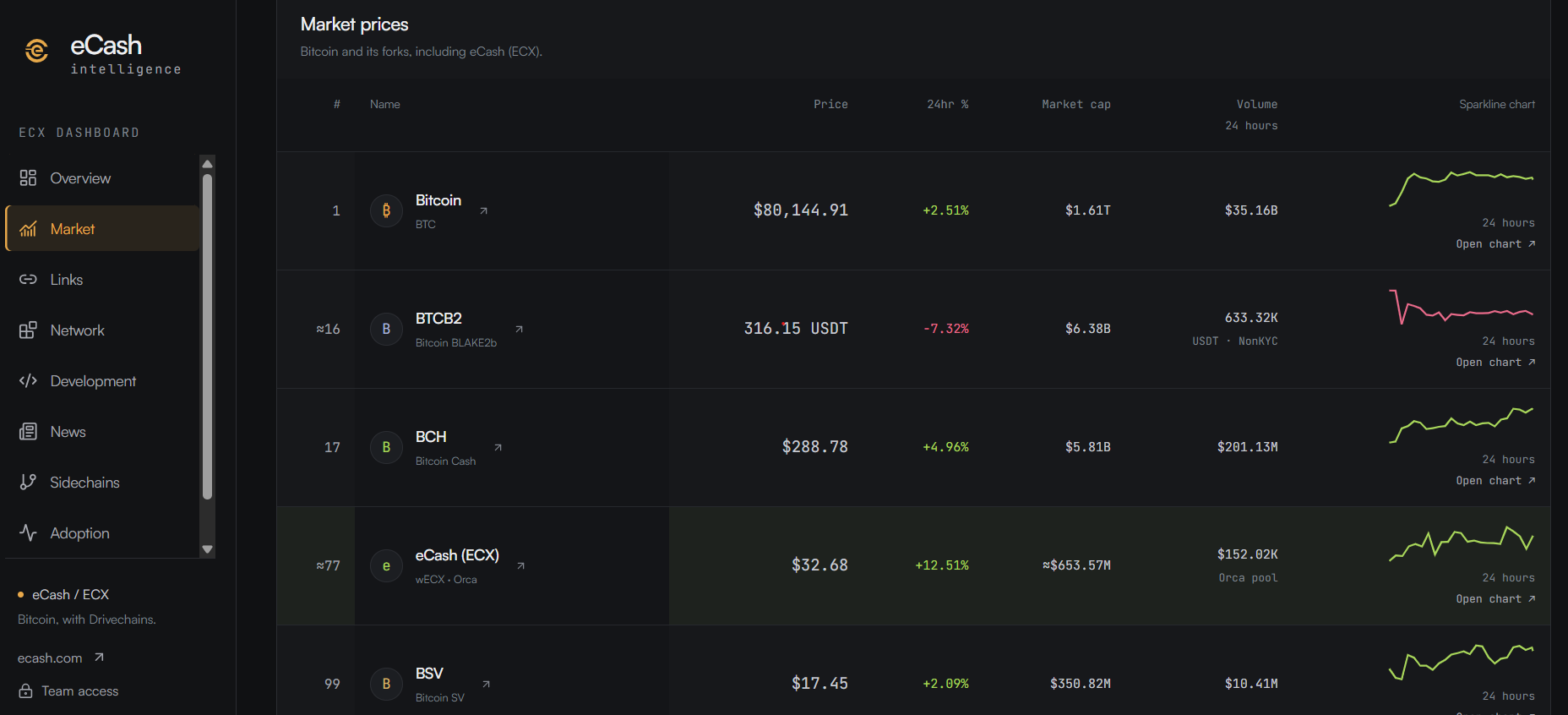
Alternative liquidity avenues have also emerged outside of native exchange listings. Orca, a prominent decentralized exchange operating on the Solana blockchain, has introduced a liquidity pool allowing users to swap USDC for wrapped ECX, known as wECX. While this provides a synthetic mechanism for market participants to gain exposure to the token, it relies on a wrapped asset bridge rather than native trading on the eCash blockchain itself.
Independent market data tracking remains fragmented. Major data providers have reflected varying statuses for the asset; CoinMarketCap listed ECX at a valuation of $32.63 with approximately $355,000 in 24-hour trading volume, whereas CoinGecko categorized the asset as a preview listing without an active price or tracked exchange markets. Prominent crypto data provider Kaiko confirmed it does not currently track the token, leaving traders with limited centralized market intelligence.
LayerTwo Labs reported that early over-the-counter and initial exchange observations saw ECX fluctuate between $40 and $50, though official order book depth metrics were not published. Instead, the firm pointed toward the total value locked within the Orca liquidity pools as a decentralized benchmark for available market depth.
"If our fork replicates even a fraction of Bitcoin Cash’s initial performance, the liquidity will be staggering," Sztorc asserted, adding that participants concerned about near-term liquidity constraints are free to hold their assets and evaluate their options later. "We are actively adding new exchanges and trading pairs, so the user experience will only improve. Otherwise, you’re welcome to take your free money and leave."
A Different Vision for Bitcoin
Ultimately, the long-term viability and valuation of eCash will rest upon tangible adoption—specifically whether developers successfully deploy functional applications and whether users demonstrate a willingness to pay transaction fees for those services. Sztorc notes that active network usage and fee generation will serve as the primary metrics for evaluating the project’s success throughout its foundational year.
Addressing persistent skepticism regarding the security model of Drivechains—particularly the theoretical concern that miners might coordinate to compromise sidechain funds—Sztorc remains entirely dismissive of what he labels superstitious fears.
"If you genuinely believe miners will torch their own billion-dollar operations for a short-term theft on an L2, then you shouldn’t trust Bitcoin’s L1 either," he said.
For the broader cryptocurrency community, the debut of eCash introduces a polarizing alternative vision for Bitcoin’s technological evolution, providing developers with a dedicated sandbox and tokenholders with a novel digital asset. Whether eCash transcends its origins as an experimental fork to become a thriving ecosystem will depend entirely on market participation and real-world utility in the months ahead.