
Decentralized finance (DeFi) protocols may soon have a powerful new weapon in their ongoing battle against sophisticated hackers, exploiters, and state-sponsored cyberattacks. A newly introduced security system developed by Phylax offers decentralized applications a way to intercept and stop malicious transactions before they can settle on the blockchain. While this technology promises to drastically reduce the staggering financial losses plaguing the crypto sector—such as high-profile incidents tied to North Korean hacking groups and United States-sanctioned actors—it has also ignited a fierce debate among developers, researchers, and legal experts over potential centralization risks, smart contract freezing, and the fine line between proactive security and forced censorship.
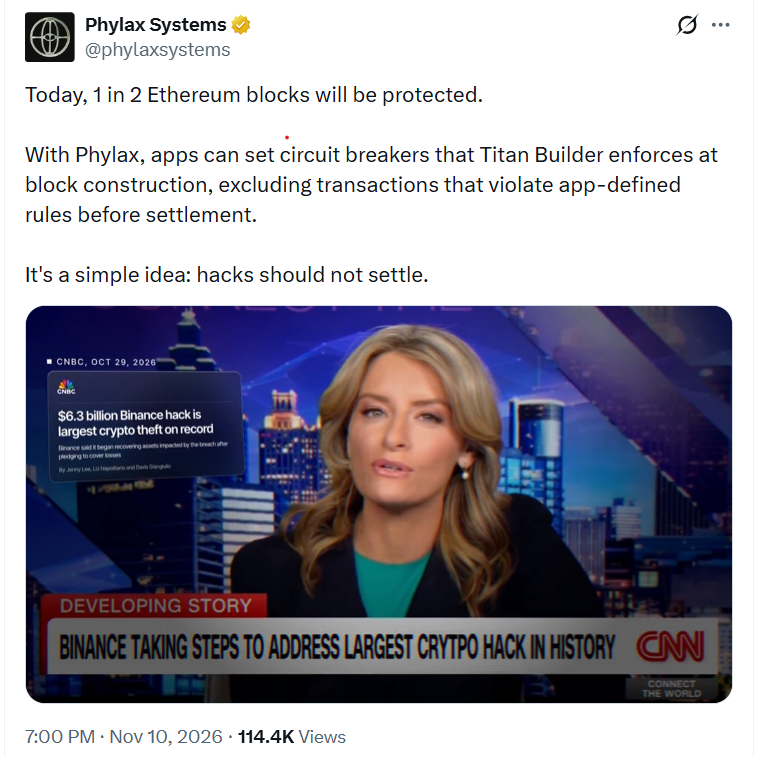
The system, announced on November 10, centers around an integration between Phylax and Titan Builder, a prominent block-building entity that reportedly produces roughly one out of every two Ethereum blocks. Through this collaboration, Ethereum-based applications are given the capability to define specific, custom rules designed to weed out transactions that threaten harmful outcomes during the block construction phase. Titan evaluates pending transactions against these pre-defined security rules prior to including them in its constructed blocks.
By catching malicious actions at the block-building level, the mechanism shifts the industry’s security paradigm away from reactive monitoring systems or emergency interventions that typically occur only after an attack is already underway. The core mission, as stated by the developers, is straightforward: to stop users from losing money to hacks and protocol errors in DeFi.
A Security Mechanism with a Potential Freeze Risk
The practical application of this circuit-breaker approach can be illustrated through common vulnerabilities in smart contract architecture. In a scenario outlined by Phylax, a vulnerable lending vault might mistakenly be tricked into releasing $1 million to a user whose underlying shares are only valued at $1,000. With the Phylax system operational, a configured circuit breaker could instantly cap the total amount leaving the vault within a single transaction, thereby preventing the liquidity pool from being entirely drained.
Proponents argue that similar technological safeguards could have mitigated the catastrophic losses seen in recent high-value exploits, such as the massive $6.3 billion Binance hack and the $380 million Bitget exploit. In both of those historical incidents, malicious actors successfully compromised exchange wallets and subsequently moved staggering amounts of digital assets through various decentralized protocols to obfuscate and launder funds.
Despite the obvious defensive benefits, the implementation of such technology has not arrived without significant warnings from legal and technical commentators. Digital assets lawyer Gabriel Shapiro quickly voiced concerns following the announcement, pointing out that decentralized applications integrating the system could theoretically become vulnerable to freezing if block builders suddenly stopped providing the necessary attestations.
According to Shapiro’s analysis, smart contracts can be configured to systematically reject incoming transactions unless they originate from builders that have successfully performed the mandated security checks. If those participating builders were to halt their attestations, the protected application functions could experience prolonged stalls, rejecting legitimate and malicious transactions alike until the builder operations resumed.
Addressing these concerns, Phylax founder and chief executive Odysseas Lamtzidis explained that protocols can easily mitigate this risk by defaulting to an inclusive operational posture when security checks encounter downtime.

"The sane default we provide and suggest to protocols is a fail-open behavior," Lamtzidis said.
However, Lamtzidis noted that this critical safeguard remains optional, leaving individual project teams to weigh the competing priorities of safety and operational availability. While some protocols may choose to prioritize absolute safety to prevent exploits, others might opt differently. He also emphasized that protocols retain full autonomy over whether their underlying smart contracts are entirely immutable or capable of being modified via decentralized governance structures.
In response to these design choices, Shapiro argued that fail-open protections should ideally be mandatory, and any future adjustments to these security safeguards ought to be subjected to strict time delays to prevent protocol administrators from abruptly stripping away defenses.
Ethereum’s Builder Concentration Problem
Beyond the immediate mechanics of circuit breakers and transaction filtering, the rollout of the Phylax system has brought renewed attention to the broader structural issues plaguing Ethereum, particularly the heavy concentration found within its block-building market.
Ethereum researcher Fan Zhang observed that technology like the one offered by Phylax is only becoming viable today because the ecosystem’s block production has already grown so centralized. While acknowledging that the tool introduces appealing security benefits—especially in an era where automated artificial intelligence bots can discover smart contract vulnerabilities faster than ever—Zhang cautioned that layering additional code at such a critical juncture in transaction processing introduces novel points of failure. These potential risks range from simple implementation errors to severe vulnerabilities like builder signing-key theft, loss, or outright impersonation.
"I think the community is very concerned about centralized builders and is making efforts to address them. So I’m concerned that these efforts may undermine each other," Zhang added.
Echoing these apprehensions, Ethereum researcher Sen Yang warned that if major DeFi protocols become heavily reliant on a small, select group of builders for security enforcement, it could inadvertently grant those specific builders an unfair competitive advantage, thereby worsening existing market concentration. Yang noted that while Ethereum’s proposed enshrined proposer-builder separation (ePBS) upgrade—slated for inclusion in the upcoming Glamsterdam upgrade—may help reduce ecosystem reliance on third-party relays, it does not directly solve the underlying issue of builder market concentration. Nevertheless, Yang pointed out that transactions excluded by dominant builders could still theoretically find their way into blocks produced by non-censoring builders, resulting in temporary transaction delays rather than permanent exclusion.
Where Does Security Become Censorship?
A central point of contention surrounding the Phylax system involves the philosophical and practical boundaries separating protocol-level security from unauthorized censorship. Phylax maintains that its technology does not establish any new centralized authority over Ethereum transactions because the rules are entirely formulated by the applications themselves, making the entire mechanism explicitly opt-in.
Lamtzidis compared the automated security checks to conditional logic already commonly embedded within smart contract codebases.
"It’s no different than a ‘require()’ statement," Lamtzidis remarked, adding that genuine censorship requires arbitrary decision-making or external coercion.
Zhang drew a similar conceptual line between applications voluntarily choosing to filter transactions and external entities forcing censorship onto an unwilling network.
"Applications willingly signing up for filtering is fine, as a user can walk away from such applications," Zhang explained. "It’s externally forced censorship that’s the problem. That’s where I’ll draw the line."
Stefanie Boss, co-author of academic research focusing on censorship resistance and compliance behavior within Ethereum’s consensus mechanism, suggested that filtering rules driven by transaction outcomes rather than the identity of the transaction sender are generally viewed as carrying lower risks.
"In this case, it is also result-driven, which is often considered less risky," Boss noted, adding that she considers the underlying security objective entirely legitimate because the financial and systemic harm caused by major exploits vastly outweighs the impact of this specific type of transaction exclusion.
Even so, Boss offered a concluding word of caution, noting that rule sets could theoretically be co-opted over time to enforce regulatory sanctions or politically motivated exclusions.
"It is important to ensure that there are proper safeguards in place to make sure that these rules will remain fair and designed for security," she said.