

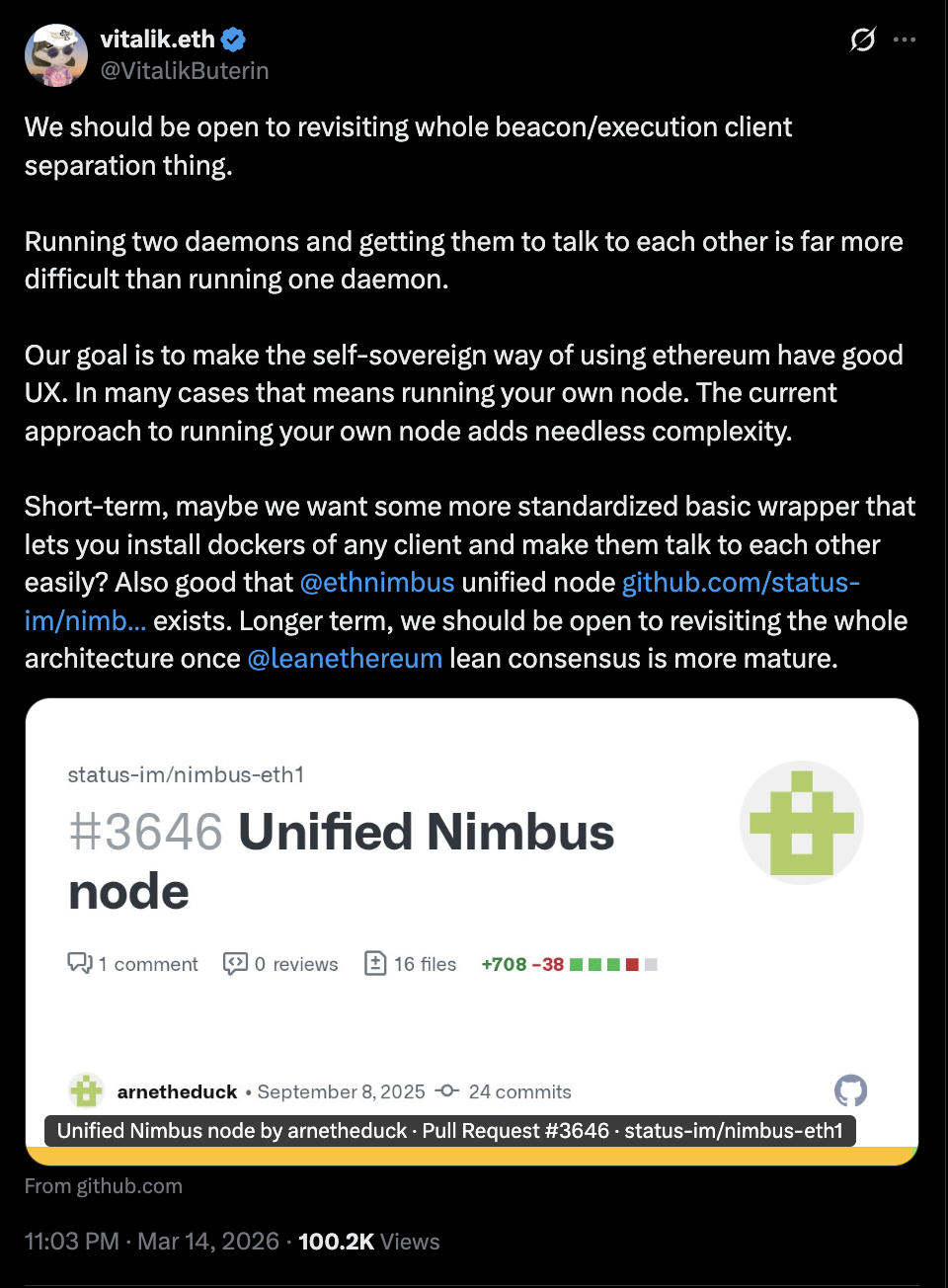
Ethereum co-founder Vitalik Buterin has introduced a new proposal aimed at radically simplifying the process of running a node on the Ethereum network. Through a pull request published on Saturday, Buterin outlined a technical blueprint to merge the backend programs currently used by nodes to interact with Ethereum’s Beacon Chain—which is responsible for consensus and staking—and the network’s execution layer into a single, unified code structure.
For years, Ethereum node runners, frequently referred to as validators, have been required to operate two entirely separate software programs simultaneously. Each of these distinct programs demands individual setup, regular maintenance, and continuous synchronization to properly coordinate and communicate the complex data produced by Ethereum’s dual-layered architecture. While this modular design has served core protocol development well, it has simultaneously introduced substantial operational friction for those wishing to participate directly in network consensus.
This architectural requirement significantly raises the technical complexity associated with running a node or providing validation services for the broader Ethereum ecosystem. Consequently, ordinary users find it increasingly difficult to set up and manage their own local infrastructure, inadvertently forcing a heavy reliance on centralized third-party service providers and remote procedure call (RPC) nodes.
Addressing these growing systemic hurdles on social media, Buterin expressed strong frustration with the industry’s passive acceptance of high technical barriers. Writing on the platform X, formerly known as Twitter, he criticized the prevailing mindset that node operations should be outsourced to institutional specialists.

"I feel like at every level, we have implicitly made this decision that running a node is this oh so scary DevOps task that it is ok to leave to professionals," Buterin stated. "It is not. We need to reverse this. Running your own Ethereum infrastructure should be the basic right of every individual and household. ‘The hardware requirement is high, therefore it’s okay for the DevOps skill and time requirements to also be high,’ is not an excuse."
Even for individuals who possess the financial resources to purchase high-end computing hardware and maintain the necessary technical expertise, time constraints often act as an insurmountable barrier, Buterin noted, emphasizing that operating nodes should fundamentally be an effortless endeavor.
The Ethereum network and other prominent smart contract-enabled blockchains have faced persistent criticism across the developer and user communities regarding the severe hardware requirements and steep technical learning curves needed to run a validator. Critics and researchers have repeatedly warned that these mounting barriers threaten to undermine the core ethos of decentralization by concentrating validation power into the hands of institutional operators and specialized entities.
Buterin Proposes Partially Stateless Nodes to Further Decentralize the Network
The push for a unified code structure builds upon a broader, long-term technical roadmap designed to lower the barrier to entry for everyday participants. In May 2025, Buterin introduced a concept for partially stateless nodes, an architectural shift intended to liberate node operators from the burden of maintaining a complete historical record of every single block ever generated on the network. Instead, these specialized nodes would store only the specific data actively required by the individual node runner to verify current operations.
By shedding the requirement to retain massive volumes of historical data, this approach substantially reduces both hardware costs and continuous data storage requirements for everyday users who wish to run nodes for personal purposes, such as safely broadcasting transactions and independently verifying the blockchain’s state.
According to technical documentation from Go-Ethereum, commonly known as GETH, disk space serves as the primary and most relentless bottleneck for node operators worldwide. As smart contract blockchain networks like Ethereum continue to process vast amounts of economic activity and complex state transitions, they generate significant quantities of data. This unrelenting data growth demands ever-increasing storage capacity, effectively turning specialized node hardware into an unyielding practical necessity for serious participants.
To combat the creeping centralization fostered by these hardware and software constraints, Buterin has repeatedly highlighted the systemic dangers of leaning too heavily on centralized infrastructure. In detailed posts on the Ethereum Research forum, he warned that an unhealthy market structure heavily dominated by a small group of remote procedure call providers creates critical points of failure and vulnerability.
"A market structure dominated by a few remote procedure call (RPC) providers is one that will face strong pressure to deplatform or censor users. Many RPC providers already exclude entire countries," Buterin wrote.
This deep commitment to decentralization and open-access infrastructure is also reflected in Buterin’s personal capital allocation strategy. In late January, Buterin revealed that he had set aside 16,384 Ether, representing a value of approximately $45 million from his personal holdings, specifically dedicated to supporting privacy-preserving technologies, open-source hardware development, and secure, verifiable software projects. He noted at the time that these substantial funds would be deployed gradually over the course of several years, aligning with a broader operational shift within the Ethereum Foundation toward a period characterized by mild austerity while maintaining rigorous momentum on its core technical roadmap.