
The cryptocurrency industry’s heavy financial backing of United States Republican candidates has inadvertently alienated Democratic lawmakers whose support remains vital for passing federal digital asset legislation, according to former New York Governor Andrew Cuomo.
Speaking during a high-profile panel discussion alongside OKX CEO Star Xu at the Token2049 conference, Cuomo addressed the strategic political choices made by digital asset advocates and political action committees. He argued that the sector’s lopsided investment strategy has created unnecessary political hurdles, particularly as the industry pushes for the passage of major regulatory frameworks like the CLARITY Act.
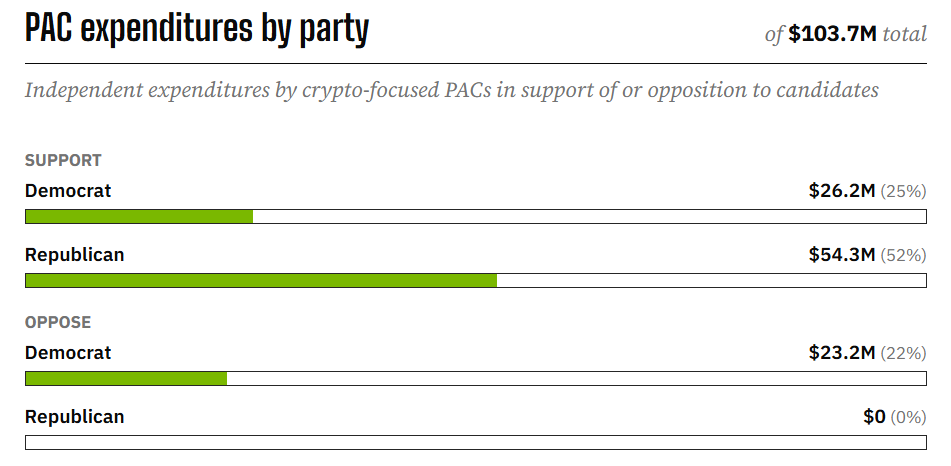
According to data compiled by Tech Influence Watch, crypto-focused political action committees have directed substantial financial resources into the 2026 election cycle. Current tracking figures indicate that crypto PACs have spent $54.3 million supporting Republican candidates, compared with $26.2 million allocated to support Democrats. Additionally, the tracker notes that another $23.2 million has been spent actively opposing Democratic candidates.
Cuomo suggested that this financial imbalance carries inevitable political consequences in Washington’s deeply divided legislative environment. “When you invest heavily in the Republican Party, by definition, you’re going to alienate Democrats,” Cuomo remarked during the panel session.

The political calculus surrounding digital asset regulation takes on heightened urgency as control of Congress hangs in the balance. Prediction markets, including a Kalshi metric evaluated recently, put the probability of Democrats winning both chambers of Congress at approximately 61%. Cuomo noted that if Democrats secure control of Congress following the midterm elections, they could pursue various legislative and oversight strategies. Such a scenario could involve attempting to roll back executive and agency-level crypto initiatives implemented by the current administration, or alternatively, engaging in bipartisan negotiations to work with the Trump administration to pass the full CLARITY Act.
Emphasizing the necessity of bipartisan cooperation, Cuomo stressed that achieving durable federal regulation requires broad consensus. “You need Democrats to pass the bill. You need Republicans. You have to be more balanced,” he stated.
Democrats Aren’t Inherently Anti-Crypto, Says Cuomo
During the panel discussion, Cuomo also pushed back against widespread perceptions within the digital asset community that the Democratic Party is fundamentally opposed to cryptocurrency and blockchain technology. He challenged the narrative that partisan lines neatly divide supporters and detractors of financial innovation.
“There’s a sense that Democrats are anti-crypto,” Cuomo said. “As a matter of fact, I could argue that the crypto technology is exactly suited to the Democratic Party. It’s empowering people who otherwise wouldn’t have access to financial products, and the Democratic Party has been working to do that all its life.”
Despite the former governor’s assertion regarding the philosophical alignment between financial decentralization and Democratic ideals, legislative realities on Capitol Hill have proven complex. Federal crypto legislation has historically attracted votes from members of both parties, though Republican lawmakers have generally demonstrated a more unified front behind major digital asset bills.
In July 2025, a bipartisan coalition formed in the House of Representatives when 78 Democrats joined 216 Republicans to pass the CLARITY Act, overcoming opposition from 134 Democrats who voted against the measure. In the upper chamber, the GENIUS Act secured support from 18 Democratic senators before passing the Senate in June 2025.
However, partisan divisions became more pronounced later in the legislative calendar. During a September procedural vote, all Senate Democrats—alongside four Republicans—voted against advancing the CLARITY Act. Policy analysts noted that many of the concerns raised by lawmakers during that period were closely tied to potential conflicts of interest surrounding digital asset businesses linked to the Trump administration.
Despite these procedural roadblocks, support for comprehensive market structure legislation remains active across party lines. Following the failed procedural vote, a group of seven Democratic senators issued a joint statement reaffirming their ongoing commitment to working toward the passage of the CLARITY Act.
Meanwhile, crypto-backed political action committees continue to adjust their electoral strategies ahead of upcoming legislative battles. Fairshake, one of the prominent crypto-focused PACs operating on the national stage, announced that it plans to support 32 distinct House candidates in the November midterm elections. This electoral slate includes backing for 19 Republican candidates and 13 Democratic candidates, reflecting a targeted approach as the industry navigates the complex landscape of American politics.