As the wider cryptocurrency market charts flip decisively from red to green, the digital asset lending sector is experiencing a pronounced resurgence of institutional and retail interest following a particularly dismal second quarter.
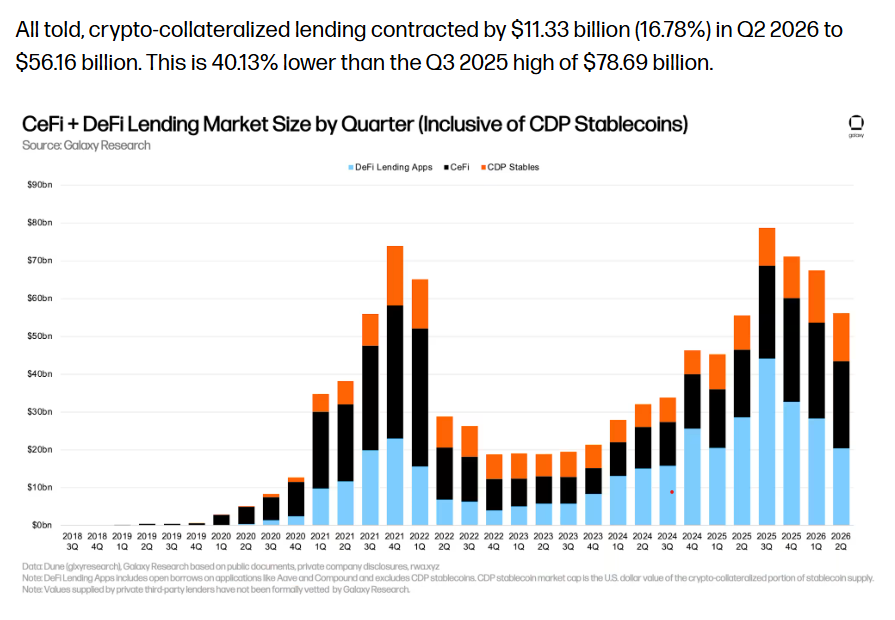
Market figures published by research firm Galaxy illustrate a dramatic reversal of fortune for the industry. During the second quarter, approximately $11.33 billion departed the crypto lending sector, resulting in a quarterly market contraction of roughly 16.78%. This sharp outflow was driven in large part by a profound crisis of confidence among users and investors, sparked by the high-profile Kelp DAO hack in April. That exploit left participants interacting with Aave, widely regarded as one of the most trusted protocols in decentralized finance, temporarily unable to access their Ether.
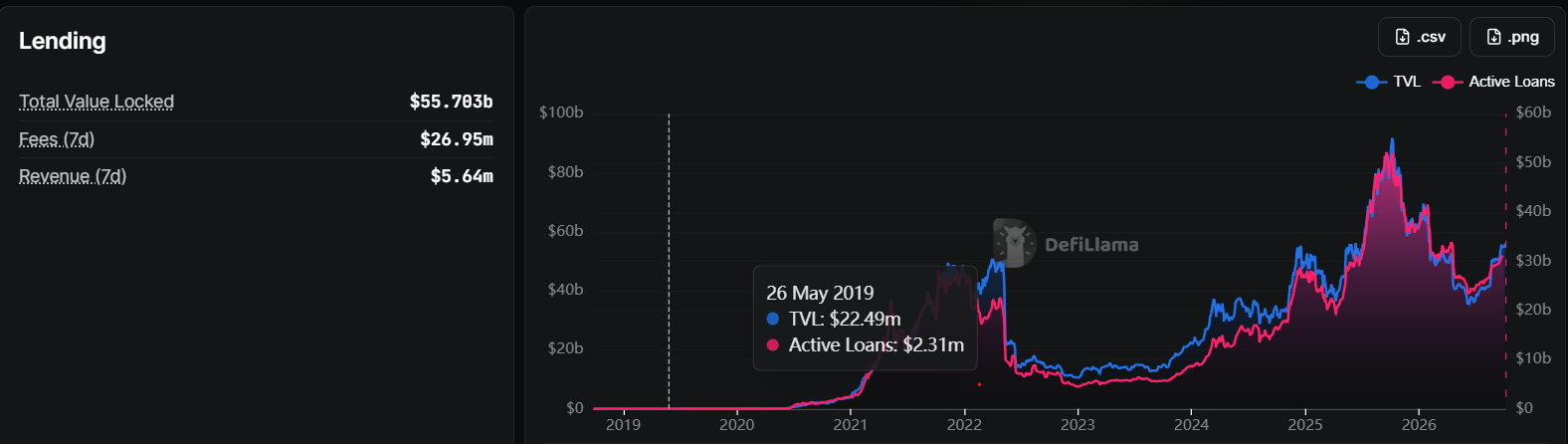
However, the tide has turned dramatically since the beginning of July. Total value locked (TVL) across decentralized lending protocols has surged by more than 55%, climbing from its quarterly lows back to sit comfortably around the $56 billion mark today, according to data from DeFiLlama.
While this rapid influx of capital signals renewed market health, it also means that the figurative honeypot has grown substantially larger. This dynamic forces a critical question for the ecosystem: Can users truly trust interlinked DeFi lending protocols in an era defined by sophisticated hacks, where an exploit originating on any single protocol can trigger a cascading series of devastating effects for every other platform connected to it?
Stani Kulechov, the founder and chief executive officer of Aave Labs, acknowledges that systemic risk management has firmly moved to the forefront of industry priorities. When a protocol accepts a specific token as collateral, it is implicitly taking on the structural risks of that token’s entire foundational architecture, including its cross-chain bridge, its verifier configuration, its price oracle, and its issuer’s operational security standards. Unfortunately for the broader market, that exact web of dependencies is what ultimately dragged Aave into operational trouble earlier in the year.
An Expanding Attack Surface
The vulnerabilities inherent in modern decentralized finance architectures were laid bare in April when malicious actors successfully exploited a Kelp DAO cross-chain route. During the incident, the attackers minted 116,500 unbacked rsETH tokens, which held a market value of approximately $290 million at the time. A significant portion of these fraudulently generated tokens was subsequently deposited as collateral into various Aave markets to borrow other high-value crypto assets.

Even though Aave’s core smart contracts remained unbreached and functioning as designed, the shockwaves from the exploit were immediate and severe. The protocol witnessed a staggering withdrawal of deposits totaling around $15 billion in the immediate aftermath of the security breach. To protect its user base and contain the systemic fallout, Aave was forced to emergency-freeze its rsETH and wrsETH lending and borrowing markets.
Reflecting on the crisis, Kulechov explains that Aave has fundamentally reevaluated its security paradigm, adopting a much more holistic approach. The protocol has completely rebuilt its risk management framework around a wider view of the ecosystem, operating on the foundational principle that security can no longer stop rigidly at the smart contract level. Traditional code audits and security reviews historically missed the critical systemic risk sitting quietly within the bridges, verifier networks, and external infrastructure that modern yield-bearing assets depend on to function.
Industry participants emphasize that everyday users of lending protocols will similarly need to exercise rigorous judgment regarding how deeply exposed a given platform is to both internal and external threats. Every single wrapper, cross-chain bridge, and price oracle standing between a lender and the underlying asset represents another potential point of failure where a loan can go disastrously wrong.
For institutional credit platforms, conservative risk management remains the baseline for survival. Serious lenders must fundamentally operate on the assumption that a borrower can fail at any given moment and work backward from that worst-case scenario. This requires constant operational awareness regarding asset visibility, real-time tracking, and emergency exit strategies in the event of a system failure.
When Security Fails, Containment Matters
DeFi lender Spark has taken a similarly rigorous stance on ecosystem dependencies. Chief Executive Officer Sam MacPherson notes that beyond traditional smart contract audits, his team routinely reviews complex governance designs, operational security protocols, collateral quality metrics, liquidity management frameworks, and broader systemic dependencies.
Demonstrating this proactive philosophy, Spark actually began phasing out rsETH on SparkLend as early as January—months before the April Kelp exploit occurred. The decision was made after a formal risk assessment determined that the asset’s low usage and minimal revenue generation simply did not justify the mounting additional risk created by supporting it within the lending pool.
Aave has implemented comparable governance mechanisms, establishing a system where every supported asset is re-reviewed on a strict quarterly basis and immediately re-evaluated following any material change to its underlying structure. In line with these elevated chain-level standards, Aave has already initiated an orderly wind-down process for its operations across six specific networks that failed to meet the new, stringent requirements. While no protocol can realistically control the entire macro cryptocurrency ecosystem, leadership teams argue they can certainly control how much external risk they choose to ingest and how rapidly they can respond when vulnerabilities surface.
Preventing security failures is only one part of the operational challenge facing decentralized finance. Protocols must also transparently demonstrate how any potential loss would be swiftly contained if something does go wrong.
The Margin for Human Error
While technical exploits frequently dominate industry headlines, human error remains one of the single largest vulnerabilities in the crypto lending space—and paradoxically, the one most frequently overlooked by participants.
Many of the most catastrophic financial losses in the history of the industry have ultimately boiled down to poor private key management, flawed access control configurations, or individuals falling victim to social engineering attacks. Standard smart contract audits are structurally incapable of catching or preventing human-centric vulnerabilities of this nature.
Additional layers of systemic risk materialize when deposited assets are aggressively deployed across external protocols to generate supplementary yield. Crypto lenders learned this hard lesson during the brutal market unwind of 2022, when major centralized lenders such as Celsius, Voyager, and BlockFi imploded after taking on speculative risks that their customers either did not fully understand or never expected them to take.
To minimize this attack surface and protect client assets, alternative institutional lenders like Ledn take a fundamentally different approach. Instead of rehypothecating client funds into various DeFi yield farms, Ledn keeps client Bitcoin securely stored with qualified institutional custodians. Every transactional step introduces an additional point where something can potentially go wrong; therefore, keeping transaction counts to an absolute minimum directly reduces the overall risk of a security breach. The only definitive way to take those operational risks completely off the table is to maintain client assets in strictly segregated custody with tight internal controls and minimal asset movement.
Market observers note that systemic pressures can easily compromise sound decision-making during periods of rapid capital inflow. When user deposits start flowing into a platform faster than management can find legitimate, productive places to deploy them, the intense commercial pressure to maintain high promotional yields can easily lead to poor strategic choices. In these scenarios, risk standards are sometimes loosened, or loans are extended to institutional borrowers that the platform would have summarily rejected under normal market conditions. Historically, the credit managers who successfully weather severe market downturns are precisely those who possess the discipline to say no to incoming capital when they lack a secure, high-quality place to deploy it.
Can AI Make Lending Safer?
Amid ongoing concerns regarding advanced artificial intelligence hacks, automated exploits, and rogue autonomous agents escaping human operational control, the technology is also emerging as a powerful tool to help make crypto lending significantly safer.
Aave is already actively integrating AI-assisted testing alongside its conventional security and auditing pipelines. In recent engineering initiatives, the protocol utilized mutation testing to deliberately inject hundreds of complex bugs into its upcoming V4 smart contract codebases. The specialized AI-driven test suites successfully caught a vast majority of the artificially introduced vulnerabilities.
During a comprehensive security review of its V3 and V4 codebases, three distinct AI security tools generated a combined total of 71 analytical findings. Following rigorous manual review by human engineers, 20 of those findings were validated as genuine security concerns. The remaining 51 false positives underscored why human security experts and experienced researchers will likely remain gainfully employed for the foreseeable future. Artificial intelligence excels at processing vast amounts of code with incredible breadth and speed, but because a significant portion of raw automated findings consist of false positives, expert human judgment remains utterly essential.
At the same time, artificial intelligence represents a classic double-edged sword for the digital asset industry. As autonomous AI agents increasingly take on the responsibility of managing capital on-chain, their specific operating permissions, input data sources, and complex decision-making logic inevitably transform into a brand-new potential attack surface that must be secured with the same rigor as any core smart contract.
As crypto lending enters this new phase of recovery and growth, the fundamental challenge facing the industry extends far beyond simply writing secure code. Protocols must ensure that every single interconnected puzzle piece in the modern DeFi stack is thoroughly understood, continuously monitored, and reliably contained when things inevitably go wrong.