

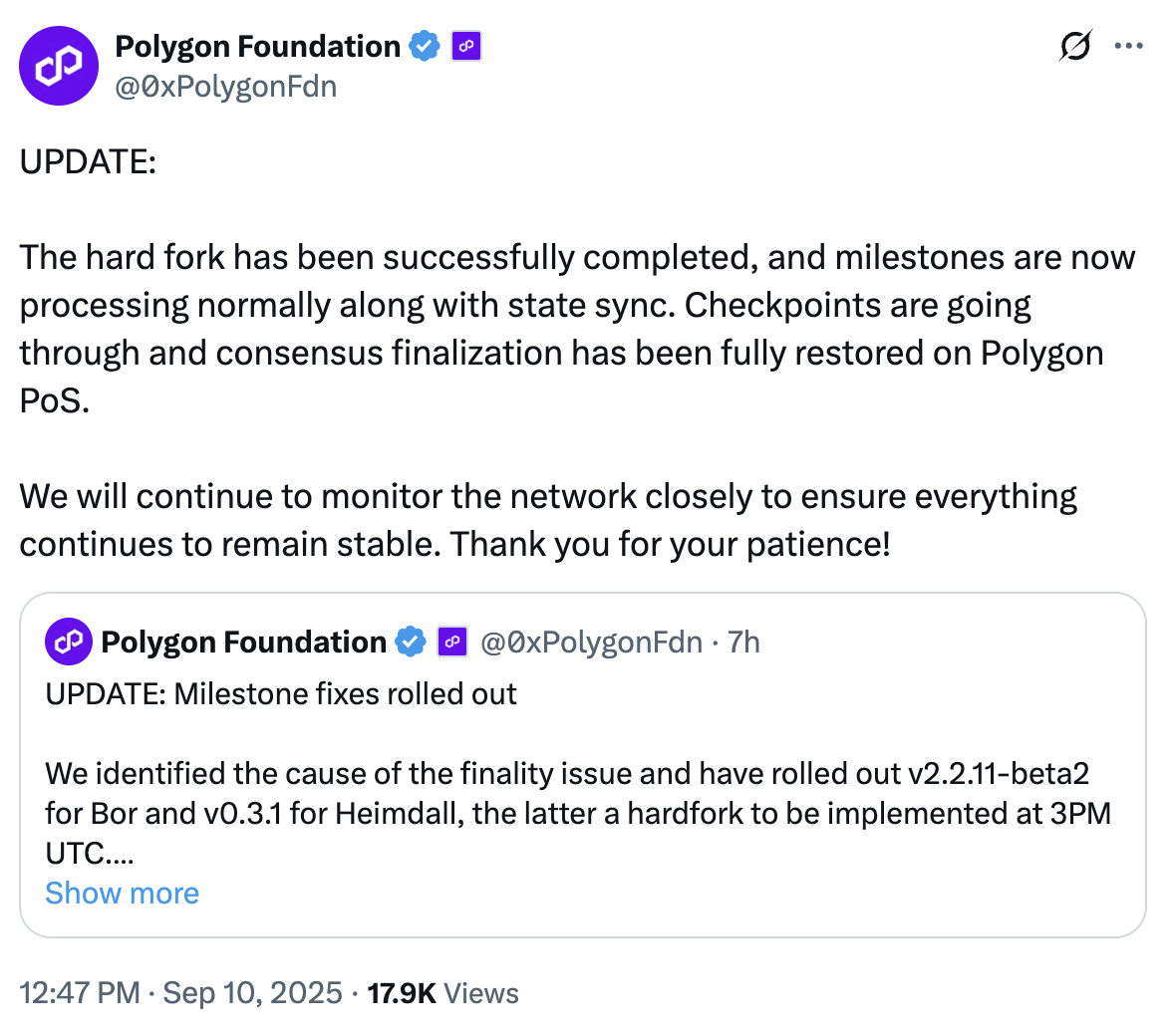
The Polygon Foundation, the primary organization overseeing the development and growth of the prominent Ethereum layer-2 scaling network, announced on Wednesday that full consensus and finality functions have been successfully restored across its infrastructure. The operational recovery follows a recent software bug that caused a number of network nodes to fall out of sync with the broader blockchain, temporarily disrupting remote procedure call (RPC) nodes and fracturing communication between applications and the underlying blockchain layer.
To combat the disruption, the Polygon core development team swiftly executed a hard fork. This decisive technical intervention successfully resolved the software anomaly that had been plaguing various remote procedure call nodes, which are vital pieces of infrastructure utilized to relay transactional information seamlessly between decentralized applications and the blockchain layer itself. According to official communications released by the Polygon Foundation on Wednesday, the network’s core components are now operating under stable conditions, with normal finality and consensus metrics fully re-established.
The root cause of the unexpected disruption has been traced back to a faulty proposal submitted by a network validator. According to insights shared by Polygon co-founder Sandeep Nailwal, this erroneous proposal inadvertently pushed a collection of Bor nodes—the specialized nodes responsible for transaction ordering and block production on the network—onto divergent network forks. This divergence created a split in how nodes perceived the state of the blockchain, leading to synchronization failures and communication bottlenecks.
Addressing the technical details of the remedy, Nailwal explained the multi-layered software updates deployed to neutralize the issue. The team rolled out targeted fixes encompassing both Heimdall v0.3.1, which is a new version incorporating a hard fork specifically designed to delete the identified and problematic milestone, and Bor 2.2.11 beta2, which successfully purged the corrupted milestone data directly from the underlying database. With these critical software patches now live and operational across the network, node operators are no longer experiencing stuck states, allowing checkpoints and milestones to process and finalize normally.

The Broader Challenge of Network Reliability in Modern Blockchains
Software bugs of this nature continue to present an ongoing hurdle for blockchain networks across the industry. As modern cryptographic protocols steadily grow in complexity by simultaneously hosting intricate smart contract functionality, decentralized file storage solutions, and advanced cross-chain interoperability frameworks, the surface area for potential software anomalies expands. Consequently, unexpected bugs may become more frequent occurrences, occasionally disrupting the seamless on-chain user experience that developers and ecosystem participants have come to expect.
Despite the disruption caused by the node synchronization failure, transaction viewing and tracking on Polyscan, the premier block explorer for the Polygon ecosystem, quickly returned to normal. Data and transaction logs across the platform are currently displaying properly, offering reassurance to end-users and developers relying on accurate, real-time ledger visibility for their daily operations and decentralized application interactions.
Polygon Experiences Second Software Bug Since July
Wednesday’s software bug, while disruptive to node communication and finality tracking, did not actually halt block production on the Polygon network. Instead, the technical issue specifically impacted node communication dynamics, creating a noticeable discrepancy between continuous block production and the data that the impacted nodes were successfully relaying to the broader ecosystem.
This incident marks the second notable software-related hurdle faced by the Polygon network since July of this year. During the summer incident, the Heimdall mainnet—the crucial consensus client responsible for relaying communications between nodes for Polygon’s proof-of-stake consensus mechanism—was temporarily halted for approximately one hour.
Much like the mechanics of Wednesday’s incident, block production on the network never truly ceased during the July event, and new blocks continued to be steadily added to the chain via the Bor mainnet infrastructure. At the time, Polygon spokespeople clarified to industry media that the partial consensus layer outage was directly triggered by an unexpected validator exiting the network. Following the sudden departure of that unnamed validator, several remote procedure call nodes were forced to undergo a resynchronization process with the blockchain, reestablishing vital communication channels to fully resume normal operational functionality across the layer-2 network architecture.
With the rapid implementation of the latest hard fork and associated software updates for Heimdall and Bor, the Polygon Foundation has demonstrated its capacity to address and mitigate protocol-level discrepancies swiftly. As the layer-2 landscape continues to mature and handle escalating transaction volumes within the broader Ethereum ecosystem, the network’s resilience in navigating and overcoming these technical challenges remains a critical focal point for developers, validators, and community stakeholders alike.