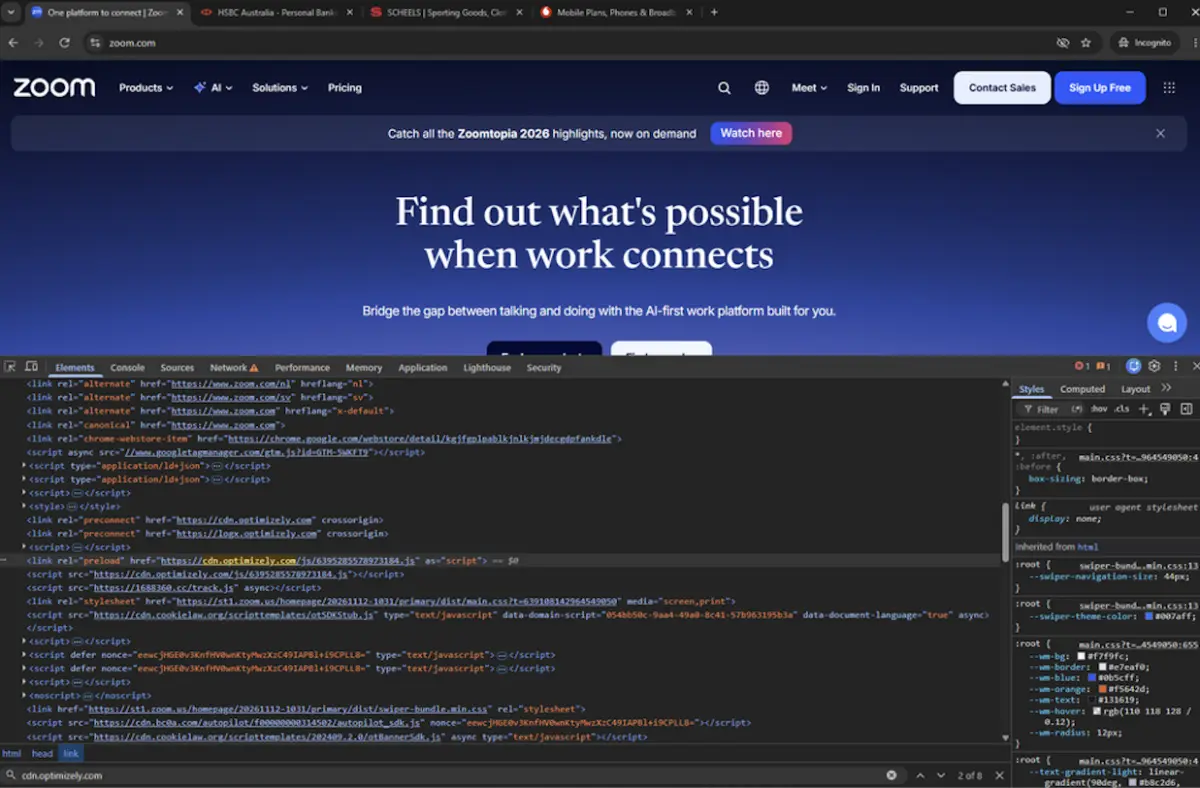
At least 178 top web destinations unwittingly served a variety of malware exploits against visitors over a recent 24-hour period, highlighting a critical vulnerability involving Optimizely, a prominent industry platform that helps websites customize user experiences and test out new features. Cybersecurity experts say the incident, which saw data-stealing malicious software silently injected into high-profile sites such as the BBC, CNN, Equifax, Ledger, and Zoom, was severely exacerbated by the widespread reality that few popular websites enforce strict rules on the sources of third-party content.
According to a detailed blog post from the security firm Report URI, the malicious JavaScript code was served to visitors across 178 organizations through Optimizely’s experimentation platform. Report URI researcher Scott Helme wrote that the payload delivered by the malicious script was actively rebuilt 26 times over the course of a single day, dropping a multi-purpose malware kit capable of stealing payment card data, browser cookies, and screenshots, while dynamically swapping any cryptocurrency payment addresses for those controlled by the attacker.
Helme noted that the affected websites also served custom-made exploit code targeting known vulnerabilities in older Apple iPhone and iPad devices. Known in the threat intelligence community by names such as “DarkSword” and “Coruna,” these are zero-click exploit kits that chain together a half-dozen distinct security holes to seize complete control over outdated devices and extract sensitive data without user interaction.
“The important lesson here is that trusted JavaScript doesn’t always remain trustworthy,” Helme wrote in his analysis. “A website can be compromised through a third-party dependency without its own code or infrastructure ever being breached.”
When contacted for comment, representatives for Optimizely confirmed that the company identified a security incident on November 16, 2026, during which an unauthorized party exploited a vulnerability in the Optimizely Experimentation product to inject malicious JavaScript into some customer projects.
“We acted swiftly to contain the incident and have fully remediated the identified vulnerability,” read a written statement shared by the company. “These measures included blocking access to the vulnerable path, deploying a fix, removing the injected code from affected projects, ending active sessions, revoking tokens, and resetting access for affected user accounts. We have also implemented additional protections to prevent malicious code from being delivered in Cloudflare. While the incident has been fully remediated, we are working with third-party experts on a comprehensive investigation.”
The incident underscores a systemic dependency across the modern web. Many top web properties no longer fully display content unless visitors agree to let often dozens of third parties serve JavaScript, a powerful web scripting language that enables interactive content. JavaScript code runs directly on the user’s device, granting it the capability to read information displayed in the browser and even modify a website’s appearance or core content.
One of the primary reasons JavaScript is so heavily utilized across the internet is that it enables precise browser fingerprinting and advanced methods of tracking visitors and clicks. According to the 2025 Web Almanac published by HTTP Archive, the median homepage loads at least 22 distinct JavaScript files. However, as the recent incident with Optimizely demonstrates, a compromise at a third-party vendor’s website can quickly snowball into a massive supply chain attack against downstream websites that end up unknowingly serving visitors tampered and malicious files.
Zach Edwards, a researcher at Infoblox and co-founder of the ad-tracking service DecryptAds, explained that Optimizely is a vendor that frequently collects data outside of standard consent flows. Its JavaScript snippets are typically embedded as close to the top of the page as possible to ensure they are among the first elements to render, a necessity because the product is primarily built for A/B testing and performance optimization.

“So to make the product work as expected, this code is setup to fire immediately on-page load, and not restrict rendering behind a consent dialog box,” Edwards said. “This means that this supply chain attack didn’t require any clicking or consent to trigger — most of the impacted clients would immediately serve up the payload as soon as someone loaded the page, further increasing risks from this type of JavaScript snippet being compromised.”
Websites can significantly minimize the chances that a breach at a third-party content provider spirals into a devastating supply chain attack by taking full advantage of Content Security Policies, commonly known as CSPs. These policies explicitly specify the domain names that are authorized to serve third-party content to a website’s visitors. However, Edwards noted that most websites—apart from perhaps the largest e-commerce platforms, social media giants, and financial institutions—do not even bother implementing CSPs, or else tend to leave them overly permissive for marketing and operational reasons.
“With literally all websites which embed 3rd party JavaScript resources, if you don’t have a content security policy then if any of those partners get compromised, new domains can be injected into your website via JavaScript which won’t be stopped,” he said. “We’re in the age of JavaScript supply chain attacks and yet almost no one is talking about why content security policies were invented and how this is largely the solution for operators, even though it’s not always simple to get it initially deployed.”
The data gathered following the incident illustrates just how rarely these safeguards are properly configured. According to Report URI, out of the affected sites, 68 had no Content Security Policy at all, while 50 of them had a CSP that was configured so loosely that it still allowed the malware payload and the subsequent data theft to occur. The firm found that only 24 of the affected sites—representing a mere 15 percent—had CSPs robust enough to fully block the malicious payload.
Furthermore, the overall deployment of CSPs across the web’s busiest sites remains quite low, hovering at about 10 percent according to Helme’s scanning site, crawler.ninja, which evaluates the top million websites daily for security issues. Helme expressed hope that this high-profile incident will encourage a broader segment of the web industry to adopt effective CSPs, noting that the situation could have been far worse. By Report URI’s preliminary estimates, the purveyors of this malware campaign managed to steal only around $7,500 worth of virtual currency from affected users, alongside an unknown volume of payment card records.
Helme frequently compares the current widespread lack of robust CSP implementation across the internet to the lawless environment of the Wild West.
“Organizations are running all this code, but they don’t know what it’s doing,” Helme said in an interview. “This is why we keep seeing such large scale breaches in places [where] there are no checks and rules in place on the code we’re running, so this was kind of inevitable. Once an attacker gets to the point of running code on your site, the question is what do they want to do with that and can they write the script to do it. Now with AI that’s not a problem anymore.”
Internet users have traditionally had the option to control the JavaScript elements allowed to run on webpages by using simple script-blocking browser extensions like NoScript. However, such tools have historically been practical primarily for security-conscious users willing to endure the friction of sifting through dozens of JavaScript requests on every newly visited website.
More recently, modern ad-blocking software has proven capable of handling many third-party JavaScript requests automatically. While standard security advice a decade ago heavily emphasized installing traditional antivirus software and enabling a firewall, cybersecurity professionals note that today, a properly configured ad and script blocker frequently functions as an essential layer of defense against browser-based threats.